
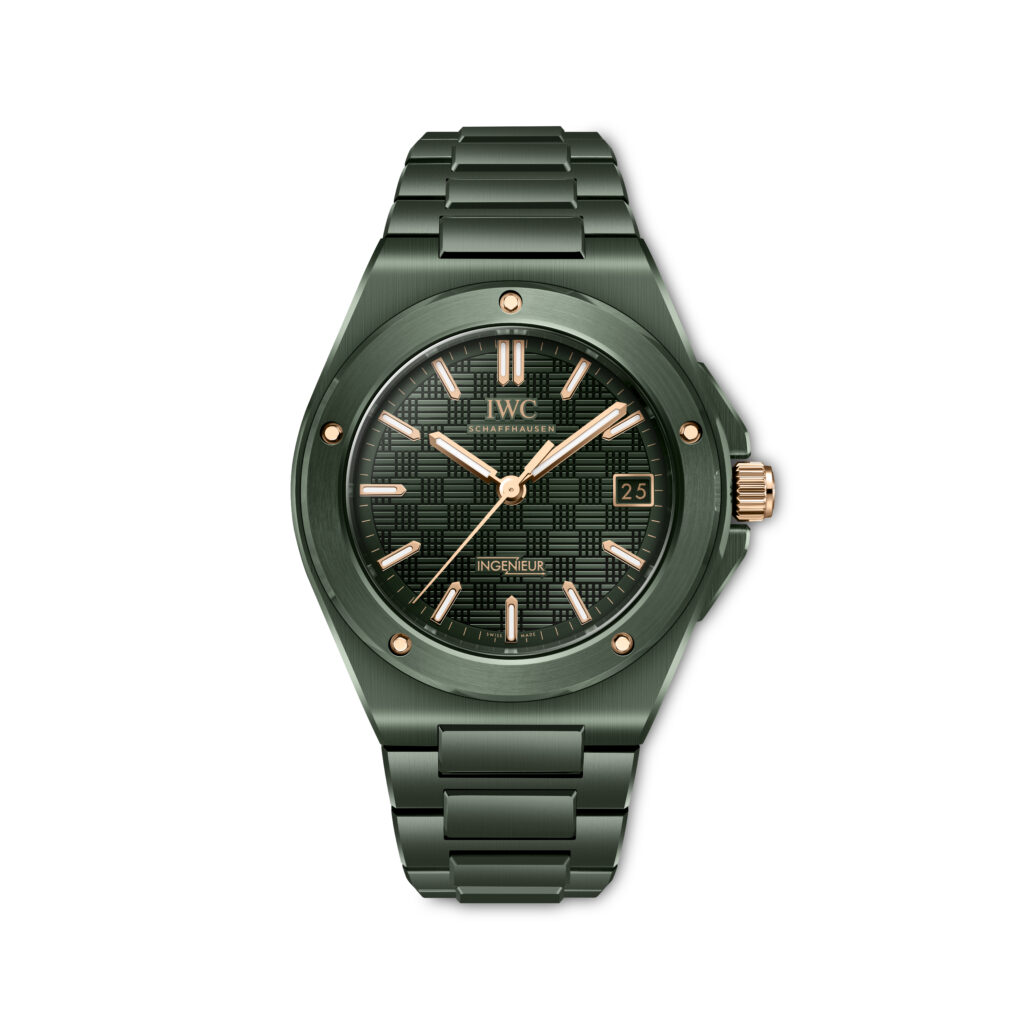
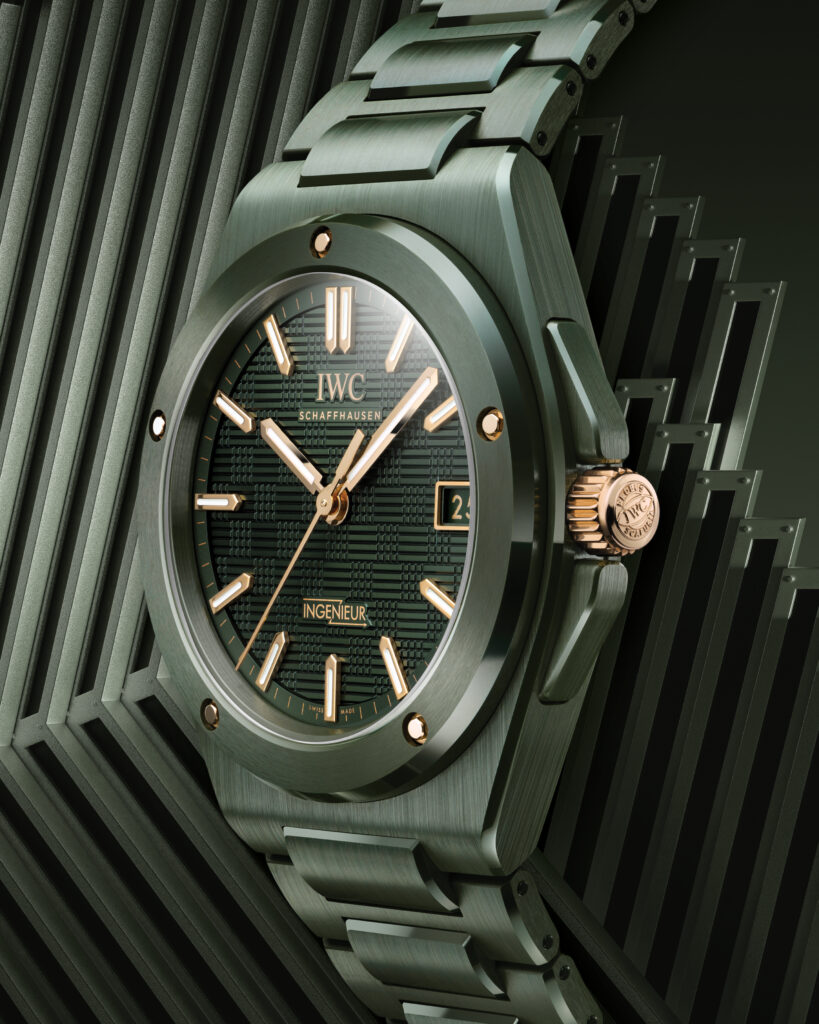
At Watches and Wonders 2026, IWC Schaffhausen unveiled a version ofthe Ingenieur Automatic 42 in dark olive green ceramic. This isn’t the brand’s first ceramic watch—IWC has been producing them since 1986—but it is the first time that the integrated bracelet design, a legacy of Gérald Genta, has been crafted entirely from this material. The novelty isn’t the color. It’s what had to be overcome to achieve it.
Technical ceramics of watchmaking grade, made from zirconium oxide, are white or black in their natural state. Any coloring is achieved by adding additional metal oxides to the green body in precisely defined proportions. The first challenge: these proportions do not determine the final color. During sintering, the parts shrink by about one-third, and the hues change. Predicting the color after firing—which must be identical on every component, produced separately—is as much a matter of materials chemistry as it is of industrial expertise.
Removal, hardness, diamond tool
Once sintered, zirconium oxide ceramic reaches a hardness of approximately 1,300 on the Vickers scale. Cutlery steel, by comparison, ranges from 600 to 800. At this level of hardness, only diamond tools can be used for machining. This is not a minor constraint: it dictates the entire manufacturing process. The final shapes must be defined before sintering, while the part is still in its green state, taking into account the shrinkage that will occur. Modifying the geometry after the fact is not an option.
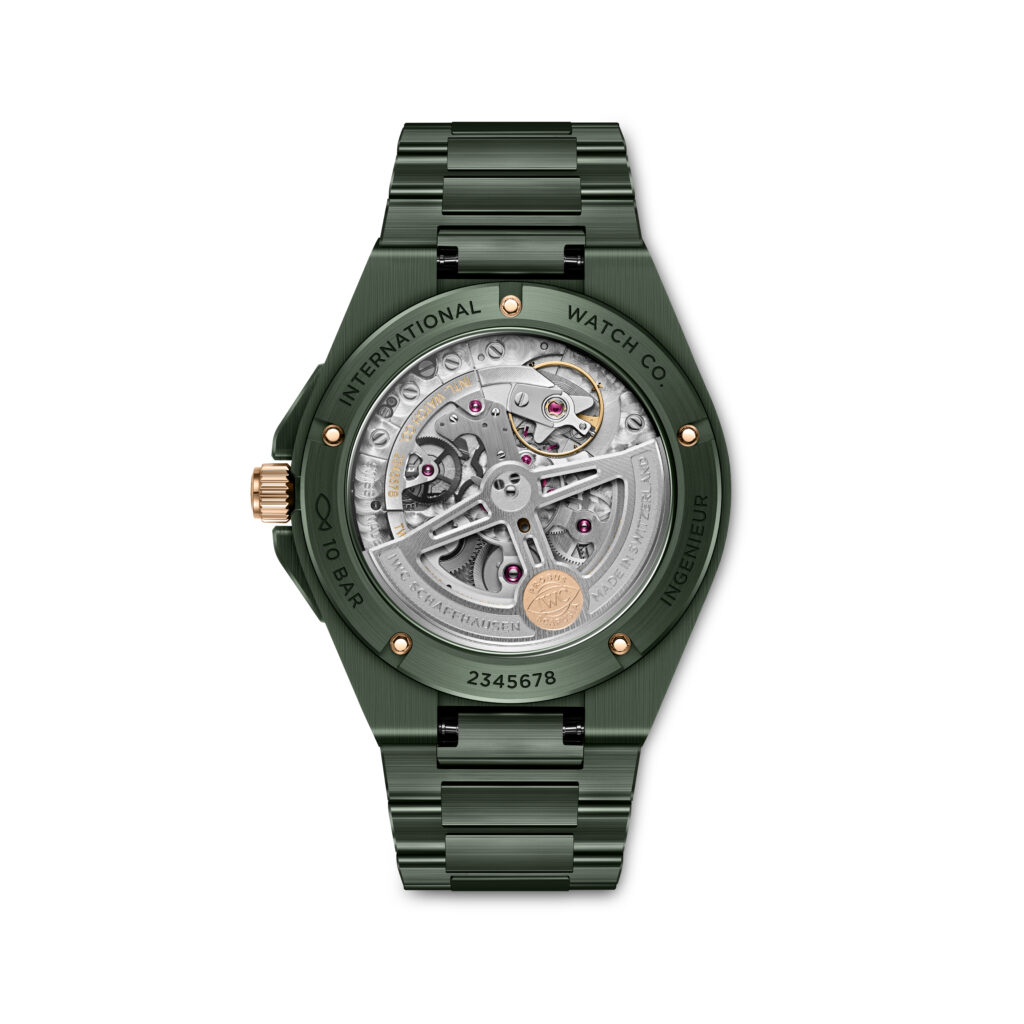
IWC solves this with a case construction consisting of several distinct components—case, bezel, case back ring, and crown guard—each sintered separately, each of which must exhibit the same shade after firing. The final assembly is secured by a titanium ring that encircles the movement, holds the functional screws in place from both the front and back, and ensures water resistance to 10 bar. There is no traditional movement case: the multi-piece ceramic case serves this purpose, held together by titanium.
The integrated bracelet—also made of olive-green ceramic—is attached to the case via the central links. Since ceramic is less dense than steel, the watch feels lighter on the wrist than its volume would suggest.
A movement made partly of ceramic
The IWC-manufactured Caliber 82110 also features zirconium oxide. The Pellaton automatic winding system—designed by Albert Pellaton, the company’s technical director in the 1950s—engages the automatic wheel and pawls in both directions of the rotor’s rotation. These components, which are subjected to the highest stresses, are made of black ceramic. The rotor’s central bearing is made of white ceramic. The power reserve is 60 hours at 28,800 vibrations per hour.
The crown is made of 18-karat 5N gold. The bezel screws, crafted from Armor Gold®—a gold alloy significantly harder than conventional alloys—serve the same purpose as ceramic: long-term resistance to contact wear.
What the watch implies is that color is not an isolated aesthetic decision. It involves a chemical process, a kiln, shrinkage tolerances, and a manufacturing sequence that cannot be reversed. The next question for IWC is how far this approach can go—other shades, other shapes—without the kiln becoming the real designer.
Cette publication est également disponible en :

