
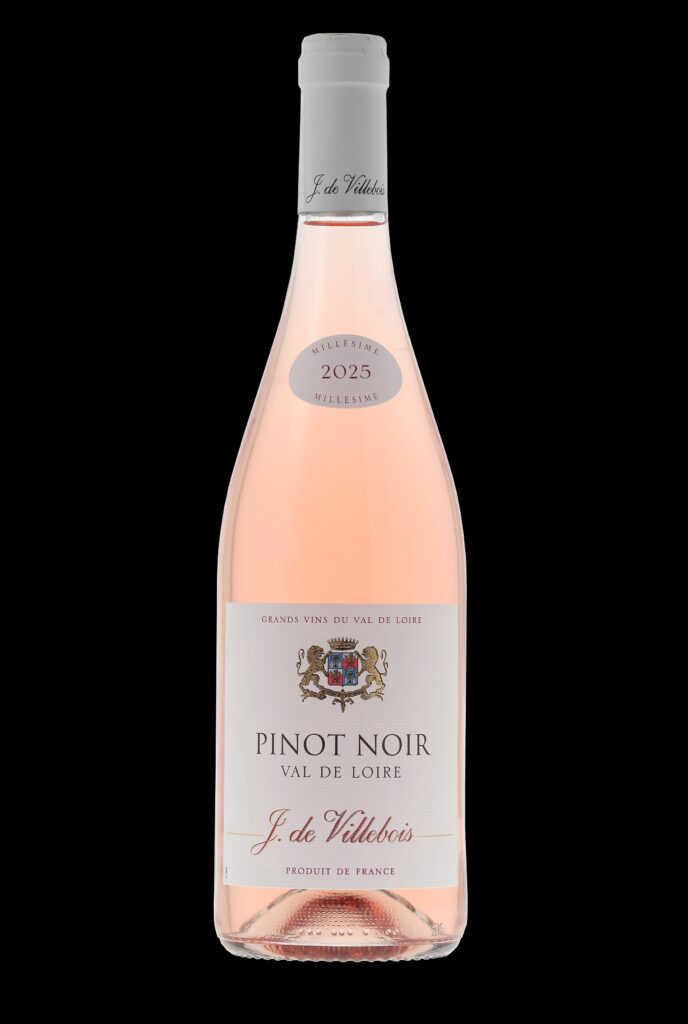
Rosé from the Loire Valley is going through a paradoxical phase. More in demand than ever on summer patios, it often finds itself confined to a formulaic aesthetic: a standardized paleness, immediate aromas, and freshness without depth. At J. de Villebois, the 2025 Pinot Noir Rosé takes a different approach. Not that of a poolside rosé, but that of a wine built around the grape variety and the soil, with that slightly northern restraint that the Loire region still manages to preserve.
Here, the winery produces a Pinot Noir grown on sandy-clay soils mixed with flint. This detail matters more than the usual talk about “rosé of the moment.” The flint imparts a dry, almost smoky tension that prevents the fruit from veering into cloying sweetness. Grass cover between the rows and mechanical work around the vines also reflect a winemaking philosophy focused on mastery rather than the pursuit of maximum yield. Alberto Tonetto, the estate’s winemaker, sums up this approach with a simple phrase: “We put ourselves at the service of Pinot Noir.”
In the glass, the coral color remains luminous without coming across as artificial. The nose opens with notes of yellow peach and fresh cherry, along with a more unexpected hint of cotton candy, quickly followed by a drier sensation on the palate. The 2025 vintage, in fact, boasts a style distinct from the more immediate Loire rosés, with nuances of dried fruit and spices that emerged during winemaking and aging.
This trend says something about the current evolution of French rosé. Long confined to being a seasonal wine consumed very young, it is gradually becoming a canvas for technical expression for wineries that seek not so much immediate appeal as texture and length. At J. de Villebois, this approach remains restrained. On the palate, the wine retains a juicy framework and supple body, but the freshness of the Loire Valley keeps it taut. Here, Pinot Noir acts more as a structuring grape variety than as a mere source of aroma.
The suggested pairings—scallop carpaccio, grilled prawns, burrata with heirloom tomatoes, or fresh goat cheese—point to a specific approach: summer cuisine centered on the taste of the sea, vegetables, and creamy textures. The wine also pairs well with saltier dishes thanks to its combination of ripe fruit and crisp freshness.
The estate’s history also sheds light on this cuvée. Joost de Willebois, former president of the Amsterdam Stock Exchange, purchased his first vineyard in Touraine in 2004 before gradually building up a portfolio of vineyards along the Loire River, stretching from Touraine to Sancerre. In 2015, the acquisition of a historic estate in Verdigny made it possible to bring winemaking practices closer to the original terroirs and to refine the work on individual plots.
This entrepreneurial journey could easily be framed as a story of a spectacular career change. The estate prefers to emphasize a philosophy of precision and continuity, particularly through its commitment to the “Vignerons Engagés” label since 2021. Here again, the focus is not on environmental branding but on the overall organization of vineyard operations, from the soil all the way to distribution.
The 2025 Pinot Noir Rosé retails for 9.50 euros. The price is almost beside the point given what this wine represents: an attempt—still rare in this category—to produce a Loire rosé that prioritizes nuance over immediate impact.
Cette publication est également disponible en :

