
A short while ago, we set off to discover a city that leaves no one indifferent: La Grande Motte. Criticized by some for its concrete architecture, it was precisely to discover this unusual architecture that we set off.
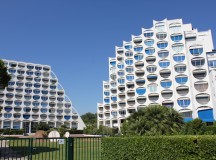


La Grande Motte is a town well worth a visit. Nestled in the heart of nature and the marshes, it’s a challenge we owe to the will of men. The same men who decided forty years ago to create a futuristic, modern city in the heart of an inhospitable land, transforming it into a unique seaside resort.
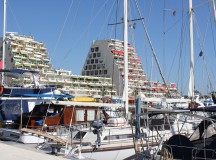

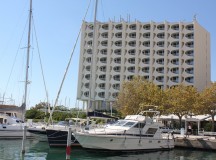

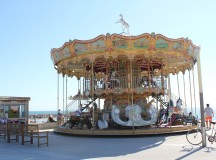

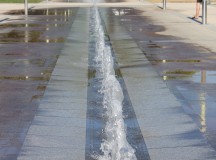
This concrete construction and 60s vision of the city is often decried by those who don’t have the keys to understanding the city. Without these keys, it could be seen as a classic seaside resort lacking in charm and greenery, when in fact it’s quite the opposite.
A look back at a city full of surprises.
“La Grande-Motte is a kind of holy place: men and women come here to worship the sun. It’s a religion as old as the hills, and one that is enjoying a revival these days”
Jean Balladur,
A political decision
On the shores of the Mediterranean, near Montpellier, architect and urban planner Jean Balladur (1924-2002) invented a Sixties seaside town whose modernity was embodied in pyramidal shapes evoking the millennia-old solar cults of Mesopotamia, Egypt and pre-Columbian America. This is not the least of the paradoxes of this resort, which has sprung up from the sands and marshes in an unlikely and hostile location in a region that, at the time, was far from being the stuff of dreams. Languedoc-Roussillon was a deprived region severely affected by the phylloxera crisis that had ravaged its vineyards and mosquitoes. The French government decided to capitalize on Languedoc-Roussillon’s wealth of tourist attractions, and launched an ambitious coastal development project. The project was carried out with the utmost secrecy, to avoid stirring up real estate speculation. On June 18, 1963, the Mission Interministérielle d’aménagement de la cote Languedoc-Roussillon, or Mission Racine, was created, named after its president Pierre Racine (1909-2011). The Mission Racine owed its effectiveness to the fact that it was conceived as a “commando” operation that escaped the usual bureaucratic red tape and procedures, reporting only to the highest levels of government. Its success, in an operation that P.Racine himself describes as Mission Impossible, is also due to the small number and quality of the people who make it up, and their sense of public service. In just over twenty years, they took up the challenge of developing these 180km of coastline, draining it, removing mosquitoes and building freeways. They created six tourist resorts with almost 100,000 beds, separated by areas of coastline that had been declared undevelopable in order to preserve the coast’s natural, wild character. As early as 1962, a team of eight architects, led by Georges Candilis, secretly drew up an overall development plan for the coast. Each was also entrusted with the development of one or more resorts, most notably Balladur at La Grande-Motte.
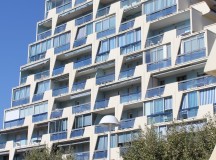

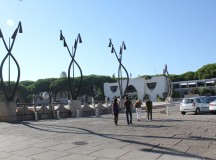




The city of a man
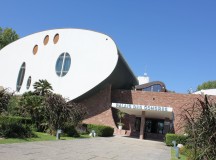
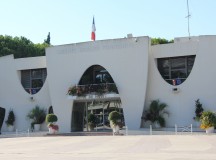
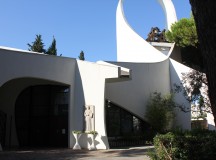
Balladur enjoys exceptional prerogatives, comparable to those enjoyed by the chief architects and urban planners of the stricken cities of the Second World War. Appointed for twenty years, he reported directly to P. Racine, in whose full confidence he would always remain. He designed the town’s urban plan, defined the architectural principles, supervised the architects and reserved the right to build a few major public buildings: the town hall, the church and the convention center. Balladur is a singular architect. A disciple of the philosopher Jean-Paul Sartre, he was destined for a literary career, which he abandoned in favor of architecture after the war, convinced that it would be more useful in a country that needed rebuilding. Balladur is a modern architect, but he is not prepared to let himself be confined to one school of thought. He reflects personally on his mission as an architect. La Grande-Motte is the most accomplished expression of this.
The reinvented seaside town
Far from denying the wild beauty of the site, Balladur sought to compose with its constituent elements: the sea, the sun and the wind.
Balladur also sought the right scale for the future city he was charged with imagining. La Grande-Motte is a seaside resort for all, a city dedicated to the worship of the sun.
Four urban principles govern La Grande-Motte: contain the automobile; differentiate neighborhoods; compose in volumes and voids; build a green city.
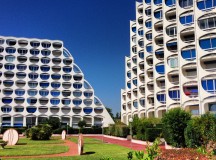
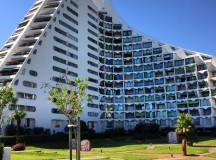
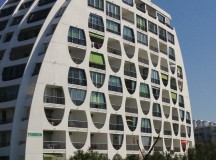
The neighborhoods, with their differentiated shapes, are articulated around the harbor, whose shape and orientation have been calculated to take into account prevailing winds and currents, so that the boats moored in the harbor have little slipstream whatever the wind. To the east, the Pyramids district, whose orientation has followed this incline; to the west, the curving Conques de Vénus. To the north of the harbour, the Great Pyramid establishes a link between east and west. On the outskirts, the residential area of detached houses, the golf course and the poplar grove of the campsite complete the scheme.
Balladur’s concern to protect the plantations and transform this inhospitable area into an oasis of peace and freshness led him to adopt a volumetric composition. He cuts or sculpts his forms into contrasting and varied volumes. But in the name of a principle of duality that is dear to him, the architect gives as much importance to emptiness as to volume. Contrary to popular opinion,” adds Balladur, “the void is the raw material of architecture.
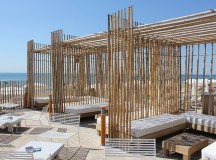

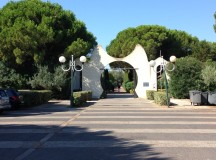
La Grande-Motte is a green city. The expression belongs to the vocabulary of modernity. As early as 1935, Le Corbusier imagined the concept of the Ville Radieuse (Radiant City), where buildings were densified in height, freeing up to 85% of the ground for vegetation. These principles were never applied. In La Grande-Motte, however, vegetation occupies a third of the city’s surface area, i.e. 130 hectares. It’s not just a question of enhancing the view, but of a real, strong urban intention in which vegetation plays a full part in the design of public spaces. The green city offers a remarkably comfortable living environment for residents, who can stroll in the cool shade of the vegetation over a large part of the municipality. From the earliest drafts of the urban plan, the planting scheme was integrated into the city’s design. Landscape architects Elie Mouret from 1964 to 1969, and above all Pierre Pillet from 1965 to the end of the town’s construction, worked closely with the architects to turn La Grande-Motte, where nothing else grew, into a veritable oasis.
The men behind this unique architectural creation imagined a magical city in which the omnipresent vegetation wraps itself around the concrete in a singular and abundant alliance. No less than 80 km of footpaths, 28,000 trees and parks, 70% of the city in natural spaces.
La ville des Pyramides
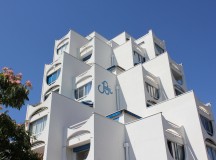
At a time when modern architecture was triumphing, impoverished by the repetitive mass layouts and banal forms of large-scale housing developments, Balladur designed La Grande-Motte with a pure, geometric architectural style, in the service of formal diversity and freedom. There are many reasons for the choice of pyramidal forms, starting with the rejection of the “inhuman and stupid concrete blocks” that, according to Balladur, overwhelm the French landscape. By opting for these millennia-old shapes, Balladur invented the modern seaside resort. The pyramids are a tribute to the cult of the sun.
The city seen as a total work of art
The work begun in September 1966 to level the ground, raise it by two meters, dredge the Etang du Ponant and build the port was titanic. Raising the ground required the displacement of five million cubic meters of earth and sand, the equivalent of five hundred-meter cubes! The first aerial photographs show that priority was given to building the roads and networks that criss-crossed the lunar landscape. At the same time, the ground had to be cleared of mosquitoes and then revegetated. The port’s basins were dug out of the ground after the construction of the quays that delimited them. The dikes were built using blocks cut from the nearby Cévennes mountains. In 1967, construction began on the first two pyramids along the harbor. They were the work of Balladur, who wanted to set the tone for the architects called upon to build La Grande-Motte. In the end, ninety architects were selected, including Paul Gineste and Pierre Dezeuze, two of Balladur’s closest friends. Each lot entrusted to a developer was the subject of a specification sheet specifying surface area, use, layout, number of storeys, dimensions, terraces, green spaces where applicable, colors, etc.
Thus Balladur, whose actions spanned three decades, was able to set and control the town’s architecture, giving it a real identity.
This precise framework did not preclude formal invention. It was part of the architecture-sculpture movement, which sought to renew the language of the Modern Movement, which had been under fire since the late 1960s.
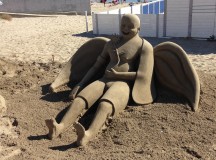
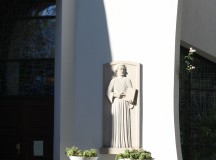
With its exceptional sculptural architecture, La Grand-Motte is also the ideal setting for a number of urban sculptures that are at one with the works of Balladur and his colleagues.
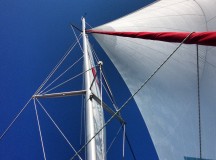
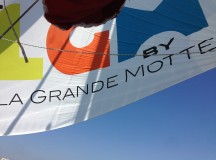
Don’t hesitate to discover the city from an original angle: parasailing to see the city from the sky, Segway to travel the city effortlessly, or a sailboat to rediscover the city from the sea.
Come and discover this Unesco 20th-century world heritage site for yourself, and you’re sure to come away surprised and charmed.
Cette publication est également disponible en :

