
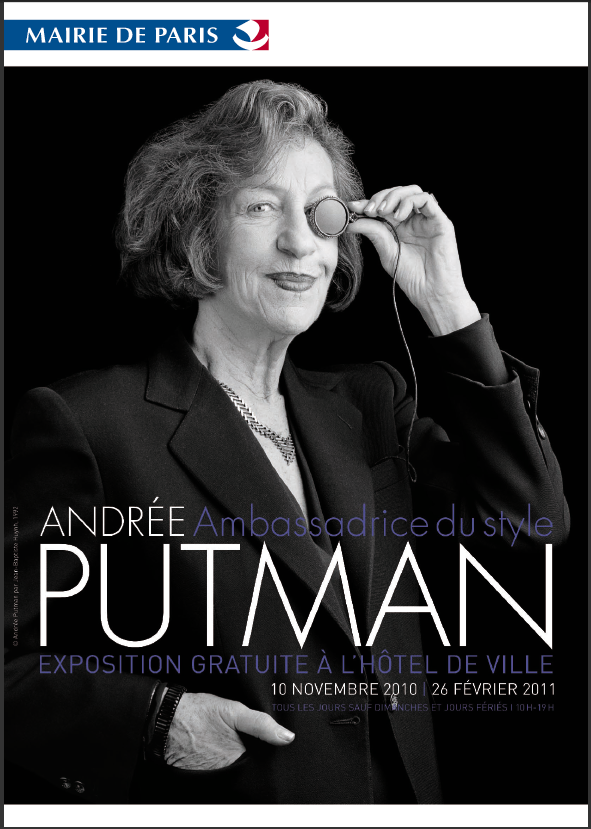
The Hôtel de Ville de Paris presents the first retrospective devoted to designer and interior architect Andrée Putman, from November 2010 to February 2011.
Andrée Putman is known for her elegant silhouette, asymmetrical haircut, deep voice and style marked by black and white, formal rigor and sobriety.
Born in 1925 in the Paris arrondissement and trained as a musician, she first worked as a journalist for various magazines, before becoming artistic director of the “Maison” department at Prisunic stores in 1958. There, she championed the idea of design accessible to all.
The 1970s were marked by her first designs for boutiques (Créateurs et Industriels, Thierry Mugler) and private residences, and the creation of a company, Ecart International, which, from 1978 onwards, enabled her to re-edit pieces of furniture by then-forgotten designers such as Eileen Gray, Mariano Fortuny and Robert Mallet-Stevens, whom she had long admired.
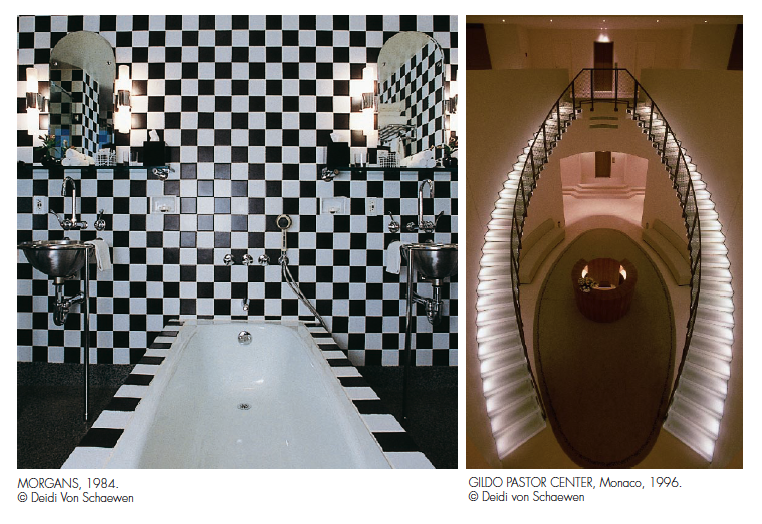
1984 marked a turning point in her professional life: for the Morgans Hotel in New York, she invented the concept of a small, boutique hotel with a distinctive design, offering a new approach to the hotel business. Of this project, she would say that it “cast a spell on her career”. Her work was hailed for its originality, for example with the use of industrial sinks in the bathrooms, which went against all traditional practices. It was for the Morgans Hotel that Andrée Putman first used the famous black-and-white checkerboard pattern so often associated with her name.
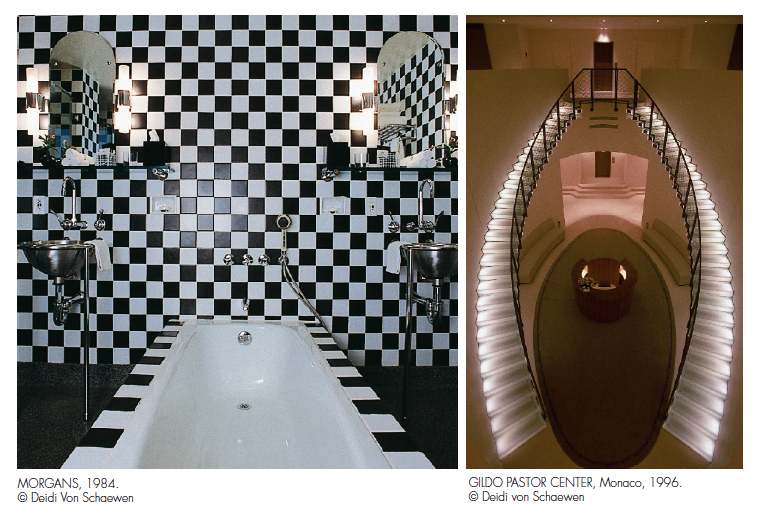
From the mid-1980s onwards, Andrée Putman devoted herself mainly to interior design, in a highly varied typology: boutiques, restaurants, hotels, care facilities, private apartments and offices all bore her hallmark, made up of attention to light, a precise sense of geometry and a concern for the right materials.
Some of these projects are of particular importance. For example, offices designed for various ministries, demonstrating Andrée Putman’s ability to play with the codes of a rigid genre (Culture in 1984, Finance in 1989 and Education in 2002). And in 1990, the CAPC-Musée d’Art Contemporain in Bordeaux was fitted out in the Lainé warehouses, reflecting her desire to rediscover the original structure of the places in which she worked, as well as her taste for industrial spaces.
By unambiguously rejecting anything that comes under the heading of traditional “good taste” without risk or originality, Andrée Putman has become the ambassador of a “French style” the world over. The exhibition at the Hôtel de Ville de Paris will evoke her work through the reconstitution of interior spaces and the presentation of furniture elements. It is also a tribute to a certain conception of design, in the image of the two-fold question at the heart of Andrée Putman’s work: “Q What can we do to lighten life? What are we going to be able to imagine that’s a little crazy?”
Cette publication est également disponible en :

