
These days, social networking has become a must. The new generation is building a virtual life in which it reinvents itself, as a way of combating the prevailing loneliness and boredom.
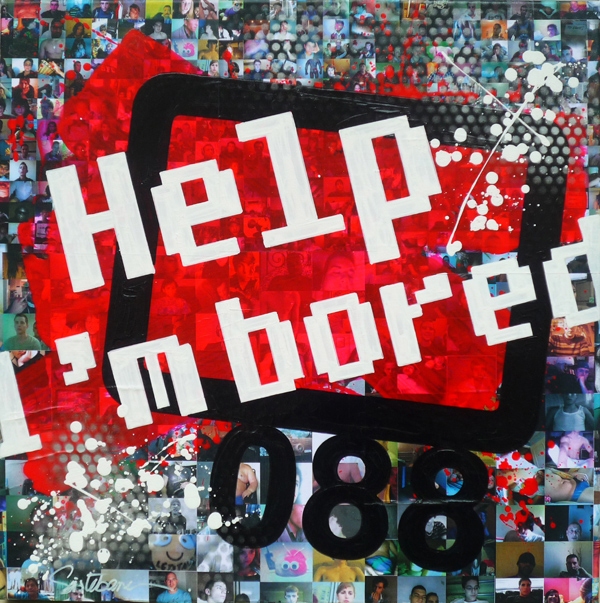 The latest addition: Chatroulette.com. This site places you in a random video chat with another Internet user connected anywhere in the world, with both parties able to press the “Next” button at any time to restart the great chat roulette. Simply press the “Play” button to be put in touch with someone whose name you don’t even know, and who doesn’t know any more about you. Based on the appeal of the unknown and natural curiosity, this site is a real success. A little taste of mystery that makes the game terribly addictive, plus the delicious feeling of transgression when talking to a stranger. But the site doesn’t shy away from bad encounters, revealing a global Cabinet of Horrors side that often features surreal scenes.
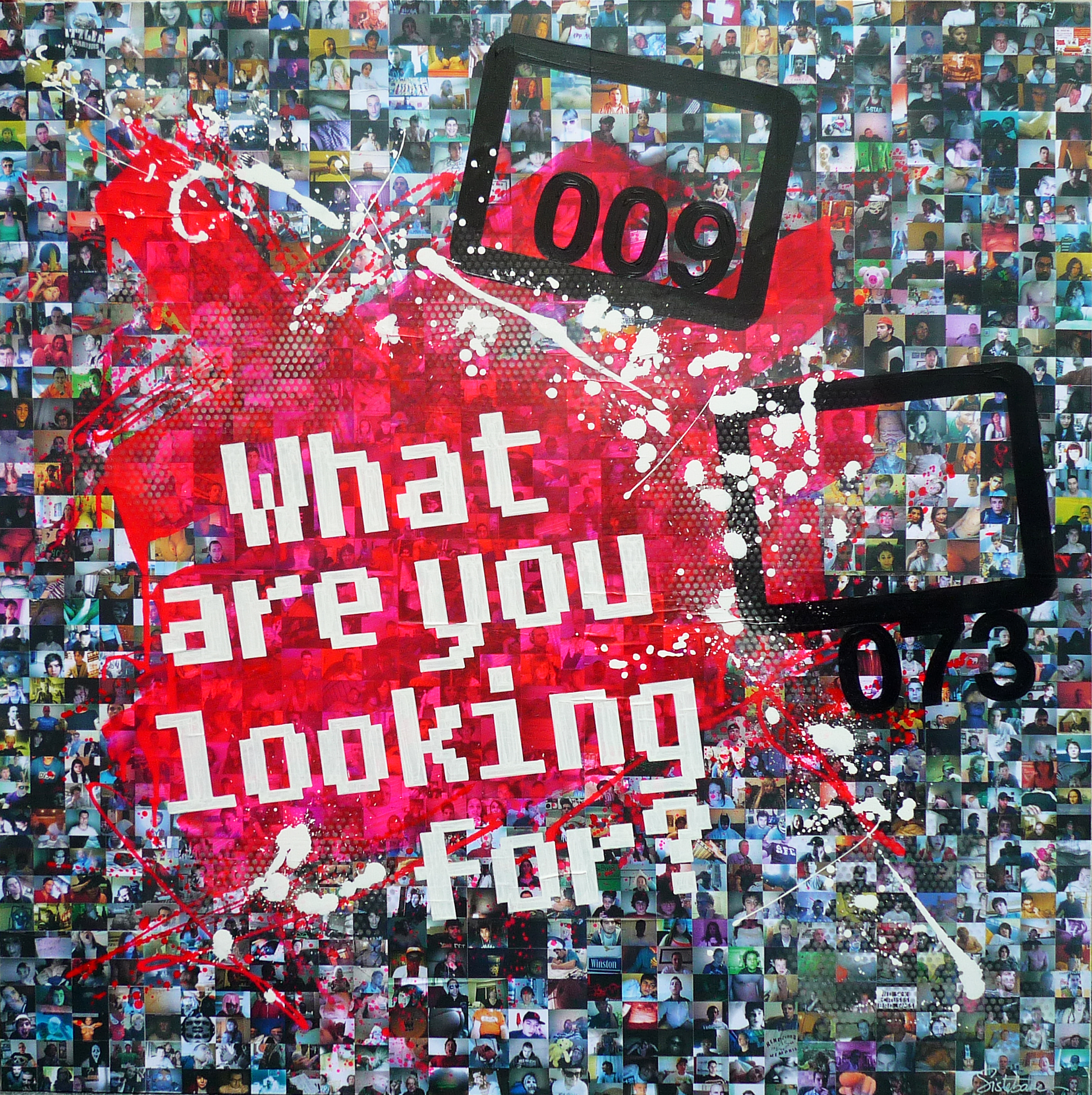
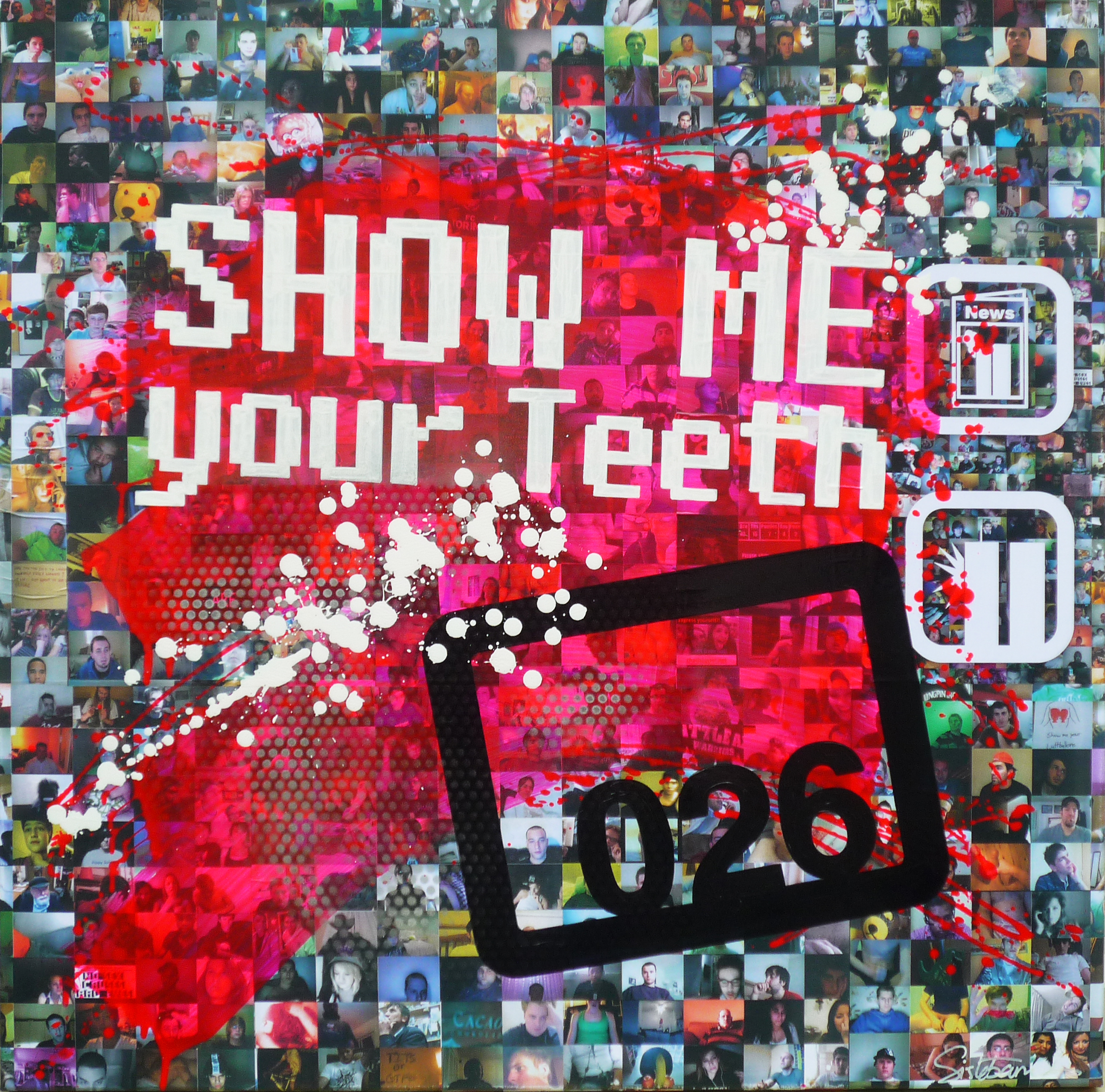
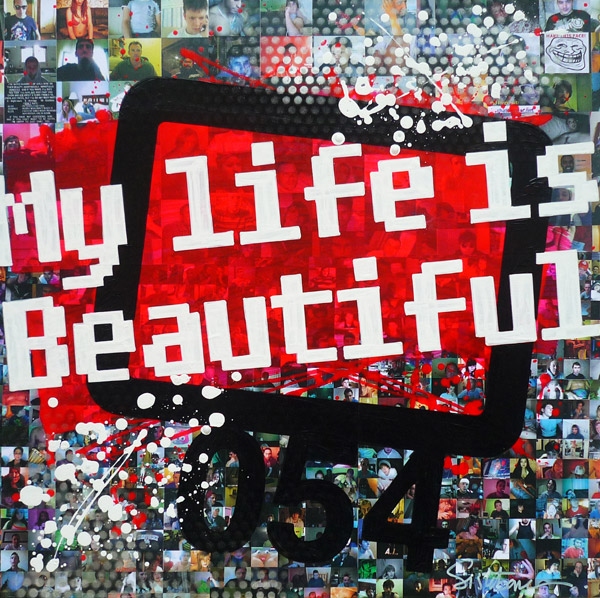
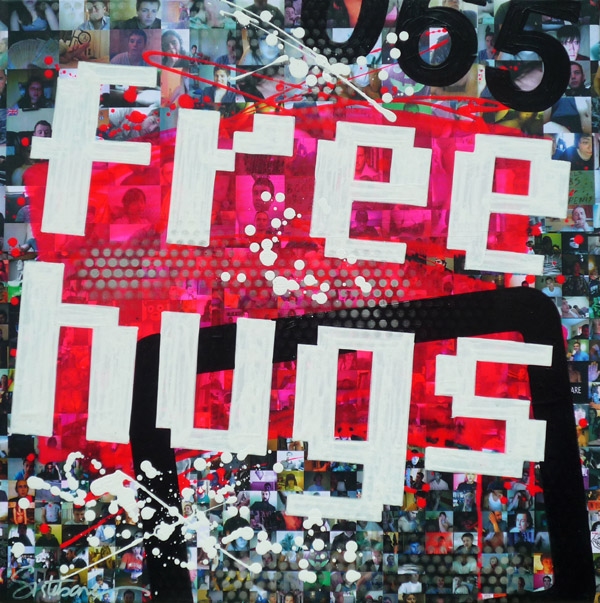
French artist SISTEBANE has taken an interest in this phenomenon. Fascinated, he took screenshots of webcams from all over the world and set them in scene in a series of paintings called “FREAK CONNECTION”, a mix of photography and painting, to show human beings’ ability to stage themselves. A cross between street-art and pop-art, these paintings show today’s society and human malaise, like a window on a society in pain, but above all a magnifying mirror.
On the occasion of the Kube Art Brunch at the Hôtel Kube in Paris, the artist agreed to answer our questions.
 Hello Sistebane, can you tell us a little about your background?
I’m Sistebane, a Frenchman living and working in Paris where my studio is located. I’m a graphic designer and illustrator by trade. I started out in the world of communications and advertising, which is still evident in my work today.
And I naturally drifted towards freelance painting as a way to express myself, to be freer in fact. I really liked advertising, but I didn’t like the environment, being more of a sheep than a shark. So I preferred to be free and independent and try painting. I wanted to give it a try first, to see what it would be like, and in 2000-2001 I started to do my first exhibitions.
Tell us about this project, “Freak Connection”.
It’s a new concept for me because I usually do things that are a little more graphic, urban, even pop art. I was fascinated by a site called chatroulette.com, a little site invented by a young Russian who was bored at home and built a very simple site: a webcam and a “Next” button. It’s a Russian webcam roulette !!!
At any time of the day, you can meet anyone, at any time. And if by mutual agreement, you or the other person in front of their webcam decides to stay chatting, you can stay together as long as no one presses the “Next” button. Otherwise you can never go back, you can never find the person again. It’s a snapshot in time.
Through these paintings, I wanted to show the unhealthy side of human beings: voyeurism, excitement and, above all, how bored people are with life in 2010. Because when you look at all the screenshots I’ve taken, all you’ll find are sad faces, sad people who are bored and often alone. And it’s this contemporary vision of technology and communication media in 2010 that I wanted to show.
 I agree with you a little. On the other hand, in the first images of chatroulette, I often saw groups of friends doing anything, dressing up, looking like Scream…
In the beginning, people dressed up and enjoyed doing it. That’s what amused me at first: people dressed up, even dressed for the occasion as if it were a date with someone, it was a bit of a carnival. As the weeks went by, people became simpler, more themselves in the end, and now you see a bit of everything. You can come across little six- or eleven-year-olds, old people or people having sex… I even found myself in the middle of a class lecture hall in the United States. They were studying the phenomenon in class, because it’s a social phenomenon after all.
It really shows the human malaise. People are in human stupidity and press the “Next” button. It’s useless, it’s a media zapper.
I confess I’ve never been on chatroulette, I’ve been a bit burned by the comments I’ve read, especially about men who keep themselves busy a bit, I find it hyper violent….
As there’s no IP search, people aren’t identified. So they can afford to be completely outrageous, outrageous and it’s a bit borderline really.
We can also see human sadness.
Completely, human sadness. People are sad, lonely, and it shows a lot. Some people leave their webcams on without realizing it, and you come into their house because it’s a camera, and you see them wandering around alone, watching TV, because sometimes they’re doing both things at the same time. You can even stay ten minutes in their home before they realize anyone’s there.
It’s true that all this is exciting in the sense that you’re into human perversity, you’re into people’s homes. There’s this curious, perverse side to it, which is ultimately what humans do every day. And on the other hand, it’s distressing and frightening because we see everything.
 This phenomenon already exists to some extent on Facebook, where there are no webcams but online discussions. This may be due to the fact that you can’t see the person in front of you. but people’s behavior is very strange: they’re very demanding when you’re not necessarily available all the time, and some people become a little aggressive and not always respectful.
It’s the virtual world, people are borderline and allow themselves to do things they wouldn’t necessarily do in real life, or even out of shyness in real life. On chatroulette, I sometimes voluntarily disguised myself to ask for a smile or something, to take away that sad side they had. I’d put on a little cap to elicit a reaction, because sometimes people were livid, impassive, nothing happened.
Then it was fun to see all these screenshots – there are four-five thousand of them, in fact – and put them in the background to create a sort of kaleidoscope of life.
It’s actually a bit of a study.
Absolutely, a study of human behavior. My previous work was on the pop art side of the street, much more down-to-earth stuff that, shall we say, interests me more, from television to cinema. This project is more about looking at people.
I live in my own world, I’m very media-oriented, very TV-oriented and very Internet-oriented. But in the end, it also concerned me because I live with the media and the Internet. When I go home, I turn on the TV and the Internet, so I live with this daily routine. Chatroulette is scary, exciting and unhealthy all at the same time. It’s human in all its power!
I really wanted to use this background, because I always use my wallpapers, I also wanted to work on a collage part. Taking these screenshots and pasting them together was interesting. It makes a patchwork of colors. I don’t necessarily work with colors, so it was a perfect fit. It’s naturally very colorful, it’s very vivid!!!!
 In addition to these photographic assemblages and collages, your paintings have three constants. The first is the presence of the color pink.
I’m very colorful in my paintings because I’m very pop art – back to that – but I didn’t want to use too much color since the screenshots were self-sufficient. I already had a patchwork of colors, so I didn’t want anything too bright or bold. I thought this pink, which is a fluorescent pink, went with everything. It was a bit generic. It purified and revitalized everything.
In fact, my paintings are in square format, a format I also like. It’s square, like television and communication.
Each of your paintings has a number.
I’m a numbers person, I’m always putting numbers in my paintings. I don’t know why, I couldn’t analyze it. I thought the subject really lent itself to it, in the spirit of saying that we’re all numbers.
We all depend on an IP something, a document, we’re all linked to a number, a credit card, etc…. It’s our daily life. But these numbers are chosen at random.
As for the phrases on each canvas…
I didn’t want strong words, but rather short sentences. I also deliberately chose a very pixelated typography. I wanted a link with the conversations we have or the non-conversations we have in relation to communication and networks.
These are phrases or words related to communication, or rather the need for communication, such as “Free Hugs”, “Show Time” because people are showing off, or “Are you talking to me” because people are asking “Are you going to talk to me?”.
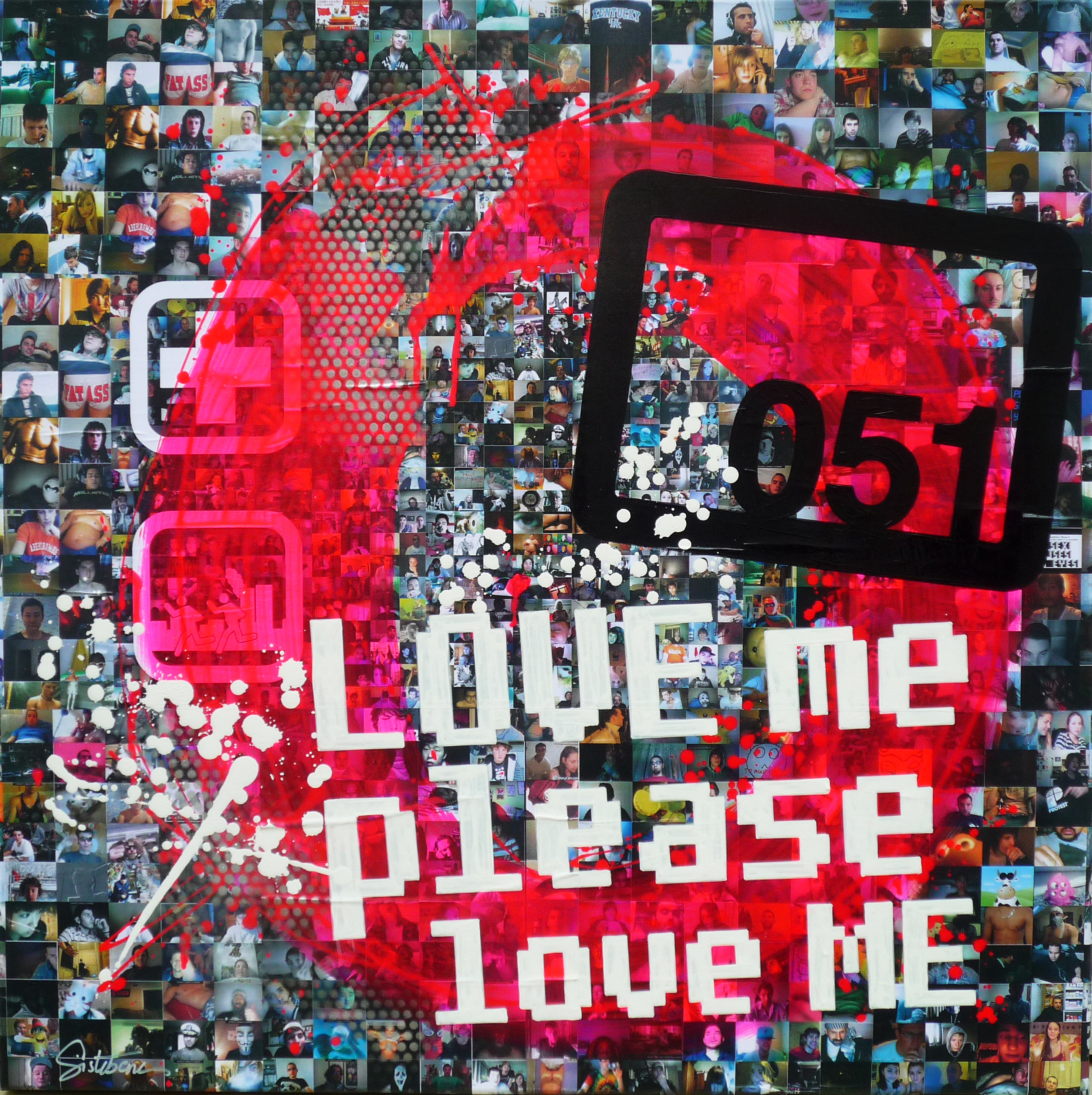 In the end, isn’t the most powerful phrase, the one that most sums up chatroulette, “Love me please love me”?
Exactly, it’s a call to tenderness, because people are bored, so they beg you: “Love me, I’m bored”.
But people also get bored on social networks. There’s the initial excitement effect, but you always end up bored if you don’t feed it with personal news. I’m not bored yet because I feed my Facebook with my news, I need to feed it, to communicate.
To get back to the sentences, they’re all about communication, or even dating sites, because after all, the Internet is a great dating site, whether there’s a flirt or not.
The Internet is about meeting, or rather not meeting. It’s about illusion and superficiality. Internet users accumulate virtual friends, they don’t communicate because they don’t see each other in real life. Or they spend more time at home, so they don’t see each other in real life.
Flirtation without being flirtatious, virtual flirting on the other side of the world. They’re very happy, they’ve made their point, but in the end, if nothing’s going to happen, nothing’s going to happen…
My work isn’t finished yet. I’m thinking of developing it with volumes, sculptures…
Well, we’re looking forward to it. Thank you for answering our questions.
Well, thank you.
Since the emergence of social networking, people have never felt so alone. Through his paintings, artist Sistebane offers us a brilliant demonstration of the biggest flaw in this individualistic society, where, in the end, people are busy observing the lives of others, bored with their own existence. It’s factual, but nonetheless powerful: we no longer really meet people, we only see them virtually.
Sistebane’s work can be seen at the Kube Hotel in Paris and the AXEL HOTEL in Berlin until July 31, 2010.
KUBE HOTEL “The Ice Kube” Design Hotel 1-5 Passage ruelle 75018 Paris
http://www.bombesproduction.com/
Marie-Odile Radom
Cette publication est également disponible en :

