
“At the bend in one of the long corridors of our minds, fantastic creatures sometimes appear. Bewitching, explosive characters emerge from the darkness and reveal themselves to us, never frozen in this matrix frame, always ready to shatter…. Confined beyond the frame, some escape, overflowing onto reality and sketching a path between them and us… “Stéphane Nigentz
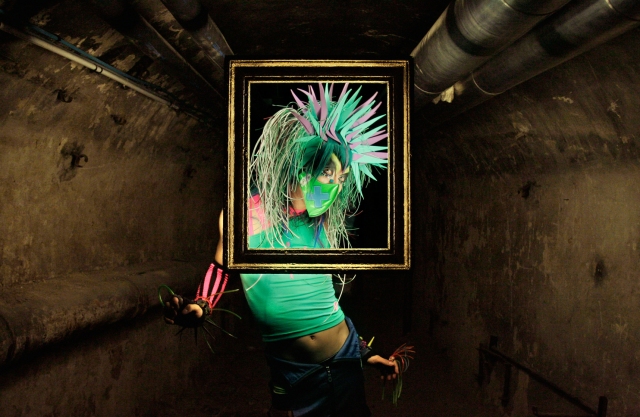
Friday, July 02, 2010 was an opportunity to enter a rather unusual corridor and meet an uncompromising Parisian photographer produced by Bombes Production: Nigentz. A practicing photographer since his teens, Nigentz is also a cinematographer for short and feature films. With his solo exhibition“Le Couloir Magique“, the artist presents an astonishing series of portraits whose common thread is a picture frame in a tunnel, or rather a dark corridor. In the course of his encounters, the photographer has selected faces and bodies that tell stories through make-up, tattoos and costumes, and photographed them through the frame.
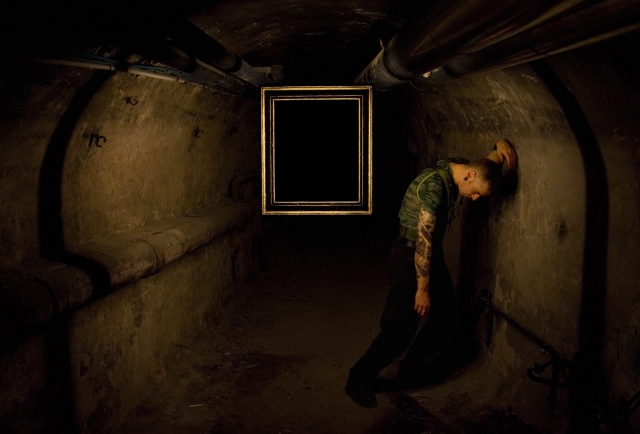
Like a gallery of family portraits, of aristocrats of the party, of gender (sexual or social), of posture and dress, Nigentz offers us a work on the notion of the “cliché” and the relationship to the image. At times erotic, malefic, magical or simply overwhelming, Nigentz’s portraits captivate us and show us what can be hidden behind the notion of image, playing on our senses and emotions, definitively going beyond this simple framework to bring us to the notion of identity.
The opening of his exhibition at Galerie G was an opportunity to try and get close to a sensitive being who doesn’t give himself up that easily.
First of all, thank you for agreeing to answer our questions. Your photos are like paintings with three elements. The first element is the tunnel, which is very strong and gives the picture a very intimate feel. Then there’s the frame, which plays its part and is even a character in each picture. It even appears on its own at one point. Finally, there are the people, who are not characters but people, who come with what they are. How did you meet them? Do you direct them, tell them a little bit about how to do things, or do they just position themselves naturally?
I’m bouncing off the frame as a character and the photo where he appears alone. What really interests me about this photo is that you can imagine whatever you want. It’s no coincidence that I put it right at the end of the exhibition, because it’s then up to the viewer to imagine their own images, their own fantasies behind this frame in this corridor.
To meet these people, I usually go to theme parties where I can meet people in fancy dress. I choose the people I want to photograph, then mix them up. Often, I work with people who don’t know each other at all, and then I set the scene. I try to tell a story through these different characters, because they will represent a cliché. I love working on and around the notion of cliché. These are people who are themselves characters. They’re not professional models, but they stage themselves when they’re out and about, at night. I intervene and direct them. Then I talk to them at length. The first photos are always useless. It’s very rare for first photos to work. I work for feature films, and I work a lot with actors. I love that there’s a real preparation when you have a feeling, a perception that takes hold of you. That’s the way I work, and I really try to bring it all together.
Lhen you meet them, do you already have an idea of how you’re going to deal with them, or do you get the idea from talking to them?
First, it’s their look, their face, their beauty or not, that catches my attention, and then I go and talk to them, which is why I say that the first photos are useless. Because it’s not easy to say that you’re going to use such and such light when it’s an impromptu shoot. If it’s a model who comes for that, I can spend an hour saying we’re going to do this, that and that, and not get the camera out. But in this case, I still have to show them psychologically that I’m a photographer. So I take time to get to know them. And based on what they tell me, I’ll ask them to go this way or that.
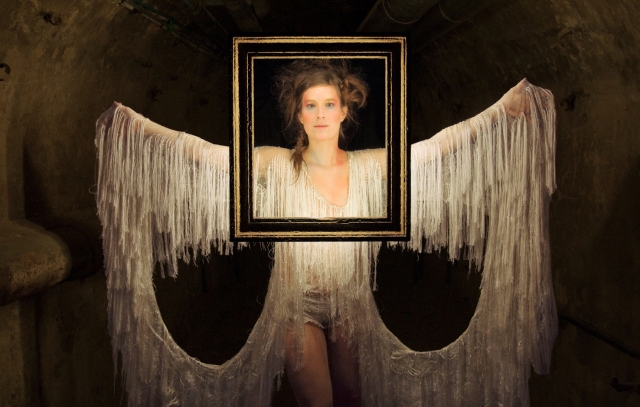
The photo of the girl in the white dress, the angel, is very interesting. It reminds me of the book The Phantom of the Opera. The dress forms a white mask, it’s quite ethereal and reminds me of the ghost Eric, also known as the angel.
I didn’t have that reference at all. I’d seen the Phantom of the Opera films, the Italian film and De Palma’s film, but I didn’t have it. There’s a lot going on in this photo. Not only is it an angel, but at the same time, when you look at it from a distance, the dress could represent a skull and crossbones…
A vanity, seen through the mask.
Absolutely, a vanity. There’s a lot going on in the fact that this chick is completely relaxed, completely angelic, and that there’s a second dimension if you see her from a distance. It’s one of the photos I staged entirely. I worked with a girl I met whose movement I love and who has done a lot of dancing. I went and got a dress and asked a make-up artist to do the session with me. We really started from scratch. And it wasn’t a party at all. The photo was taken in the same location as the others, but on an afternoon, because I’ve become close to the people in whose homes I’ve been able to take all these photos.
This photo is really quite good. At first glance, you can’t see the mask. You notice the dress, the idea, and then as you get closer, the mask appears and the girl completely fades out, replaced by another image.
I have the impression that with me, it’s rather the opposite. I tend to focus on faces and see what’s happening on a face. Then I’ll step back and discover this kind of eye.
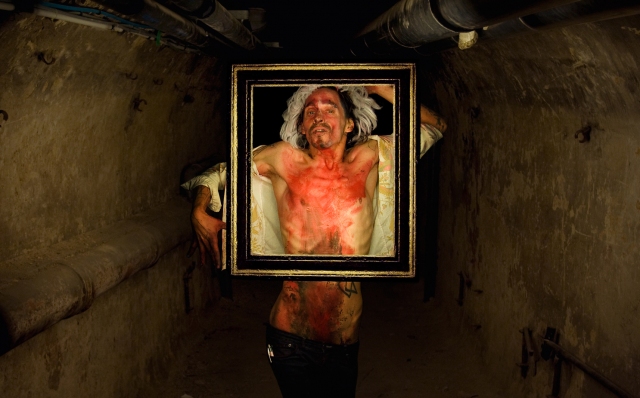
The images are quite powerful, like that of the scarified man whose face is completely bloodied.
The two photos go together. I often put them next to each other. The image of the scarified man is really raw apple.
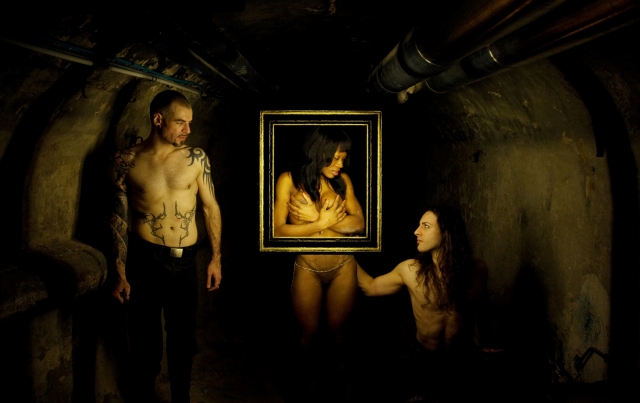
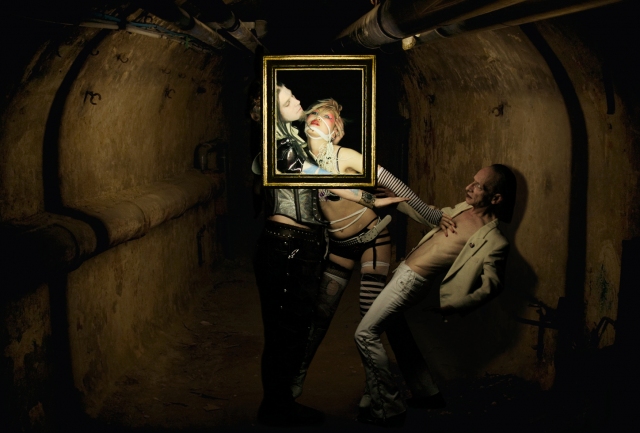
The triplet is really interesting. On the one hand, we have a man who is excluded and who shows it, and a “couple” on the other. The glances are very intense.
There’s a very strong story behind this photo. At these parties, I ask the characters to let themselves be photographed, so I asked these three people to pose. It turned out that he and she had never met. I asked the two boys to enter into a game of seduction with her. There’s a whole series, some of which are projected there. It lasted maybe half an hour or three quarters of an hour, where I asked the two boys to try to seduce her. So obviously she’s in the middle, with a boy on either side trying to win her over. The girl chose Yann, the other felt excluded. I pushed that scene. And the extraordinary thing about this image is that, after this meeting, Yann and this girl had a real story together. In this series, I have a few other photos of lovers, of people who are truly devoted to each other, that I didn’t create all the time. I’ve managed to capture this, I’ve made real images of lovers that are projected.
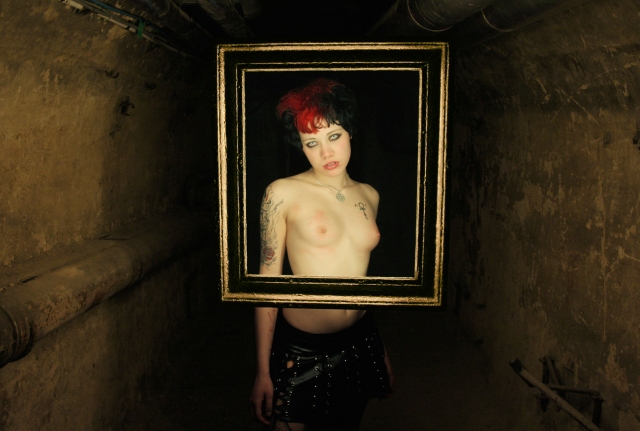
There are a lot of nudes. There aren’t many in print, but many are projected onto the screen. For non-models, wasn’t it too difficult to get them to pose nude?
They’re non-models, but at the same time they’re people who put their characters on stage. After all, they’re not used to photography. But sometimes it doesn’t work. I like directing actors or models, and since they also like playing and portraying characters, they tend to let themselves go and go very far. Then again, it’s 4 a.m. in Paris in a nightclub, so masks come off, even if they’re wearing different ones.
Looking at your photos, your work is ultimately about identity. It’s a very striking relationship to identity.
It’s ALSO a work on identity, on the frame and the out-of-frame. About who I am, wearing this costume, about what I show and who I really am. I try to work on the discrepancy between what people may perceive of someone’s look and what that person really is.
And what do you put about yourself in these photos, since it’s also a question of that identity?
What do I put about myself and at the same time what do I propose to the people who see my photos? In fact, it’s a form of interrogation about fantasies, about clichés and eroticism. How do I situate myself, what images do I want to see in there?
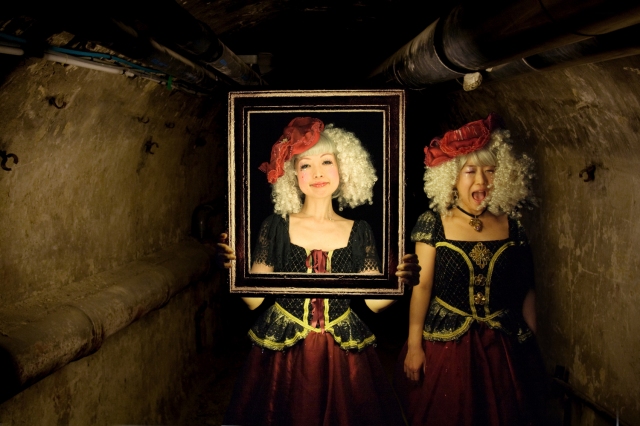
There’s a lot of duality in your photos, beyond the couples. Otherwise, it seems to me that there are also montages in your photos?
Sometimes there’s an element in the photo that I want to make disappear, but there’s no editing. I can remove elements or leave only what’s inside the frame, but there’s no editing. The photos are really like that.
Well, that’ll make a good closing sentence. Thanks again for taking the time to tell us about your work.
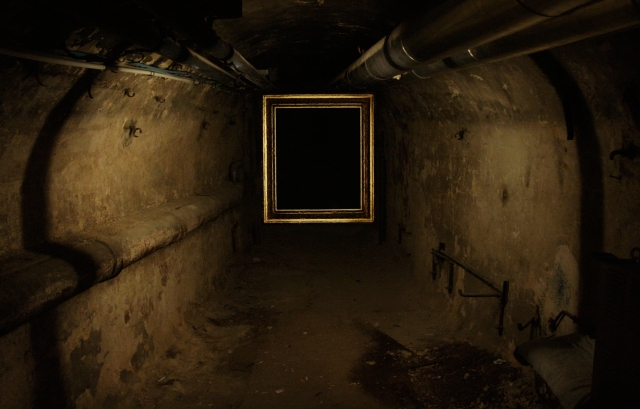
Finally, the question of identity through the cliché comes up quickly when looking at Nigentz’s work. All we have to do is look through this empty frame to create our own images.
You can admire the artist’s work on the Bombes Production website www.bombesproduction.com/presentation-nigentz.html.
Nigentz will also take part in the group show“Nervousness” at Galerie G, 23 rue des Lilas 75019 Paris, from September 08 to 24, 2010.
Marie-Odile Radom
Cette publication est également disponible en :

