
Chinon is, first and foremost, a color. Red—derived from Cabernet Franc—has shaped the image of this Loire Valley appellation for centuries—its tuff formations, its cellars carved into the rock, and its fine dining wines, which Rabelais already mentioned. White wine has been permitted here since the AOC’s inception, but it accounts for less than 5% of total production. Domaine des Bernard, based in Cravant-les-Côteaux, has decided to make a statement with it.
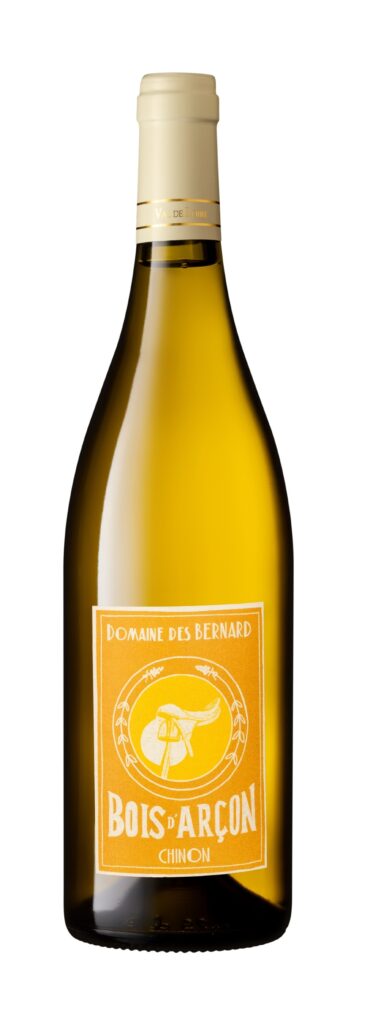
Bois d’Arçon 2023 is the estate’s second white wine. Its release brings the share of white wines in total production to 25 percent—an unusually high figure for Chinon, suggesting something more deliberate than a mere stylistic exercise.
The vines are thirty years old. They are planted on clay-loam soil with limestone at depth, in the eponymous vineyard site. This soil profile—clay on the surface for water retention, limestone in the subsoil for drainage and minerality—is one of the classic terroirs for Chenin in the Loire Valley, more often associated with neighboring appellations (Vouvray, Montlouis, Savennières) than with Chinon. This is precisely what makes the project so distinctive: the Domaine des Bernard does not seek to imitate the whites of the Layon. It produces a Chenin from Chinon, working with the local lithology.
Wine production is carried out without any added ingredients. The grapes, harvested by hand into small crates, are slowly pressed in a pneumatic press after a light settling. The slow pace of pneumatic pressing is no mere detail: it reduces the extraction of bitter compounds from the skins, preserves the wine’s aromatic finesse, and produces a cleaner juice than rapid pressing. Fermentation—both alcoholic and malolactic—takes place in stainless steel tanks, with no additions. Aging lasts seven to eight months on fine lees, always in stainless steel. This choice of container is an aromatic decision: whereas oak barrels or concrete tanks influence texture, stainless steel preserves the primary character, the immediate fruit, and the tension of a vintage.
Malolactic Fermentation in White Wines
Malolactic fermentation (MLF) transforms malic acid—which is harsh and sharp—into lactic acid, which is smoother. In dry white wines from the Loire, whether to allow MLF to occur or to halt it is a fundamental decision: letting MLF run its course, as we’ve done here, rounds out the texture and reduces the perception of acidity on the palate. With a Chenin that is naturally high in acidity—pH 3.3 for the 2023 Bois d’Arçon, with residual sugars at 0.3 g/L—this decision helps make the wine more approachable without compromising its structure.
The 2023 vintage saw rainy weather during the harvest, which resulted in grapes with thin skins. For a grape variety like Chenin, thin skins mean less potential extraction during pressing and a naturally more delicate juice. The estate managed this climatic factor through a gentle processing method rather than chemical adjustments.
At 16 euros, Bois d’Arçon positions itself as a deliberate entry-level offering in a “carte blanche” that, in Chinon, has yet to be written. The question raised by this estate is not whether Chenin can succeed in Chinon—the appellation’s great white wines have already answered that. Rather, it is whether an estate can forge a dual identity within an AOC whose commercial narrative remains entirely monochromatic.
Cette publication est également disponible en :

