
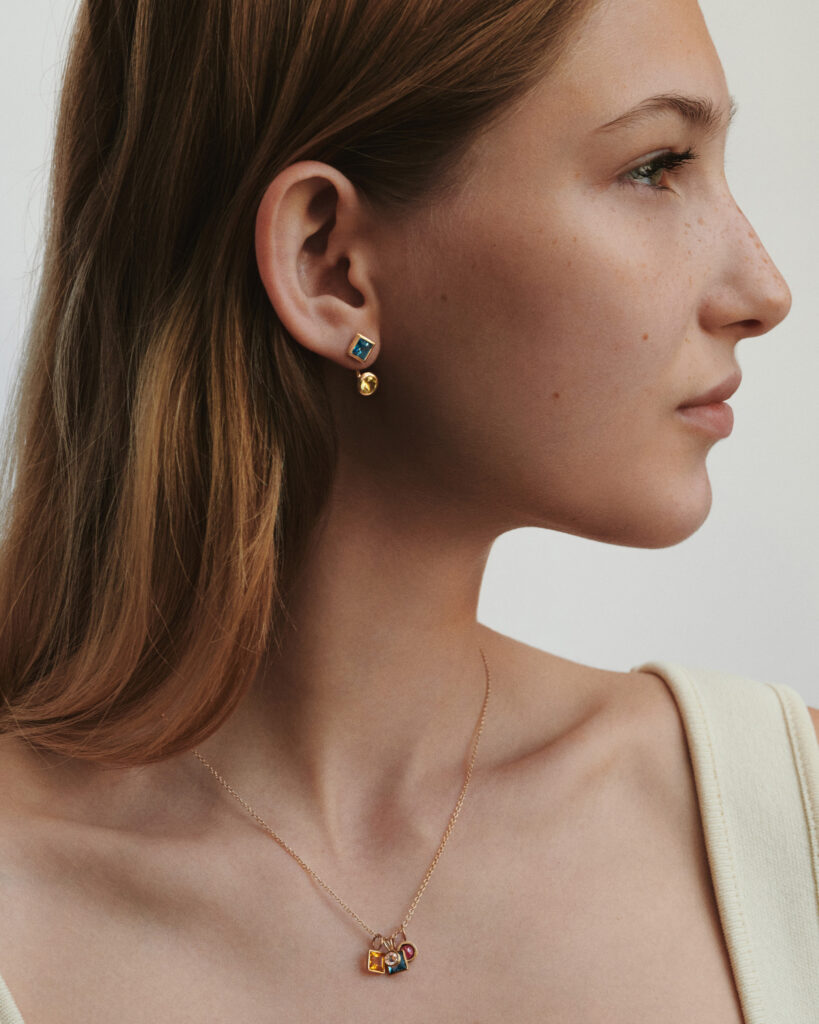
Created in 2017 by designer Aurélie Bidermann for Poiray, the Lolita collection returns at the forefront of a summer selection. Each stone imposes its own geometry — a way of telling the story of colour without ever naming it as a selling point.
A street, a name, a chosen direction
Poiray was founded in 1972 by François Hérail and Michel Ermelin, but its story truly began in 1975, when the two founders set up on Rue de la Paix, a few steps from Place Vendôme. The name they chose refers not to a jeweller, but to Paul Poiret, the early twentieth-century couturier whose Art Deco lines had made an impression on them both. From the outset, this choice placed the house in a textile and graphic lineage rather than a strictly gemmological one — a way of distinguishing itself from Place Vendôme’s expected vocabulary from the very beginning.
The gadroon as a recurring motif
In 2017, the house launched two collections with literary allusions simultaneously: L’Attrape-Cœur and Lolita. The latter, designed by Aurélie Bidermann, revisits the rounded gadroon, a motif the house has explored since its beginnings. Designed to be worn alone or layered, Lolita jewels combine colours freely: each stone corresponds to a distinct cut — square for blue topaz, round for rhodolite garnet, triangular for moonstone. The layering the collection encourages thus rests on a precise geometric rule, not simply on a chance combination of shades.
This systematic logic — one shape per colour, one colour per mood — explains the collection’s longevity. Nearly ten years after its launch, Lolita has not needed reinvention to remain wearable: adding a stone or layering another strand is enough for the whole to keep working.
This way of organising colour through shape sets Lolita apart from a simple seasonal collection. Where many houses treat colour as a covering, added each summer to an unchanged structure, Poiray makes it a component of construction: removing a geometry would mean removing a shade, and vice versa. The collection therefore offers less a range of colourful jewels than a method for thinking about layering without disorder.
A summer selection that goes beyond a single piece
For this summer selection, the house pairs Lolita with Cœur Entrelacé bracelets and the Ma Première watch, whose interchangeable-strap principle — devised in the house’s Paris workshops back in 1987 — continues to shape a large part of its jewellery-watch production. Together, the three pieces outline the same idea: jewellery conceived as a system in which colour, motif or strap can be exchanged without ever calling the original structure into question.
This principle of interchangeable elements, whether applied to a watch strap or a coloured stone, implicitly defines Poiray: less a collection of fixed pieces than a grammar of combinable elements, leaving each wearer to write her own sentence. A watch passed down, a bracelet layered, a stone added: the house sells less a finished object than a vocabulary each wearer expands at her own pace, over several years rather than a single season.
Detail — In the Lolita collection, each gemstone colour has its own cut: square for blue topaz, round for rhodolite garnet, triangular for moonstone.
The question remains open as to what the house will add next year to this grammar of stones and shapes — a fourth colour, a new cut, or simply the continuation of a layering principle that, since 2017, has not needed renewal to remain relevant.


Cette publication est également disponible en :


