
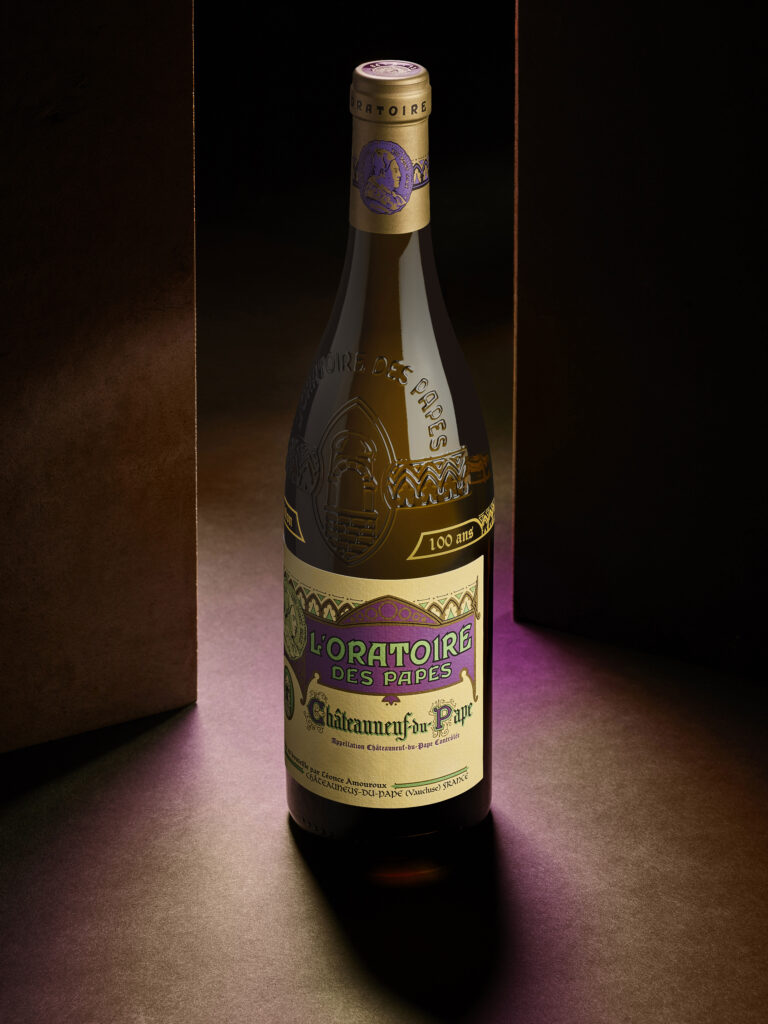
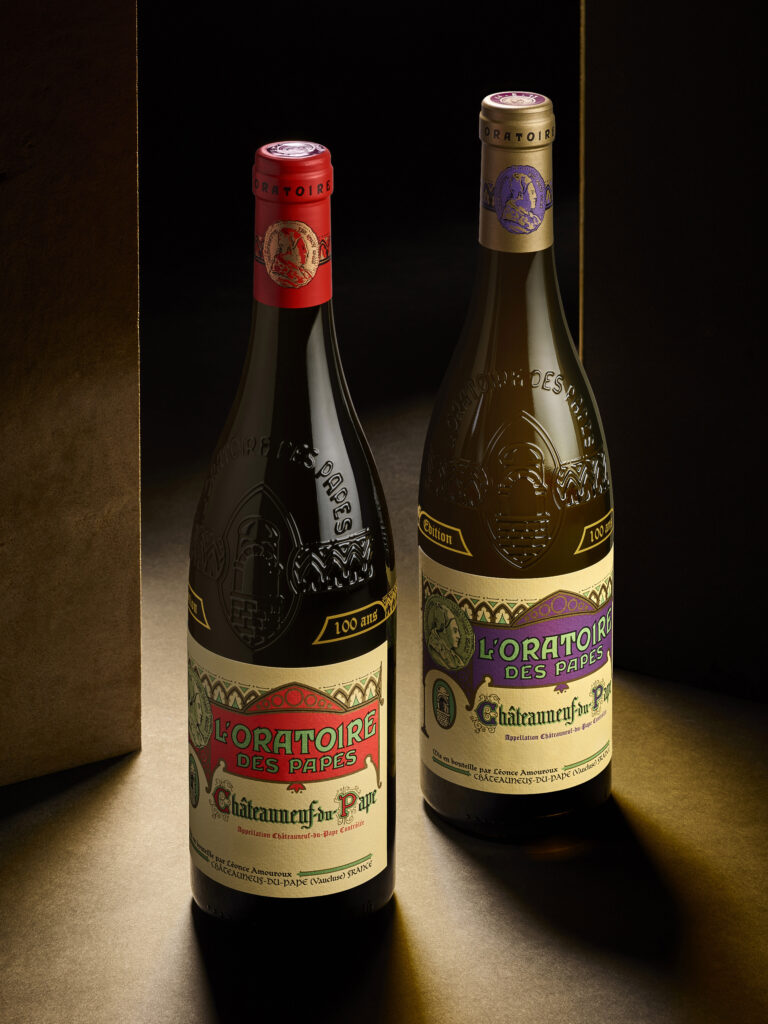
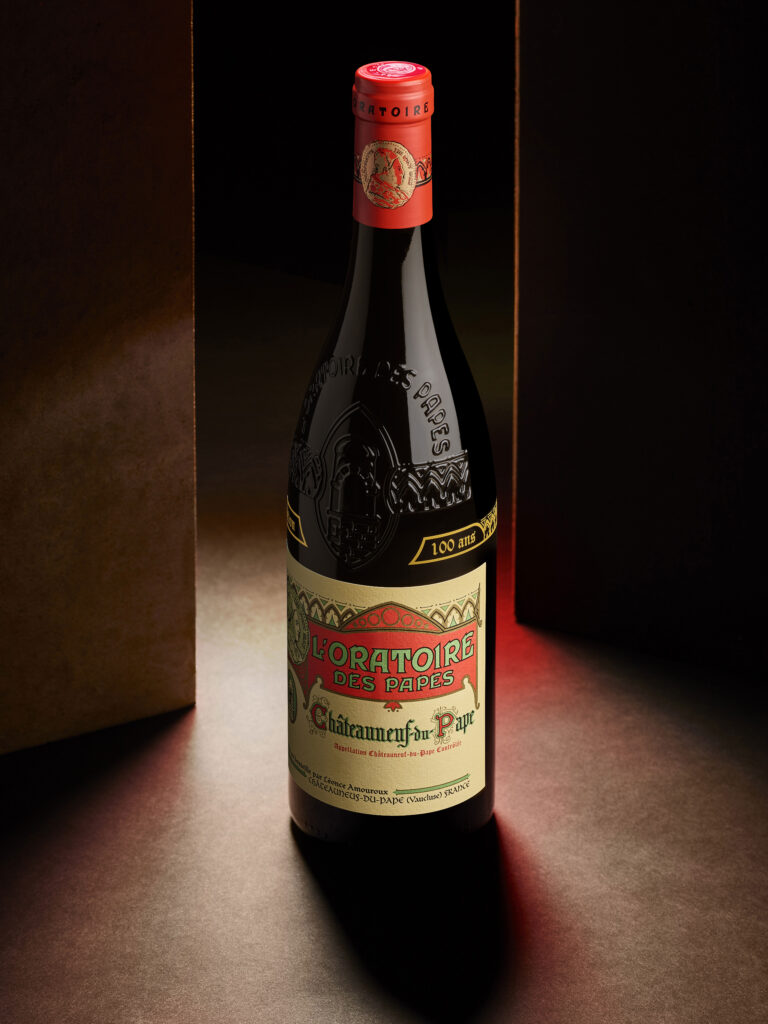
In Châteauneuf-du-Pape, certain labels have come to be more than just packaging: they’ve become an architectural symbol. The label for L’Oratoire des Papes belongs to that rare category of graphic designs that have spanned the century without succumbing to forced modernization. In 2026, the House will celebrate the centennial of this neo-Gothic motif—inspired by Art Deco—with a limited edition applied directly to the glass. It is a subtle way of reminding us that in Châteauneuf, heritage is not limited to rounded river pebbles or old vineyards; it also encompasses printed designs, visual traditions, and the objects that have accompanied wine culture for several generations.
The story officially begins in 1926, the year the name was registered and this label—featuring a design structured around columns inspired by Provençal cloisters—first appeared. At the time, Art Deco was making its mark with geometric lines throughout Europe: in railway architecture, transatlantic furniture, and commercial typography. In Châteauneuf-du-Pape, this aesthetic style encountered a region that was still largely rural. The result was an instantly recognizable identity that, over the decades, has become a visual hallmark of Rhône wine for export.
This centennial could have been the occasion for a grand heritage campaign. Instead, the House opted for a minimalist approach: a gold screen print applied directly to the bottles of the 2025 Blanc and 2024 Rouge vintages. No redesign. No exercise in nostalgia. Just an emphasis on the original lines. This detail speaks volumes about a broader trend in the world of contemporary wine: major wine houses are no longer seeking merely to modernize their image, but to solidify their graphic heritage as a cultural asset in its own right.
For behind this celebration of aesthetics lies a more contemporary interpretation of the Châteauneuf-du-Pape terroir. Since 2008, the vineyards of L’Oratoire des Papes have been farmed organically using natural fertilizers, site-specific vineyard management, and the development of agroforestry practices under the leadership of Edouard Guérin. This approach is not presented as an ideological break but rather as a quest for balance between soil and climate—an important nuance in an appellation long dominated by intense sunshine and generous extraction.
The 2023 red perfectly illustrates this stylistic evolution. The blend of Grenache, Mourvèdre, Syrah, and Cinsault is partly based on whole-cluster fermentation—accounting for 60% of the batch—made possible by the vintage’s excellent fruit quality. In the southern Rhône, this technical choice profoundly alters the wine’s balance: greater aromatic tension, more upright tannins, and a more distinct floral expression. The wine is then aged for twelve months in truncated-cone-shaped French oak vats, followed by eight months in concrete. Here again, the details matter: the concrete maintains thermal inertia without imposing the aromatic character of new wood.
The 2024 white wine follows a similar approach to precision. The blend consists of six grape varieties—Clairette, Roussane, Grenache Blanc, Bourboulenc, Piquepoul, and Picardan—with whole-cluster pressing and aging on lees carried out primarily in concrete tulip-shaped tanks. The soils, 90% composed of limestone fragments, account for the distinct saline character evident in the wine’s profile. In a region historically associated with age-worthy reds, this pursuit of mineral freshness in the whites also reflects the gradual shift in international expectations.
The subject thus extends far beyond wine itself. Through this anniversary edition, L’Oratoire des Papes demonstrates how a historic winery can blend graphic heritage, agronomic adaptation, and a contemporary interpretation of taste without turning its legacy into a static backdrop. This is likely where true luxury in winemaking lies today: not in the spectacle of prestige, but in the ability to maintain a clear sense of cultural continuity despite climatic, aesthetic, and economic upheavals.
In the cave cellars of the 16th-century priory, where the vats still stand, time moves slowly. The label, meanwhile, simply continues to stand the test of time. Much like certain public buildings or French railway posters: objects designed to outlast the trends around them.
Cette publication est également disponible en :

