
In Margaux, some estates live in the shadow of the 1855 classification. Château Siran belongs to a rarer category: that of estates whose absence from the classification has become an integral part of their identity. Blending aristocratic heritage, artistic culture, and agronomic modernization, the Miailhe family’s estate offers a unique perspective on the contemporary Médoc.
In the world of Bordeaux wine, history is often shaped by classifications. In Margaux, however, one of the appellation’s most respected estates owes its uniqueness to an absence.
Château Siran is not listed among the 1855 Classified Growths.
Not because its terroir didn’t deserve it—as family tradition holds—but because its owners at the time, the Toulouse-Lautrecs, reportedly refused to participate in what they considered a classification associated with the regime of Napoleon III. More than a century and a half later, this decision continues to shape the estate’s identity. While other châteaux base their reputations on an official hierarchy, Siran has built its identity on a form of historical independence.
The estate’s history, however, dates back well before 1855. The name “Siran” appears in the Médoc archives as early as 1428. The vineyard then passed through the hands of several aristocratic families before becoming part of the family estate of the ancestors of the painter Henri de Toulouse-Lautrec. In 1859, the property was acquired by Léo Barbier, a Bordeaux wine merchant, before gradually being taken over by the Miailhe family, who are now the sixth generation to manage it.
But to reduce Siran to his history would be to miss the point.
Because the true subject of the estate is the land.
South of the Margaux appellation, on the Labarde plateau, the vineyard spans twenty-five hectares in a single block. Such a contiguous plot is a rarity in the Médoc. The vines grow on ancient alluvial deposits covered with fine siliceous gravel, a legacy of the geological processes that shaped the Gironde estuary. The plateau’s natural slope, ranging from four to thirteen meters, ensures consistent drainage, while the proximity of the Gironde River helps moderate extreme weather conditions.
Since taking over as head of the estate in 2007, Édouard Miailhe has chosen to approach this heritage from a more agronomic rather than historical perspective. A large-scale replanting program was launched. Soil studies were expanded. The selection of rootstocks was reevaluated to address the challenges of global warming. The goal is not to preserve a vineyard in its current, static state, but to maintain the harmony between grape varieties and terroirs.
This approach is reflected in the vineyard’s grape varieties. Merlot accounts for 46 percent of the vineyards, followed by Cabernet Sauvignon at 44 percent. But Siran’s true signature lies in the prominence given to Petit Verdot, which makes up 9 percent of the vineyard and can account for up to 10 percent of certain blends. In the Médoc, few estates boast such a significant presence of this late-ripening variety, which is demanding but particularly well-suited to the warm gravel soils of the Labarde Plateau.
Detail
- Vineyard: 25 hectares in Margaux.
- Soils: fine siliceous gravel on ancient alluvial deposits.
- Grape varieties: 46% Merlot, 44% Cabernet Sauvignon, 9% Petit Verdot, 1% Cabernet Franc.
- Planting density: 10,000 plants per hectare.
- Oldest plot: 1920.
- Aging: Twelve to fourteen months in French oak barrels, with approximately thirty-five to thirty-eight percent new oak.
The transformation undertaken by the Miailhe family is not limited to the vineyard. The cellars have been modernized on several occasions, notably with the installation of new tanks that allow for more precise winemaking and the complete renovation of the aging facilities. Technical Director Marjolaine Defrance now leads an approach based on a detailed understanding of each vineyard plot, daily observation of the vines, and a judicious limitation of inputs. The estate is also experimenting with practices inspired by organic farming and participates in research programs dedicated to biodiversity in the Margaux appellation.
However, what truly sets Siran apart in the Bordeaux wine region is neither its grape varieties nor its investments.
It’s his connection to culture.
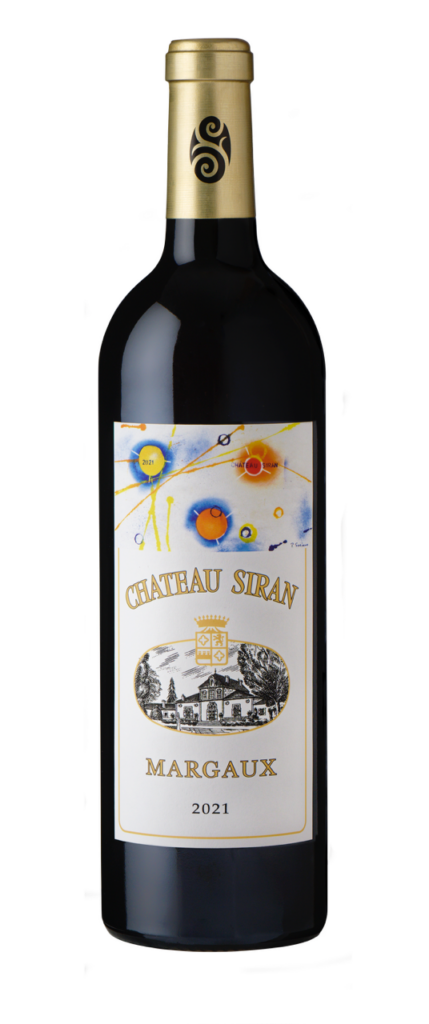
Since the 1980s, the estate has been building a collection of labels illustrated by contemporary artists. This tradition, started by Alain and Brigitte Miailhe, is a rarity in a region where bottle labels rarely change. The 2021 vintage continues this tradition with a work by the Franco-American artist Peter Soriano.
The choice of theme is no accident. Soriano, whose work explores, among other things, the effects of climate change on glaciers and polar landscapes, has created a composition inspired by space, the solar system, and the fragility of the contemporary world. The label thus becomes more than just a graphic element: it is a visual testament to an era marked simultaneously by space exploration and environmental concerns.
This convergence of contemporary art and winemaking perhaps illuminates Siran’s uniqueness better than anything else. The estate has never sought to replicate the classic model of a Médoc grand cru. Its identity has been forged through an ongoing dialogue between heritage and adaptation.
At a time when Bordeaux is questioning its future, Château Siran reminds us that a great terroir is not merely a legacy. It is a living entity, capable of evolving without betraying its roots.
And sometimes, in the Médoc, the most interesting stories are precisely those that have unfolded outside the rankings.
Cette publication est également disponible en :

