
At the foot of the Montagne Noire, white wine isn’t a given here. For a long time, the Minervois region was better known for its reds, its arid hills, its garrigue, its winds, and its soils capable of retaining heat. The Domaine de L’Ostal, however, has chosen to pursue a different path: that of a white wine built on freshness, moderate altitude, and the natural protection of the surrounding woods. In La Livinière, on the border between the Aude and Hérault departments, this endeavor takes the form of a relatively new cuvée, first produced with the 2023 vintage, with 2024 marking its first vintage certified as organic according to the submitted documentation.
The Domaine de L’Ostal has been owned by the Cazes family since 2002, a detail that matters less for the prestige of the name than for what it implies: a Bordeaux-style long-term approach applied to a Languedoc terroir. The estate spans 150 hectares, including 60 hectares of vineyards and 25 hectares of olive groves, and produces several wines under the AOC Minervois, AOC Minervois La Livinière, and IGP Pays d’Oc designations. The very name “ostal,” derived from the ancient Occitan language, means both “house” and “family group”—an etymology that is almost too fitting for an estate that approaches wine as a place before presenting it as a bottle.
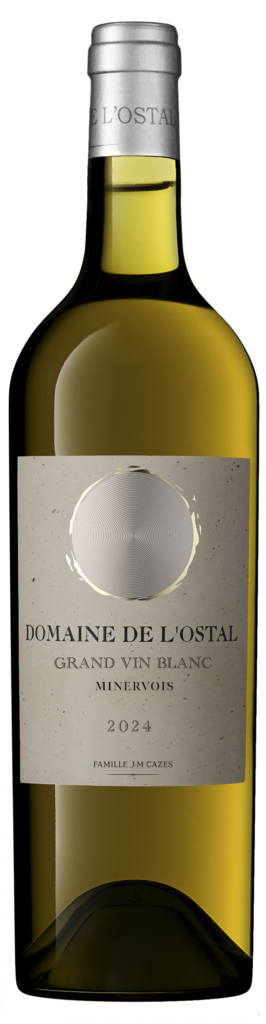
The 2024 Grand Vin Blanc is made from four grape varieties: Roussanne, Marsanne, Viognier, and Muscat. The blend itself already reveals the winemaker’s intention. Roussanne and Marsanne provide structure and depth, Viognier lends the wine a more floral character, and Muscat brings an immediate aromatic intensity. The plots mentioned in the dossier are located on hillsides, at an altitude of around 150 meters, on deep, cool soils. In a region of southern France often defined by ripeness, this choice of freshness becomes a statement of style.
The winemaking process reinforces this approach. After being hand-harvested, the grapes are pressed whole to ensure gentle extraction. Each grape variety is then aged separately in barrels for seven months before blending. This batch-by-batch winemaking is no mere formality: it allows each variety to retain its identity before seeking the final balance. Here, the oak is not meant to dominate, but rather to enhance the texture and length.
In the glass, the estate describes the 2024 vintage as having a golden color, with a nose of citrus, yellow-fleshed fruits, and a floral note. On the palate, it unfolds with a full-bodied texture, supported by acidity, and a finish designed to carry the wine well into the future. The profile suggests aging potential; the technical precision of the aging process and the composition of the blend make this promise plausible, without the need to overstate it.
This white wine from the Minervois says a great deal about the Languedoc of today. It is no longer just a region of intense sunshine, but a laboratory of nuances, where freshness is not merely a contemporary fad: it has become essential to the wine’s character. At the table, the Grand Vin Blanc 2024 will naturally pair well with Mediterranean fish, creamy poultry dishes, roasted vegetables, or soft cheeses. But its true appeal lies elsewhere: in the way it allows a softer, more restrained, almost mineral-like voice to come through under the southern sun.
Cette publication est également disponible en :

