
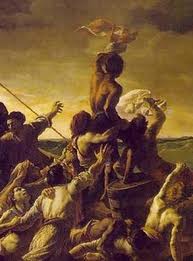
The Musée d’Art Roger Quillot in Clermont-Ferrand offers art lovers some precious moments. This summer, and more precisely until September 2, it offers a glimpse of Géricault’s ingenuity, and an incredible focus on his creative approach. Curated by Bruno Chenique, an eminent specialist on the artist, the exhibition offers a real insight into the world of the genius. Visitors can immerse themselves in the artist’s creative process.
The initial premise is ambitious: to perceive all Géricault’s dexterity, aesthetic and ethical choices through the elaboration of The Raft of the Medusa. This fundamental work, dated 1819, is a turning point in the history of art. A stylistic turning point (as the initiator of Romanticism in France), a thematic turning point (through the omnipresence of a contemporary and impacting ‘news’ story), it was an almost instant success. Produced between 1818 and 1819, and exhibited at the 1819 Salon under the censored title Scène de Naufrage, the canvas was omnipresent. Its sheer size, 5 by 7 meters, is imposing. In opposition to the neoclassicism so popular at the beginning of the 19th century, the work sets itself up against all preconceived ideas. A bold digression, it transports the viewer.
Based on a real event, the sinking of the raft Méduse, the work oscillates between a reconstruction of the facts and an ethnological presentation of the event. The frigate Méduse proves to be at the heart of the story. Sent to Senegal by Louis XVIII to consolidate his authority, it ran aground along the Senegalese coast on July 2, 1816. Human error appears to have been the cause. The captain, Hugues Duroy de Chaumareys, had not sailed for 25 years when he agreed to undertake this voyage. On board the ship were 400 people, including a few civil servants, the crew and two companies of soldiers. The latter, testimony to the aborted Empire, were exiled, so to speak, by the returning Monarchy. This scrupulous analysis of the facts is supported by a book written by two survivors, Corréard and Savigny. Respectively engineer-geographer and ship’s surgeon, the two men raised public awareness as early as 1817, when they described the loss of life and cannibalism on board the frail vessel.
Géricault was undoubtedly one of the first readers, and as early as March 1818 he began work on the first studies for the work. This drama undoubtedly made a powerful impression on him.
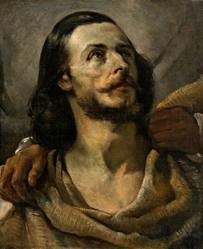
The Musée Roger Quilliot is at the heart of the plot. The exhibition revolves around a preparatory painting. It depicts Gerfant, a famous model of the time. The painting has been in the municipal collections since 1861. Initially attributed to Géricault, it was de-attributed in the 1970s under the influence of art historian Lorenz Eitner. In 1972, writing a book on Le Radeau de la Méduse, he made no mention of this study head.
The ‘rehabilitation’ began in 2007. It became inevitable with the analysis undertaken by Lumière Technologie. Lumière Technologie applied the Layer Amplification Method (LAM), enlarging the underlying pictorial layers by a million times. Pigments become highly perceptible, enabling certified identification. Each artist has a very specific palette of pigments, inherent to his or her work. This reveals itself as a signature in its own right. What’s more, multispectral scanning has revealed a portrait of a woman in an underlayer. The stylistic, pigmentary and thematic elements enabled Bruno Chenique to authenticate the work.
The new process developed by Pascal Cotte and Jean Pénicaut will undoubtedly facilitate the work of art historians.
At the entrance to the building, visitors are greeted by a reproduction of The Raft of the Medusa. Imposing, it seems to recall the impact of the original painting, an impact perceptible as early as the Salon of 1819. From there, in addition to La Tête d’étude, 50 pieces – studies, paintings and sculptures – are on view. Five of them, previously unseen in private collections, are presented for the first time in a museum. All allow visitors to immerse themselves in the catastrophe and the Géricaldian approach. Grouped thematically, they captivate the eye. Firstly, the preparatory sketches for the Raft of the Medusa feature muscular backs, almost in the style of Michelangelo. 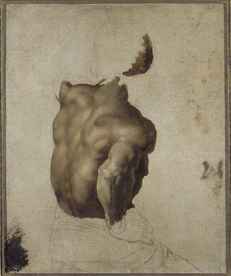 They show the hesitant staging of the action. This captured moment, the arrival of the Argus, the fleet ship that has come to rescue them, is the climax of the adventure. Only 15 survivors remain on the raft. The moment is intense. The tangle of bodies, the surges of hope, everything is analyzed. Piece by piece, like a construction set, the work unfolds.
The second part concerns bodies. Drawings and sketches in graphite, red chalk and black pencil sketch bodies and faces. These are attitudes captured in the heat of the moment. The models lend themselves to the game. 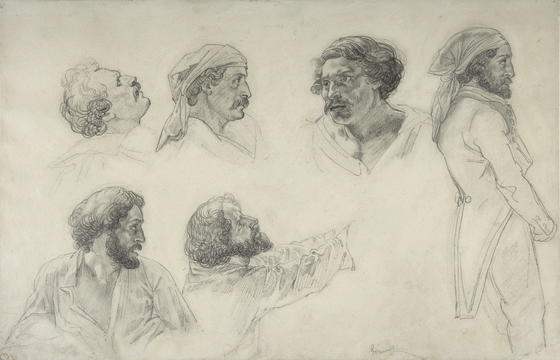
A third, entitled L’Atelier du Monde, captures Géricault’s interest in otherworldly appearances. Portraits of blacks, Orientals, shipwrecked sailors, etc., allude to his attraction to elsewhere. Underneath, he evokes his involvement in the cause of the oppressed. Indeed, on this raft, he painted the 15 survivors. 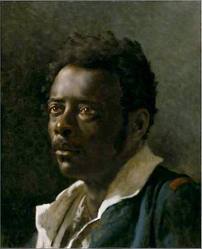 Soldiers of the Bataillon du Sénégal or crew members discredited by their social or ethnic background, they were left to fend for themselves. Géricault pays tribute to them. Better still, he becomes involved and defends the cause of men of color. Where Corréard and Savigny’s account mentions one black man, Géricault paints two. He even goes so far as to add a half-breed. At a time when the slave trade was still tolerated, and the abolition law of April 5, 1818 not always applied, the gesture is significant. The Tête d’étude or portrait of Gerfant provides a further clue. Surrounding Gerfant’s shoulders are two dull hands. They appear to belong to a mixed-race or black person. Géricault, like Benjamin Constant, Lafayette and Abbé Grégoire, defended this just cause, but through unusual mediums.
Reexamined in the light of these new elements, Le Radeau de la Méduse becomes a political work of protest. The shipwrecked men’s eagerness to save themselves seems to reflect the advance of history.
The fourth focuses on human fragments.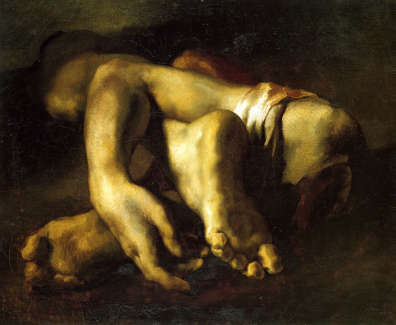 From March-October 1818, Géricault strove to capture the aesthetic meaning and complexity of human limbs. Arms, legs, heads, fleshy human body parts. With the help of phrenologist Dumoutier, among others, he was able to approach corpses and study them more closely. His oil paintings are surprising. Through sensuality, he breathes a few more moments of life into the flesh. Nineteenth-century art critic Philippe Burty captured this fascinating ambiguity: “We know (…) a heap of disarticulated limbs that throw the soul into the deepest emotion; but we quickly forget the horror before the sublimity of the execution. (…) It’s a masterpiece because we sense, beyond all misunderstanding, that Géricault himself was moved in the presence of ‘that je ne sais quoi which no longer has a name in any language’.”
The final section lists some of the artist’s last works. By 1823, he had contracted tuberculosis. But he continued to create. 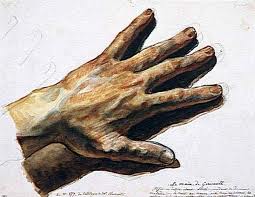 Drawings with his left hand, moldings with his right, etc., a number of self-portraits testify to his artistic commitment. A few works by friends and contemporaries represent him.
 In this captivating exhibition, Le Marq and Bruno Chenique give Géricault a special place in the 19th century. An artist against all odds, Géricault reveals himself as a citizen with a universality that was previously underestimated. The Raft of the Medusa, a figurehead of Romanticism, advocates equality and the friendship of peoples and men. Delacroix and other friends of Géricault are represented.
The choices made by curators Bruno Chenique and Anne-Charlotte Cathelineau are appropriate. Thanks to them, visitors have the sensation of ‘entering the painting’ and becoming part of the adventure. He becomes an actor and an integral part of the subject. The catharsis effect is proven. The scopic impulse, for its part, is heightened tenfold by the “tumultuous” aesthetics of the entangled bodies.
It would be a mistake not to come and admire this presentation at Le Marq. Don’t hesitate, you won’t regret the Clermont-Ferrand experience!
Musée d’Art Roger Quilliot- MARQ
Quartier historique de Montferrand
Place Louis-Deteix
63100 Clermont-Ferrand
Tel 00 33 (0)4 73 16 11 30
http://museedart.clermont-ferrand.fr
Exhibition Rendezvous
Guided tours – August Tuesday to Friday, 11 am and 3 pm ‘Géricault’s quest for the human’.
2nd and 4th Saturday of the month at 3 p.m.
Some hotel suggestions
Hôtel des Puys
Place Delille- Clermont-Ferrand
04 73 91 92 06
Suite Novotel
Avenue de la République- Clermont-Ferrand
04 73 42 34 73
Résidhome Gergovia
Avenue de la République- Clermont-Ferrand
04 73 74 74 00
And taste
Fleur de Sel
8, rue Abbé Girard,
63000 Clermont-Ferrand
04 73 90 30 59

Cette publication est également disponible en :

