
Owning a château in France goes well beyond a simple property transaction. It means entering the history of a territory while taking part in a market dynamic driven by a clientele in search of the exceptional and of tangible safe-haven assets.
A heritage charged with meaning
A château confers a particular status on its owners. These residences, often laden with strong symbolic value, embody history, architecture and French elegance. Owning a château means taking part in the preservation of a collective heritage, while giving oneself a setting for living that has no equivalent anywhere else.
Each château tells a singular story, tied to its region, to the period of its construction and to the families who lived in it. This narrative dimension forms an important part of its appeal, beyond mere architectural quality.
An extraordinary setting for living
Beyond its heritage dimension, the château offers a setting for living that few properties can match. Large reception rooms, wooded parks, remarkable architecture: these residences lend themselves as readily to family life as to hosting events or hospitality projects, combining art of living with heritage influence.
To picture it concretely, here is a selection of châteaux for sale chosen for their exceptional character and their heritage potential.
A market segmented by region
The French château market is characterised by strong regional disparity, each territory carrying a different stratum of history. The Loire Valley remains the absolute reference: land of the kings of France during the Renaissance, it saw the rise of residences conceived as architectural manifestos, surrounded by vineyards and game-rich forests that recall their original vocation as royal hunting residences.
In the Dordogne and the Périgord, the heritage is older and more defensive. The châteaux there still carry the memory of medieval conflicts and of the Hundred Years’ War, with their keeps, their watchtowers and their commanding positions over the valleys. It is a rawer stone, a more direct relationship with the terrain.
Burgundy, a former duchy that rivalled the kingdom of France, has preserved residences that are both defensive and refined, often linked to the wine route and to a tradition of hospitality dating back to the neighbouring abbeys. In Brittany and Normandy, the châteaux tell another story, that of great maritime families and independent duchies, with a more massive architecture, designed to withstand winds and sea spray.
Finally, in the Île-de-France and around Paris, the châteaux bear witness to the proximity of central power: residences of courtiers, aristocratic hunting lodges or homes built to rival the court, today sought after for their accessibility from the capital. This heritage geography allows each buyer to choose a region according to the history that resonates most with their own life project.
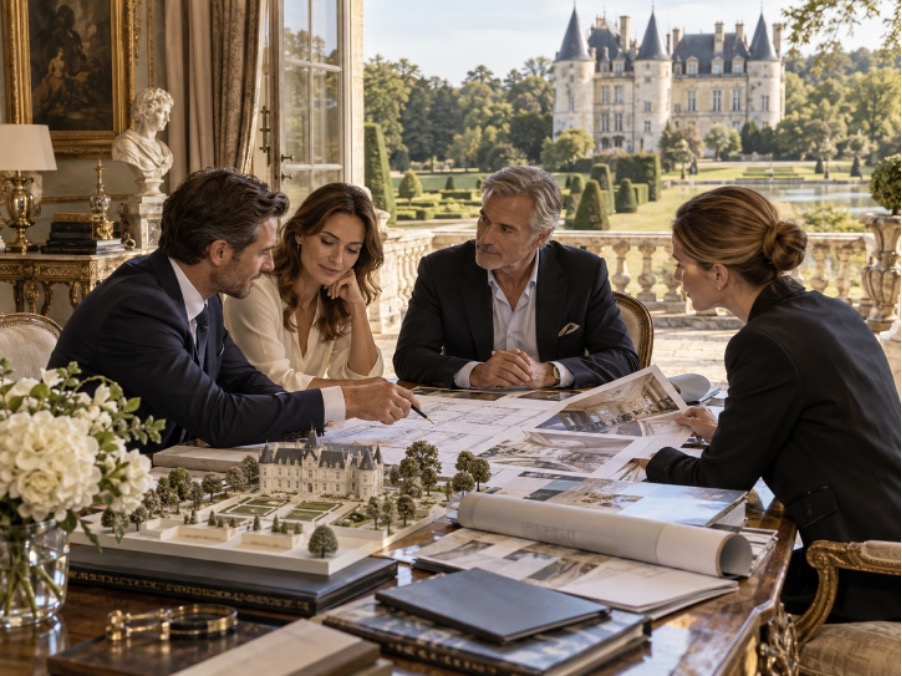
A life project as much as a heritage strategy
Investing in a château is not a simple property acquisition. It is a heritage strategy in its own right, driven by the wish to create value through the family and cultural history of the place. This territorial anchoring profoundly transforms the relationship to risk: unlike other asset classes, the château belongs to a long cycle of appreciation, more insulated from market variations.
For many owners, acquiring a château also becomes a family project of transmission, a heritage one shapes for the generations to come, while living in it fully in the present.
What are the steps to buy a château?
Acquiring a château does not follow the course of a conventional property transaction, and surrounding oneself with the right counterparts from the outset conditions the serenity of the whole project.
Define the project before searching
Everything begins with a simple but structuring question: will the château be a private residence, a family home, or the base for a hospitality project, boutique hotel, receptions, wine estate? This reflection then guides the choice of region, of the size of the property and of the level of heritage protection sought.
Surround yourself with specialist experts
The château market is a niche market, where the support of an agent specialised in prestige properties makes all the difference in identifying the properties that are genuinely available and understanding their history. Throughout the process, a notary accustomed to historic properties, a heritage architect and a tax adviser become indispensable partners, particularly when the property is listed or registered as a Monument Historique.
Check the heritage status and the condition of the château
Before any offer, it is advisable to check whether the château is listed, registered on the Supplementary Inventory of Historic Monuments, or unprotected, this status determining the possibilities of future alterations and the involvement of the Architecte des Bâtiments de France. An in-depth assessment of the building, complemented by the usual surveys, also makes it possible to gauge the soundness of the property before committing.
Cette publication est également disponible en :


