
On the slope that never faces the sun directly, the grapes ripen more slowly. Since 1874, the Duménil family has made this a guiding principle of their winemaking. Frédérique Poret-Duménil, representing the fifth generation, carries on this tradition with a precision that owes as much to geology as it does to family heritage.
The Montagne de Reims is not homogeneous. Its northern slope—Chigny-les-Roses, Ludes, Rilly-la-Montagne—operates on a principle opposite to that of most major wine-growing regions: the lack of direct sunlight slows ripening, lengthens phenological cycles, and preserves acidity. What others consider a constraint, Duménil has transformed into a defining characteristic. The estate’s 8 hectares, classified as Premier Cru, are spread across these three villages and feature a geology consisting of five superimposed layers: chalk, marl, sand, silt, and fine clay. The subsoil, irrigated by natural springs rich in calcium chloride, is worked through scarification and light plowing to encourage deep root growth—with the roots drawing directly from this minerality.
The forest overlooking the plots is not merely a backdrop. It regulates temperatures in both summer and winter and acts as a thermal barrier against storms. These combined factors—exposure, stratified soil, and the forest’s regulating effect—form the geological framework upon which Frédérique Poret-Duménil builds her assemblages.
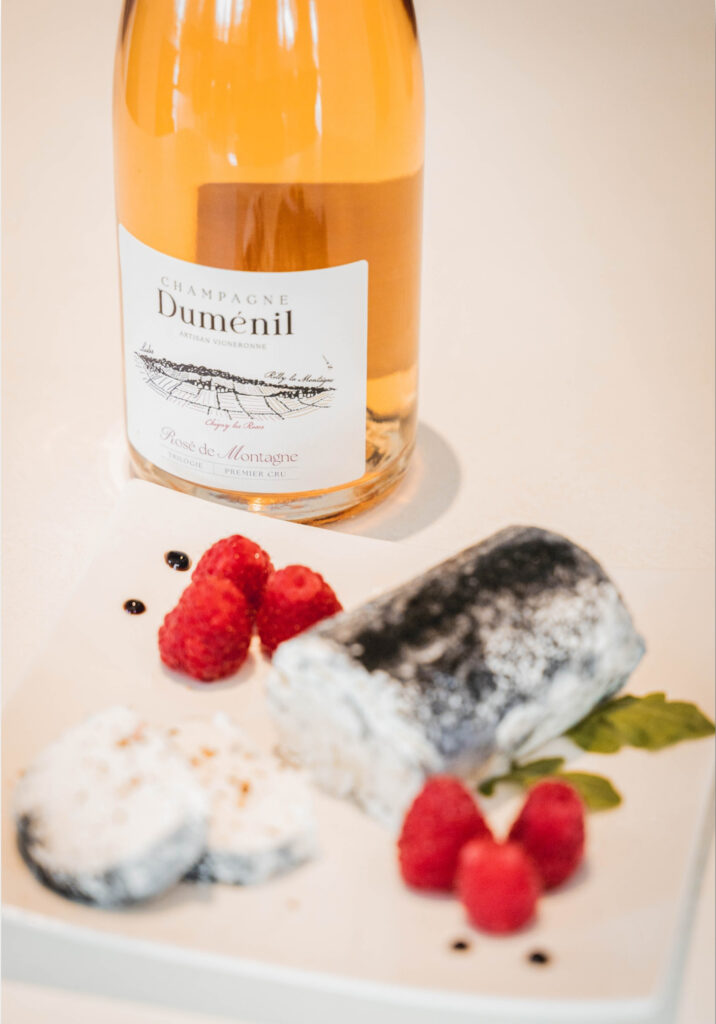
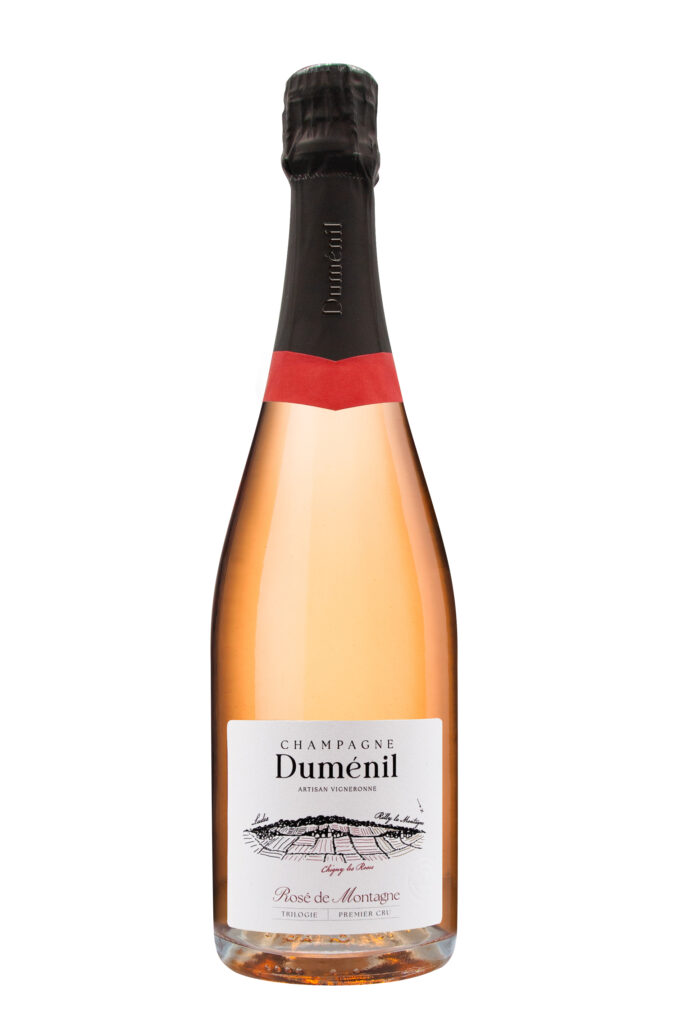
Rosé de Montagne is the clearest example of this method. It is made from three Champagne grape varieties in strictly equal proportions: Meunier, Pinot Noir, and Chardonnay—one-third each. Chardonnay in this area has a specific history: it was Cécile Duménil, Frédérique’s grandmother, who introduced it here as early as 1969 to create, according to family lore, “timeless vintages.” Sixty years later, the vines planted at that time have an average age of between 30 and 50 years. The red wine used in the blend—7 to 8%—comes exclusively from the “Les Beaunes” plot in Ludes, from Meunier vines planted by Cécile in 1958. Sixty-eight years of vine age for less than one-tenth of the final volume: the logic of the relationship between age and concentration is clearly embraced here.
“When crafting this wine, I focus more on fruit than on intensity. The two-thirds blend of red grape varieties builds the structure around a lovely, rich body. The remaining one-third of Chardonnay adds a touch of freshness to the melody, illuminating it with that elegance so characteristic of our northern slopes of the Montagne,” says Frédérique Poret-Duménil.
The principle of immediate pressing: two Coquard presses with inclined plates (4,000 and 8,000 kg, with variable capacity) allow the pressure to be adjusted for each plot. The rule is absolute—“as soon as the grapes are picked, they are pressed”—to limit oxidation and preserve the primary aromas. The juices are then transferred to temperature-controlled stainless-steel tanks for alcoholic and malolactic fermentation. The Rosé de Montagne ages for five years on its lees before disgorgement, followed by four months of rest. The dosage is made using a liqueur based on reserve wine and cane sugar, according to a recipe specific to each cuvée—Frédérique Poret-Duménil refers to an “orgue à liqueurs” in the cellar to describe the precision instrument that calibrates this final step.
At Duménil, blending is considered the heart of the craft. “The art of blending requires a diverse supply of grapes and a thorough understanding of one’s terroirs. Each blend is created according to a secret recipe that is passed down from one generation to the next,” explains Frédérique. This tradition spans five generations, beginning with Élie Duménil, who, in 1874, was among the few Champagne winemakers to produce his own wines for sale—at a time when winemaking was still the exclusive domain of wine merchants. In the 1920s, his descendant Émile-Paul was already offering the Rosé cuvée to customers at a bistro in Chigny-les-Roses: local wine as a community offering, long before this approach became a market strategy.
Current production stands at 80,000 bottles per year, distributed equally between the French market and export markets. The wine library, established starting with the 1999 vintage, preserves the estate’s aromatic legacy from generation to generation.
In the Champagne region, where the market is dominated by the major houses that blend hundreds of crus, the Duménil approach is different: three villages, 30 plots, and a single family. The constraints of this small territory—on a slope that receives little attention in the appellation’s official marketing—have become the guiding principle for a style that the north-facing exposure has made impossible to replicate elsewhere.
Cette publication est également disponible en :

