
Some vintages tell the story of a grape variety. Others tell the story of a place.
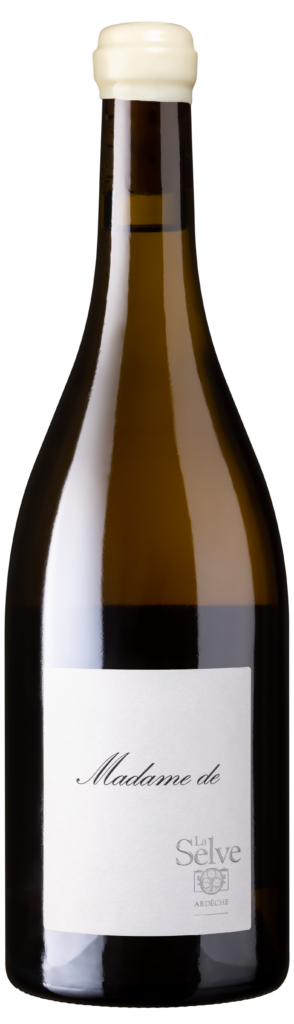
Madame de 2023, produced by Château de la Selve in the Ardèche IGP, clearly falls into the second category. Behind this almost literary name lies a limited production of 2,500 bottles and 80 magnums, all from a single vineyard: Ribeyrettes.
This choice reflects a contemporary approach to wine. While Viognier is often sought after for its immediate aromatic expression, this cuvée focuses more on its ability to convey the character of the landscape.
The vineyard is located on a hilltop at an elevation of 123 meters. Its subsoil consists of montmorillonite clay, a type of clay that swells when exposed to water and then shrinks during dry periods. In a Mediterranean climate characterized by significant temperature fluctuations between day and night, this characteristic becomes a key factor in the vineyard’s water management.
The vineyard is managed according to the principles of organic and biodynamic farming and holds Biodyvin certification. The eighteen-year-old vines yield approximately thirty-five hectoliters per hectare, a moderate yield that promotes concentration without seeking excessive extraction.
The winemaking process continues this approach of restraint. The grapes are harvested by hand and then pressed immediately. Fermentation takes place with native yeasts in demi-muids that have previously held up to eight vintages. This detail is worth noting: the use of older barrels significantly limits the aromatic impact of the wood and allows the fruit and terroir to express themselves more fully.
The wine is aged for twelve months on fine lees. Here again, the technique is intended less to enrich the wine than to give it additional texture and depth.
Detail
- Variety: Ribeyrettes.
- Area: fifty ares.
- Soil: montmorillonite clay.
- Grape variety: 100 percent Viognier.
- Farming: Organic and biodynamic, certified by Biodyvin.
- Fermentation: indigenous yeasts in demi-muids.
- Aging: twelve months on fine lees.
- Production: 2,500 bottles and 80 magnums.
Beyond the technical data, this vintage is part of a broader trend observed in several French regions: the revival of age-worthy Mediterranean white wine. Its projected aging potential of ten to fifteen years reflects this ambition. Viognier is no longer viewed merely as a grape variety offering immediate aromatic expression, but rather as a wine capable of gaining complexity over time.
Perhaps the most interesting aspect is the paradox of this wine. Produced in a sunny climate, in the heart of the Ardèche garrigue, it emphasizes precision over power. It serves as a reminder that, in winemaking, heat does not preclude nuance; it simply makes it harder to achieve at times.
Cette publication est également disponible en :

