
At an event organized by VivaTech, a fashion house had an artificial intelligence studio describe, on stage, an experience in its own stores that was entirely generated by algorithms—without ever naming it. Just a few meters away, an agency was advocating the exact opposite: turning the absence of humans into a selling point in its own right.
An unsigned gesture
Adrienne Lahens heads Infinite Studios, an artificial intelligence platform serving brands, filmmakers, and creators, after spending fifteen years building TikTok’s creator ecosystem. She recounts, without naming names, the case of a fashion house for which her studio designed an in-store activation: a fashion enthusiast scans an item with their phone and unlocks an AI-generated cinematic experience, which they can then extend by co-creating their own version of a campaign featuring synthetic characters.
The object exists, and so does the device. What is missing—and what is the most revealing aspect of this encounter—is the absence of any claim to credit. The House agreed to the use of the object, funded the project, and opened its stores to the installation—but did not want its name to be associated with that of the tool that produced it.
The Assumed Opposite
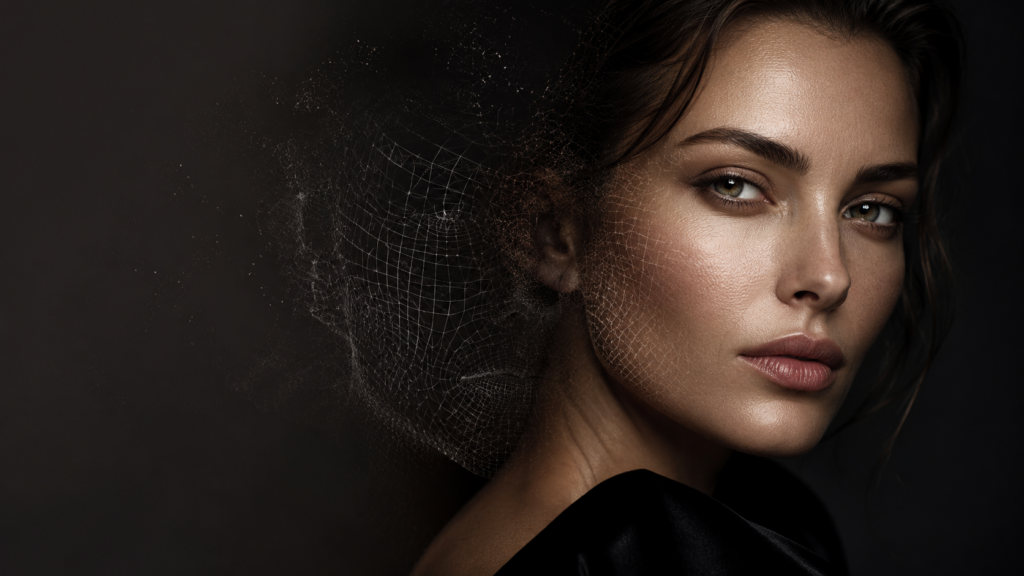
In contrast to this discretion, the Spanish agency The Clueless has built its entire value proposition on the constant assertion of artifice. Aitana López, a model generated by an antagonistic generative network and launched on July 17, 2023, now earns up to 10,000 euros a month through brand partnerships. Her founder, Rubén Cruz, explains that Aitana’s non-human nature is not a weakness to be concealed but the very foundation of her value: A brand that signs a contract with her purchases total control over the character, without the risk that a human face might one day become associated with a scandal that would reflect poorly on the partnership.
Twenty people currently work at The Clueless, five of whom are dedicated exclusively to managing Aitana—a figure that, in and of itself, shows that the “synthetic model” is first and foremost a human job disguised as a finished product.
The Detail — Aitana López was launched on July 17, 2023, generated by a generative adversarial network (GAN). She earns up to ten thousand euros a month through partnerships, an income managed by a team of five people at The Clueless agency.
Trust as a Raw Material
Dara Ladjevardian, who heads the Delphi platform, operates in a third realm: that of verified clones of real people, rather than fictional characters. Coaches and authors—he cites Jay Shetty and Eckhart Tolle among the profiles featured on his platform—allow for the conversational reproduction of their thoughts, provided that strict safeguards prevent the clone from saying anything the person has never said or written. Ladjevardian emphasizes one point: Delphi does not sell a relationship, but rather access—just like a book or a filmed interview.
Three approaches, three relationships to the truth. The Spanish agency sells the transparency of artifice. The cloning platform sells verified likeness to a real person. The luxury brand, for its part, chooses silence—neither a lie nor a confession.
A framework that is already tightening elsewhere
This silence may not last much longer. In the United States, the agreement ratified in 2026 between the SAG-AFTRA union and the studios now governs the use of synthetic performers in audiovisual productions: a studio may use a synthetic actor for a role that a unionized actor could play only if it demonstrates “significant added value,” or else it will be required to negotiate—and the union cannot go on strike over this specific issue until 2030. Nothing comparable exists for luxury boutiques, campaigns, or event activations.
It took the film industry years of negotiations to turn a vague concern into a contractual clause. The luxury sector, which is already experimenting with the same technology within its own walls, has not yet had to address the question that Hollywood actors have finally begun to ask aloud: Who should say—and to whom—that a scene was never actually filmed?
Cette publication est également disponible en :

