
For two years, the tech industry has hailed coding assistants as the first tangible proof of a return on investment in artificial intelligence. However, despite the widespread adoption of solutions such as GitHub Copilot, Cursor, and Claude Code, the gains observed have remained relatively modest at the organizational level.
According to case studies presented by McKinsey & Company at VivaTech 2026, most companies have achieved only a 5 to 10 percent improvement in their overall productivity. This is a real improvement, but it is insufficient to justify the promises of disruptive innovation that accompanied the rise of generative AI.
The problem isn’t technological. It’s organizational.
The code has never been the real bottleneck
In a typical software project, writing code generally accounts for between 30 and 50 percent of the total effort.
The rest is taken up by a series of less visible but equally critical activities: drafting specifications, functional design, documentation, testing, validation, bug fixes, integration, and deployment.
The first AI assistants primarily sped up the development phase. A developer could produce more code in less time, but the overall organization of the project remained unchanged.
Result: a gain limited to a single stage in the value chain.
According to Stéphane Bout, a senior partner at McKinsey, it is precisely this approach that currently limits the actual impact of many AI programs.
The mistake is to add tools to an existing process rather than completely redesign the process around the agents’ capabilities.
From the augmented developer to the hybrid team
The real shift occurs when AI stops being a personal assistant and becomes a full-fledged member of the team.
McKinsey describes this new organizational structure as a hybrid human-agent model.
The principle is simple: to distribute each task among humans and agents based on their respective strengths.
Humans continue to be responsible for decision-making, arbitration, validation, and oversight.
Agents handle repetitive, analytical, or highly structured tasks:
- specification generation;
- technical documentation;
- writing tests;
- code analysis;
- implementation;
- quality control;
- error correction;
- preparation for deployments.
This distribution profoundly transforms the development cycle.
The challenge is no longer to help a developer code faster, but to create an organization where dozens of employees work simultaneously on different parts of the process.
When 100 agents replace a software factory
The most spectacular example presented at the conference concerned the modernization of the central IT system of a major international bank.
The challenge was considerable:
- more than 400 applications;
- several million lines of code;
- virtually no documentation;
- initial budget estimated at more than $600 million.
Rather than relying solely on human teams, McKinsey built an architecture consisting of more than 100 specialized agents.
Each staff member had specific expertise: Java developer, technical writer, scheduler, quality assurance specialist, or business analyst.
These agents were organized into “squads,” which were in turn organized into groups pursuing distinct objectives.
A team was documenting the existing systems.
Another was preparing the migration plans.
A third person handled the technical modifications.
The announced result is significant: a 50% reduction in program costs and timelines.
Even more interestingly, this approach introduces a new way of thinking about business.
Agents are no longer viewed as tools but as operational resources organized according to principles similar to those of human teams.
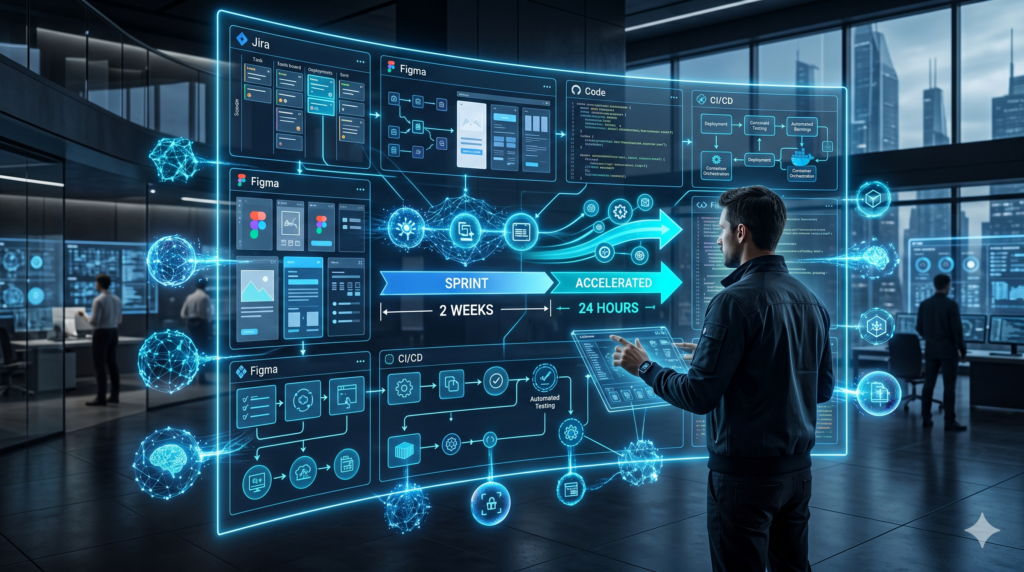
The two-week sprint becomes a single day
The second case study presented concerned application development.
The organization was already using traditional AI assistants. The gains remained limited to about 5 to 10 percent.
The transformation took place when the entire development cycle was redesigned.
In this new model:
In the morning, the Product Owner writes a high-level functional requirement.
The agent automatically generates the detailed specifications.
The developer approves the technical approach.
The agents then develop the complete implementation plan.
In the afternoon, they develop the code, create unit tests, perform quality checks, and automatically correct any detected issues.
At the end of the day, the developer receives a merge request that is ready for approval.
According to McKinsey, this organizational structure makes it possible to move from a two-week sprint to a 24-hour delivery cycle for a comparable scope of work.
So the promise is no longer just about productivity.
It’s the compression of time.
However, in industries where competitive advantage depends on speed of execution, this factor can become more strategic than cost reduction.
Documentation Becomes a Machine Asset
One of the most interesting takeaways from the presentation concerns documentation.
Historically, specifications were written to be understood by humans.
In an agent-based environment, they must be understood simultaneously by both humans and machines.
McKinsey therefore recommends the systematic use of structured formats such as Markdown, which are directly integrated into code repositories.
Documentation then ceases to be an administrative deliverable.
It becomes an active component of the production system.
In other words, it is no longer just read by developers. It is executed by agents.
This development might seem technical.
Yet it is comparable to the transformation that data underwent when companies shifted from Excel spreadsheets to modern analytics platforms.
The real challenge isn’t AI
Based on the feedback presented at VivaTech, one conclusion stands out.
Companies that struggle to achieve results with AI generally do not lack the necessary technology.
There are models available.
The tools are available.
The uses have been identified.
The impasse arises at a time when responsibilities, processes, performance metrics, and collaboration methods need to be redefined.
In other words, agent-based AI is not merely a software innovation.
It requires a complete overhaul of the operational model itself.
Perhaps that is where the true breakthrough of this new wave of technology lies.
Coding assistants have helped speed up the developers’ work.
Agents, for their part, are beginning to reshape the very architecture of the company.
And in this transition, the question is no longer how many lines of code an AI can produce.
The question becomes much more strategic: How much time elapses between an idea and its implementation?
Cette publication est également disponible en :

