
Jacques Brel – The Old Lovers’ Song
Yves Saint Laurent. Yves saint Laurent. YSL. Yves.
August 1, 1936, Oran, Algeria – June 1, 2008, Paris.
In the meantime, a history, almost official: that of a French designer with international fame, who made fashion a social work, and accompanied women in their conquests of power and freedom.
For those of you who are still tempted to use the expression “Do one’s bit for” when talking about Yves Saint Laurent, here is an excerpt from the speech he gave on January 7, 2002, at the press conference where he announced his departure and the closing of the Haute Couture house: “I created the wardrobe of the contemporary woman … I participated in the transformation of my time. I did it with clothes … I will be forgiven for taking pride in it, but I have, for a long time now, believed that fashion was not only made to beautify women, but also to reassure them, to give them confidence, to allow them to assume themselves. I have always stood up against the fantasies of some who satisfy their ego through fashion. On the contrary, I wanted to put myself at the service of women, that is to say, to serve their bodies, their gestures, their attitudes, their lives. I wanted to accompany them in this great movement of liberation that the last century knew.
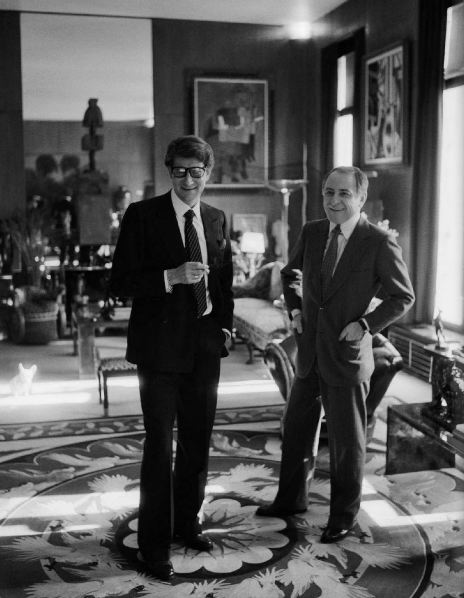
Many people already know this story, hence the importance of reading these 108 pages of correspondence – in one voice – from Pierre Bergé to Yves. If we knew Yves Saint Laurent, we learn who Yves is. We search her love story with Pierre. One understands the reasons for this. We apprehend his sexuality, his deviances (alcohol & drugs), his violence, those made to others as himself, his relationship with women, his sources of inspiration… But above all we deconstruct – a little better – the mechanics of an irrefutably brilliant mind.

Lettres à Yves de Pierre Bergé, Gallimard, 12€
The book opens with a quote from Pliny the Younger: “I have lost the witness of my life, I now fear to live more carelessly.”
Among the things you don’t find everywhere:
Page 32: “January 17, 2009
Yesterday, I wrote to you that you had set the bar very high for your profession. In fact, I always thought that this job was not at your level, that you deserved better, that you always suffered from its ephemeral side. You always knew that fashion was not an art, even if you had to be an artist to create it. That’s why you imposed such a rigorous approach on yourself. You should have been an artist in your own right, but did you have the talent?”
Page 44: “March 2, 2009
Kikou, I miss you terribly.”
Page 60: “April 12, 2009
… You had found refuge in an incredible bulimia and gluttony. You who had been, and rightly so, so proud of your body, had begun to hate it to the point of deforming it. “I have become a monster”, you said to me and it was true. The masochism with which you had played with so much skill had taken its revenge. It is certainly him who made you destroy yourself during so many years. First alcohol and drugs, then food. The food, I always knew that, for a large part, it was directed against me. A way of saying “you took away my drugs and alcohol, I’m going to get even”. What you didn’t know was that the first one to be hurt was you. You were childish, so you had childish strategies. I loved you for that too.”
page 76: “April 28, 2009
… It is you who will close my eyes, you had said to me several times. You liked formulas. I closed them for you. I didn’t know that it would be difficult, that they would refuse to stay closed. It was a nurse who placed a compress on each one. It was 11:12 p.m.”
Elisa Palmer / LUXSURE
Cette publication est également disponible en :

