

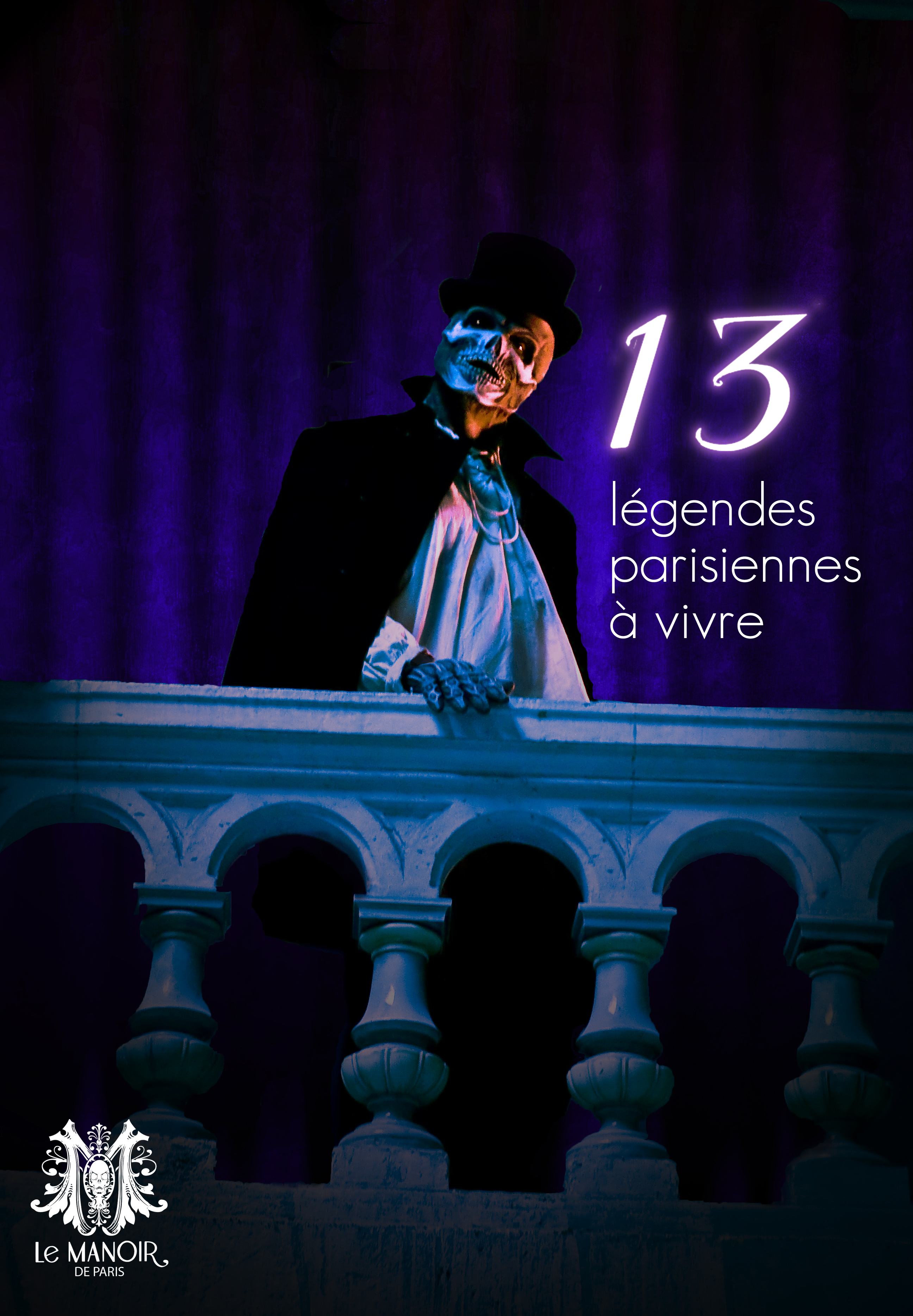
Le Manoir de Paris is undoubtedly the place to be for anyone who likes to be scared.
This place, as interesting as it is scary, will help you discover 13 surprising legends that took place right in the heart of the capital.
l
Adil Houti, creator of Le Manoir de Paris, was kind enough to talk to Luxsure.fr about his career and ambitions.
l
After creating haunted houses in the United States, he became interested in the macabre stories that abound in our city, and then quite naturally decided to bring them to the general public by making Le Manoir de Paris.
Buoyed by the success of this one-of-a-kind venue, Adil Houti hopes to create other Manoirs in France in the future.
l
A brief summary of the 13 stories you can discover at the Manoir de Paris:
l
I. The catacombs of Paris
On November 3, 1793, Philibert Aspairt ventured into the quarries beneath the Val de Grâce convent. He never returned from his expedition. 11 years later, his body was discovered beneath the rue de l’Abbé de l’Épée. A set of keys identified the skeleton of the former porter of the Val de Grâce.
II. The crocodile in the Paris sewers
In March 1984, sewage workers working under the Pont Neuf discovered a 1m-long animal lurking in a corner, just a few meters from them. It was a Nile crocodile.
III. The Phantom of the Opéra
Legend has it that a disfigured monster haunts the Opéra Garnier. Mysterious events at the end of the 19th century lend credence to this rumor: on May 20, 1886, the hall’s chandelier came down, claiming a victim during a performance of Gounod’s Faust. Ironically, this spectator was seated in seat no. 13.
IV. The prison of the iron mask
On November 19, 1703, one of the most famous prisoners in French history, the Man in the Iron Mask, died at La Bastille after 34 years in prison. What was the identity of this mysterious prisoner “always masked with a black velvet mask”, according to the prison register?
V. The vampire cellar
If the Carpathians are the original land of vampires, many stories have chosen Paris as their setting. Among the best-known are the “Vampire Chronicles” by American writer Anne Rice, whose main character is Lestat de Lioncourt, a French nobleman transformed into a vampire during the 18th century. Before leaving Paris, he bequeaths his theater to the dean of vampires on earth, Armand.
VI. The Paris Metro
At 6:30 p.m. on Sunday May 16, 1937, a young woman in a green dress and white hat was found stabbed to death on line 8. Laetitia Toureaux, the only passenger in the 1st class carriage, collapsed to the ground when train 382 stopped at La Porte Dorée station, a laguiole knife stuck in her neck…
VII. The Père Lachaise cemetery
The Père Lachaise cemetery opened on May 21, 1804, on the former property of Père Lachaise, once confessor to King Louis XIV. Renowned as the burial place of famous people, Père Lachaise cemetery is also renowned for its mysteries. Rumor has it that black masses are regularly celebrated there, and that certain tombs give access to the catacombs…
VIII. The ghost of the Tuileries garden
In 1564, Queen Catherine de Medicis decided to acquire a plot of land near the Louvre, where she lived, to build the Tuileries palace. In addition to two tile-makers, a butcher nicknamed Jean l’Ecorcheur lived there. The queen commissioned a nobleman by the name of Neuville to assassinate him on the grounds that he knew her secrets too well. As he was about to die, Jean l’Ecorcheur made a dark prediction: “I’ll be back”.
IX. The alchemist’s library
Books are a well of knowledge, and the library is the alchemist’s lair in search of the Philosopher’s Stone. One of the most famous of these, Nicolas Flamel (c. 1330 – 1418), was a bookseller on rue des Escrivains in Paris. Fulcanelli, the mysterious author of the “Mystery of the Cathedrals”, is said to have discovered the Great Work in the 19th century.
X. The bloodthirsty pastry chef
In 1387, a series of foreign students disappeared in Paris. They fall victim to a mad barber who slits their throats for a neighboring pastry chef. After chopping up their bodies, the latter uses his laboratory to make succulent pâtés “with delicate flesh”, which he sells in his shop.
XI. The cabaret des assassins
Frequented by famous artists such as Picasso, Debussy and Maupassant, Le Lapin Agile is one of the oldest cabarets in Paris. This Montmartre inn, named “Au rendez-vous des voleurs” in 1860, was for a time known as the “Cabaret des Assassins”.
XII. Gargoyles and chimeras
Legend has it that the gargoyles and chimeras of Notre-Dame de Paris come to life at night to frighten away evil spirits. Hybrid monsters, half-beasts or half-humans, these fantastic animals sculpted in stone are the guardians of Good.
XIII. The hunchback of Notre-Dame de Paris
Quasimodo is the main character in Victor Hugo’s famous novel Notre Dame de Paris. This frightening, disfigured character lived in the cathedral’s towers. Both applauded and booed by the crowds, the man nicknamed the Hunchback of Notre-Dame fascinated people like a monster.
l
l
All these stories will be told during an interactive tour, so be prepared to cross paths with the living dead!
l
Our favorite Paris Manor legend?
It’s hard to choose between them, as the actors are all excellent and the moods all different, but the scariest for us was the scene of the young woman murdered in a train carriage. The scene seemed to come straight out of a horror film, a guaranteed sensation!
Le Manoir de Paris regularly organizes themed evenings (for Valentine’s Day, Easter, Halloween, etc.) so check out the lemanoirdeparis.fr website to find out what’s going on.
Visual of the recent Easter evening:
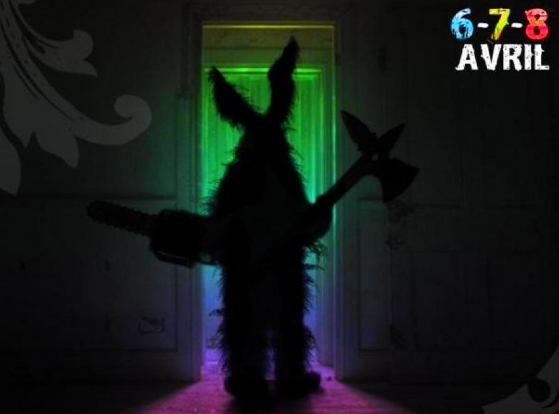
A killer rabbit chased visitors… thrill-seekers loved it!
Le Manoir de Paris
18 rue de Paradis, 75010 Paris.
Cette publication est également disponible en :

