

The other girl
Annie Ernaux
Saturday, May 28,
Paris, under the May sun,
Le Lion Est Mort Ce Soir - Pow woW ♫ ♫ ♫
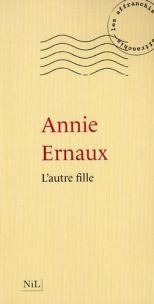
One Saturday evening in April, in exile and nursing a pretty bad hangover, I discovered and loved (double whammy) Nicolas d’Estienne d’Orves’ Je Pars à l’entracte, one of the first three books in the new Les affranchis collection from NiL Editions. As you open it, you don’t close it again, that would have been too easy. A very good book, as disturbing as it was gentle, which I enjoyed immensely.
After that… We don’t know whether the collection is worth examining in its entirety, or whether we should leave it at that. Behind each of the exquisite things, there’s often the desire not to pose potential objects of comparison, not to dare an experience that might dethrone the previous one, the one you’ve raised so high… And yet, one day, in this “let’s see” mood, we push the vice a little further. You try it.
Annie Ernaux, who needs no introduction, invites us – through 80 pages – to enter into something very special. Intimate. Her existence in the shadow of her other daughter, her sister who died of diphtheria at the age of 6, before the war, in Lillebonne (Seine-Maritime).
“…you’re not my sister, you never were. We haven’t played, eaten, slept together. I’ve never touched you, kissed you. I don’t know the color of your eyes. I’ve never seen you. You’re bodiless, voiceless, just a flat image in a few black-and-white photos. I have no memory of you. You had already been dead for two and a half years when I was born.” (p. 12)
The question is one of life. How does one exist in the eyes of the world and oneself, when in the pain and silence of others, one knows oneself to be a kind of only child, a bit of a bastard? Little Annie is all alone in the world, in flesh and bone, but she takes in her face the density and weight of the absentee, who can only be better than she is, since she’s gone. And therefore invariably in the light of God. Redoubtable.
The idea is always to love the dead or disappeared much more than the living. The ambition is to try to live with that all your life. How does one take one’s place when the other has already razed everything to the ground simply by being dead? Here, Annie Ernaux frees herself (at last) by giving us this emptiness, this vacuity, where the game of life reeks so much of the ashes and remains of the other that it’s a real pollution. A luminous pollution.
“I’m not writing because you’re dead. You died so I could write, and that makes a big difference.” (p. 35)
Elisa Palmer
Annie Ernaux
The other girl
Les affranchis collection
Editions NiL
2011 - III
7€
Cette publication est également disponible en :

