
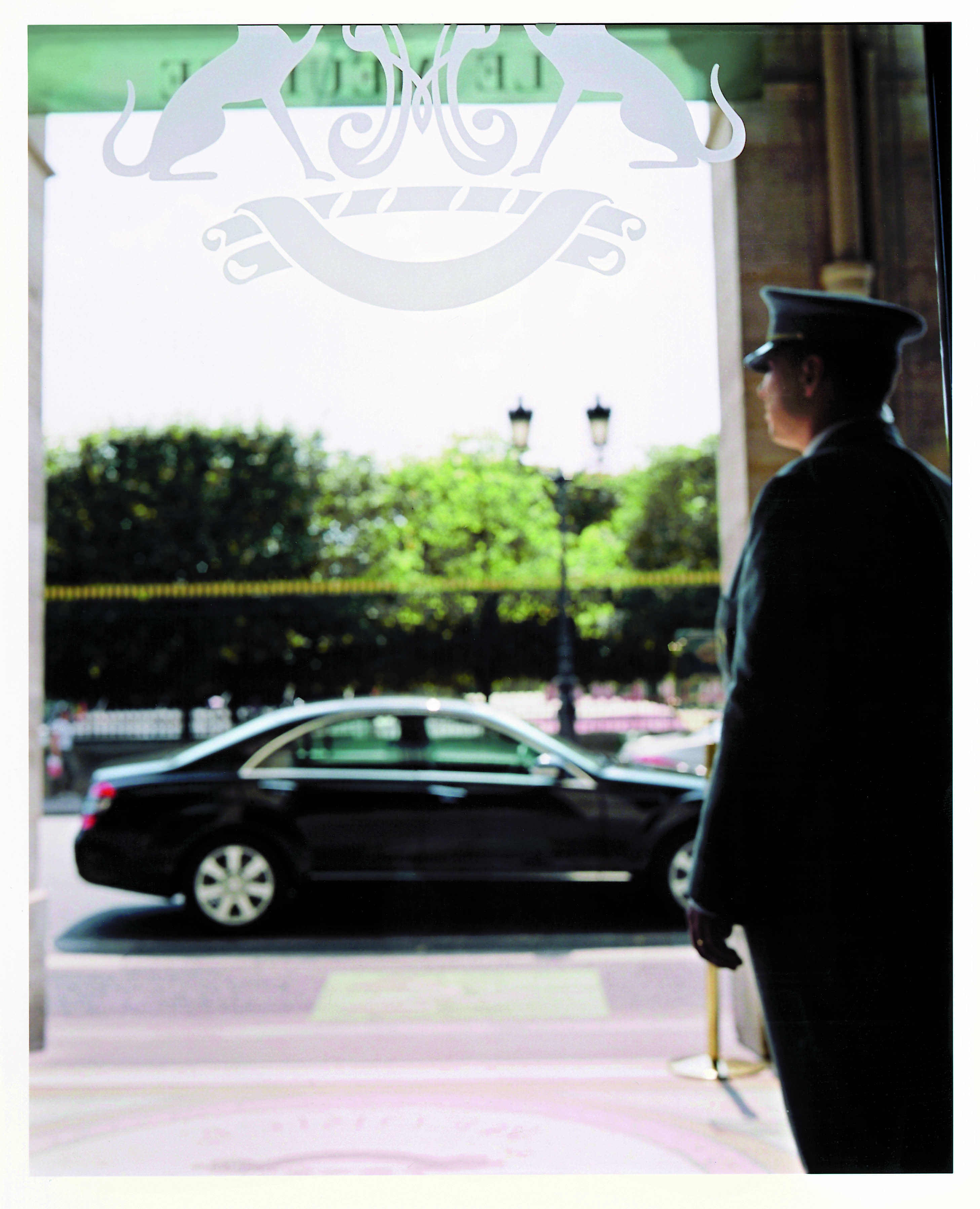
Entrée du Meurice
Augustin Meurice, postmaster at Calais, hadn’t planned the Channel Tunnel, but by the middle of the 18th century he had realized that English tourists wanted to find on the Continent the comforts and conveniences to which they were accustomed at home. In 1771, he opened an inn for them, so they wouldn’t feel out of place when they disembarked in Calais. It was only a short step from there to opening a second hotel in Paris, at 223 rue Saint-Honoré, the terminus of the stagecoach. This step was taken under the Restoration.
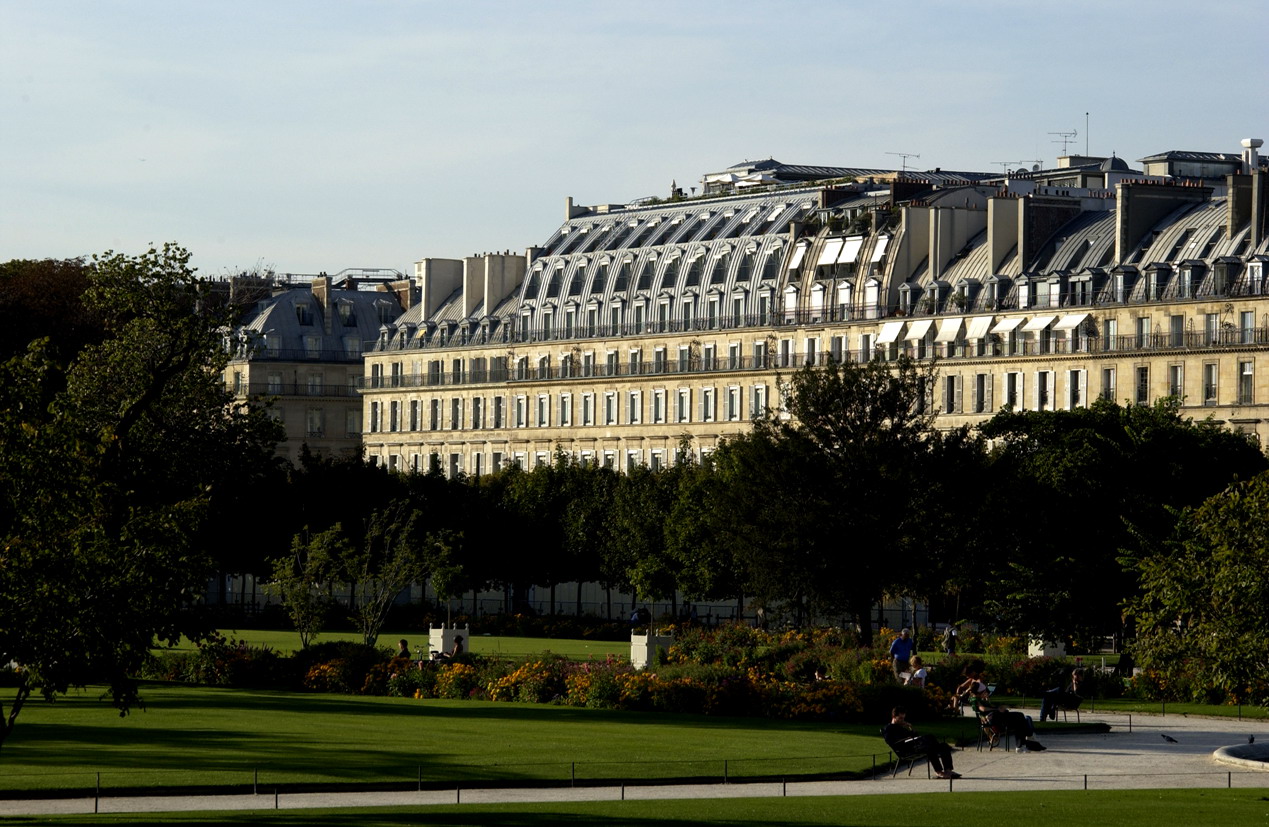
Le Meurice, vue des Tuilleries
For travelers of the time, Hôtel Le Meurice offered an unprecedented style of hospitality. Everything was done to make life easier for the visiting foreigner: administrative formalities were taken care of, valets were attached to the hotel, apartments of all sizes were rented, conversation rooms were provided, linen was laundered with soap and beaten by hand, English-speaking staff were available, a bureau de change, crews…
” For an English traveler, no hotel in Paris offers as many advantages as the Hôtel Le Meurice”, assured an advertisement of the time.
In 1835, the hotel moved to its present location on rue de Rivoli, in a new, luxurious building adjacent to the Tuileries Palace.
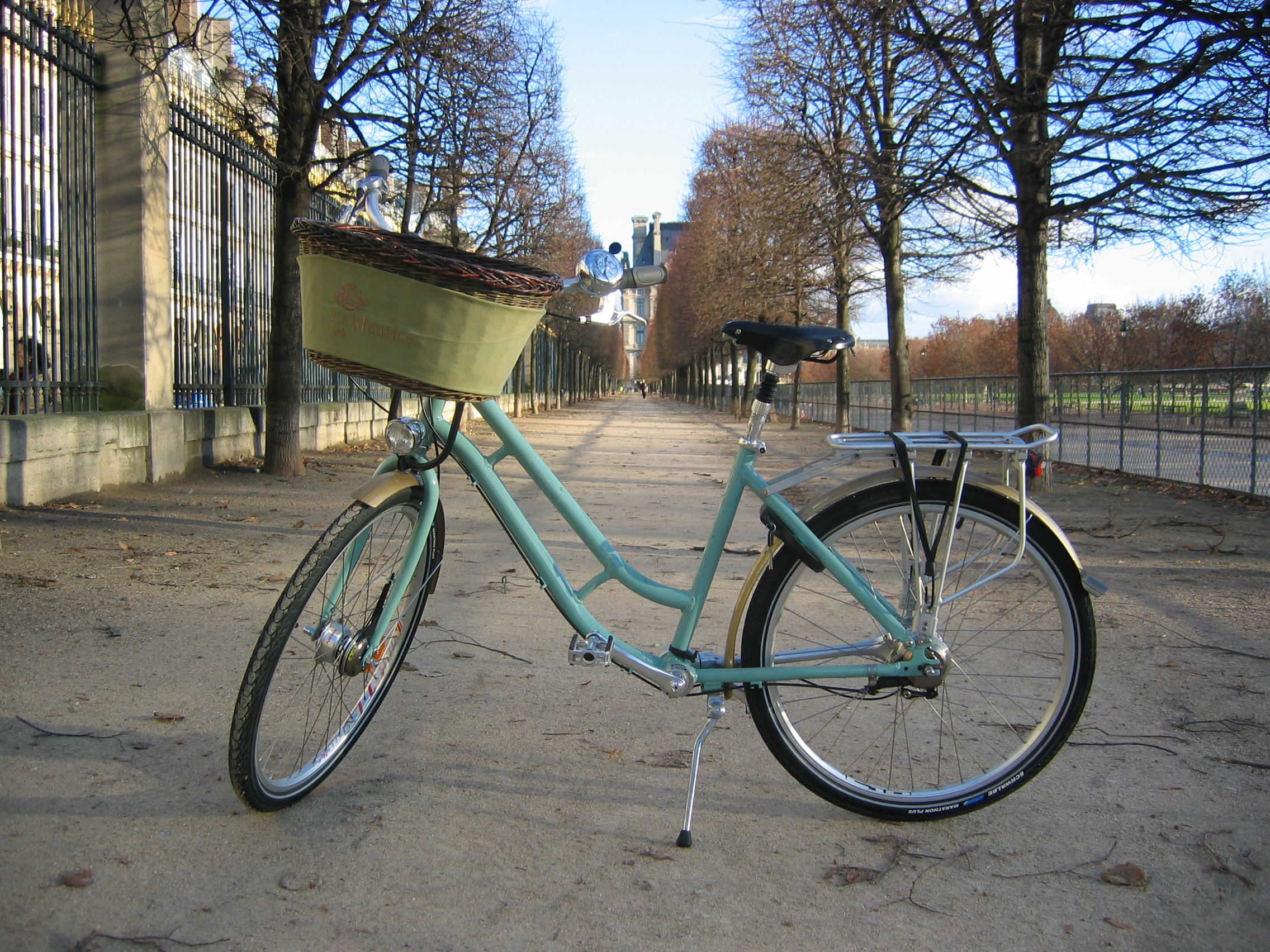
Velo Le Meurice
The elite clientele followed. From the July Monarchy to the Third Republic, Hôtel Le Meurice welcomed the high society of the time: sovereigns, aristocrats, artists and writers, who appreciated not only the quality of service and the refinement of the rooms and salons, but also the hotel’s exceptional location in the heart of Paris, close to luxury boutiques and the center of power. This was undoubtedly one of the reasons why Miss Howard, mistress and patron of the future Napoleon III, chose to stay here during her visits to the capital.
At the turn of the century, Hôtel Le Meurice changed management. One of the shareholders in the new company was none other than Arthur Millon, owner of the Café de la Paix and the Weber and Ledoyen restaurants. To compete with the Ritz, which had opened in 1902, Arthur Millon called in a leading Swiss hotelier, Frédéric Schwenter.
Under the impetus of these two men, Hôtel Le Meurice was enlarged by the addition of the Hôtel Métropole, located on rue de Castiglione. With the exception of the listed facades, the hotel was rebuilt under the direction of Henri Nénot, architect of the Nouvelle Sorbonne and winner of the Grand Prix de Rome.
The interior decoration, particularly in the ground-floor salons, was in the Louis XVI style, while the rooms were equipped with the most modern comforts: bathrooms, telephone, electric bell connecting guests to their personal servants… The elevator was a copy of Marie-Antoinette’s sedan chair. Painters Poilpot, Lavalley and Faivre were commissioned to paint ceilings and panels evoking Versailles, the Trianon and Fontainebleau.
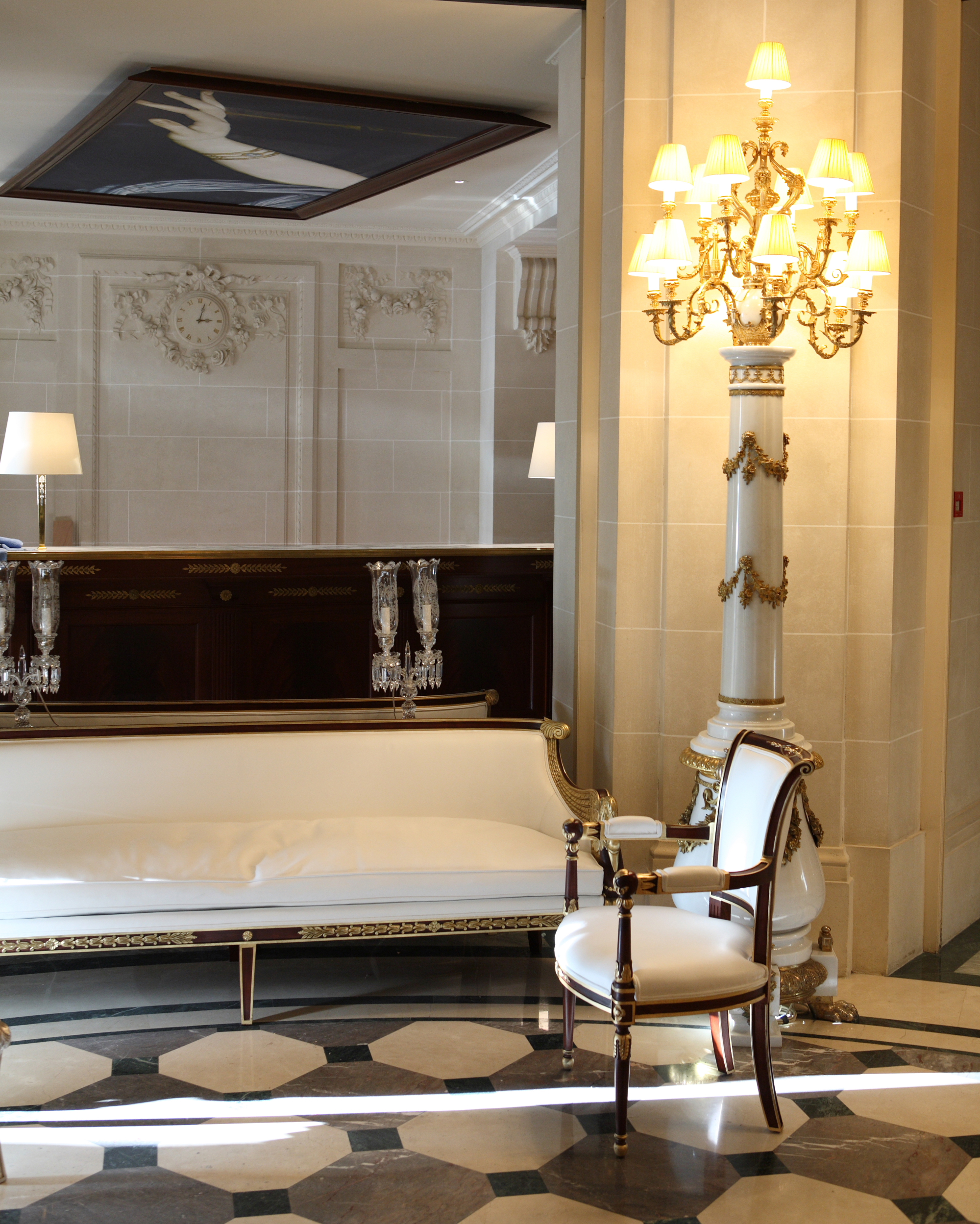
From this era, Hôtel Le Meurice has preserved the grand salon Pompadour with its white and gold panelling, the dining room, whose marble pilasters and gilded bronzes are a tribute to the Salon de la Paix in the Château de Versailles, the salon Fontainebleau and the wrought-iron glass roof that housed the lobby, recently covered by Ara Starck’s monumental canvas. It was during the course of this work that workers rescued a stray dog from the building site, which the staff turned into their mascot. Since then, the greyhound has become the hotel’s emblem.
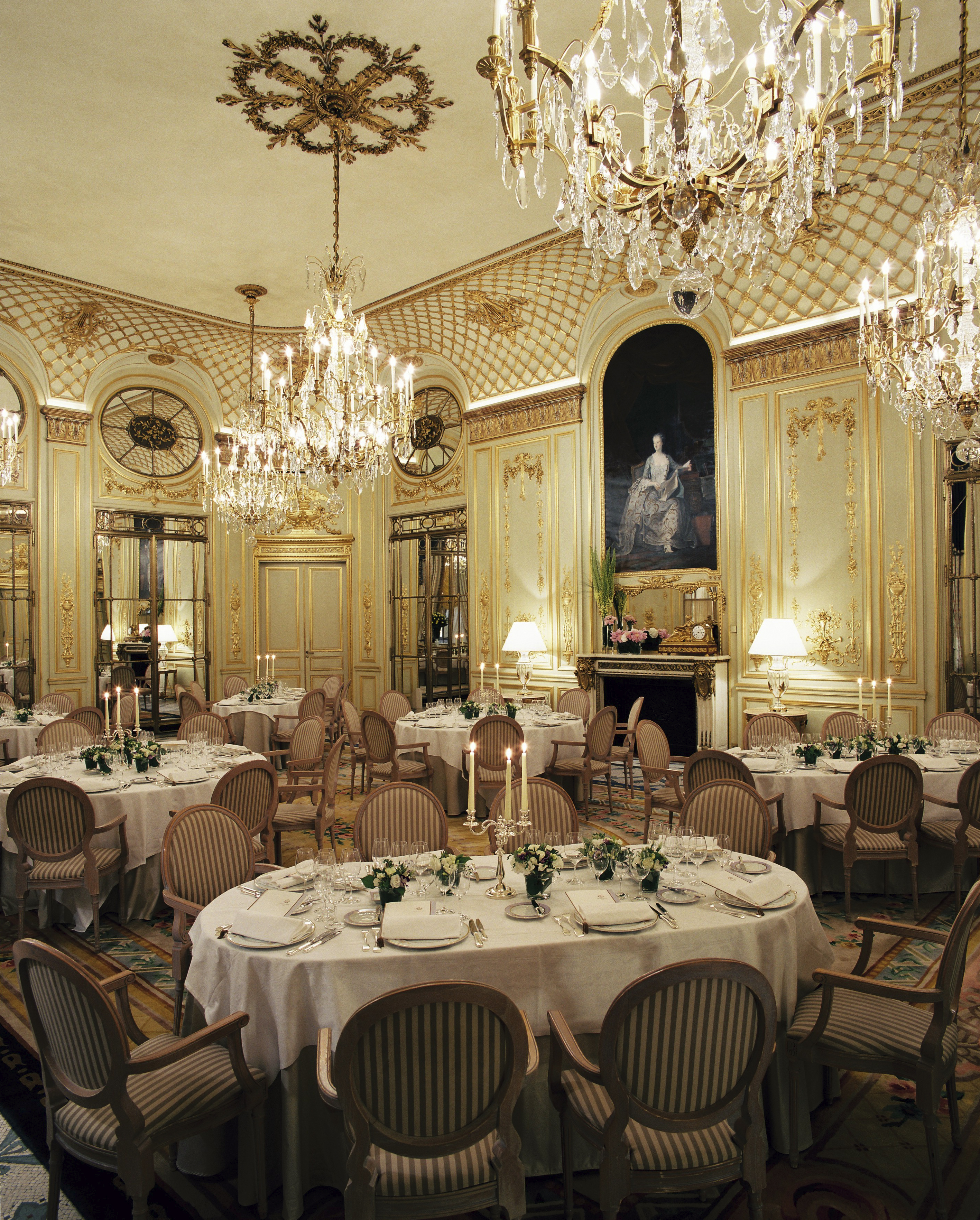
Salon Pompadour
In 1935, the poet Léon-Paul Fargue divided the clientele of Parisian hotels into three categories: “the bad, the good and the Meurice”. Among the latter, crowned heads abounded.
The first monarch to make the new Meurice his secondary residence in Paris was King Alfonso XIII, who, wishing to evolve in his familiar decor, had his furniture brought from the royal furniture depository in Madrid. When he was ousted from power in 1931, the deposed monarch made Le Meurice his refuge and the seat of his government-in-exile. Following in his footsteps, the Prince of Wales, the kings of Italy, Belgium, Greece, Bulgaria, Denmark and Montenegro, the Shah of Persia and the Bey of Tunis all made a habit of staying at the “Hôtel des rois”.
Business princes like the Rockfellers, politicians like Presidents Doumergue and Roosevelt, Count Ciano, Anthony Eden, and artists from Rudyard Kipling to Edmond Rostand, Gabriele d’Annunzio to Paul Morand, followed their example.
In the ’50s, royal families gradually gave way to discreet multinational bosses, screen stars and artists, many of them more eccentric.
Among the latter, Salvador Dalí, the “transcendental” genius of self-advertising – nicknamed “Avida dollars” by one of his former surrealist companions – was one of the hotel’s most unusual guests.
For over thirty years, for one month a year, he occupied the former royal suite of Alfonso XIII, staining the walls with paint, while his tame cheetahs clawed at the carpet.
With him, the staff – who were very attached to him and whom he honored with gifts in the form of lithographs signed by his “divine hand” – had no shortage of distractions.
Either he asked them to catch flies in the Tuileries groves, or to bring him a herd of goats on which he fired blanks; or he asked them to throw twenty-cent coins under the wheels of his car whenever he left, so that he could flatter himself that he was “rolling in gold”!
For a hotel like Le Meurice, aren’t guests’ wishes – however strange – orders?
Alongside Dalí, another unusual guest was French-American billionaire and patron Florence Gould, whose literary lunches brought together such contrasting personalities as Arletty and François Mauriac, Léautaud and Paul Morand, the Jouhandeaus, Roger Peyrefitte, André Gide and the young Roger Nimier. Thanks to her, Hôtel Le Meurice was home to one of the last literary salons in Paris.
Over the centuries, Hôtel Le Meurice has forged close, intimate ties with artists. So it’s hardly surprising that today, the hotel is home to the young generation of French actresses, musicians and internationally renowned visual artists.
Hall 1 c - Peter Hebeisen
Cette publication est également disponible en :

