

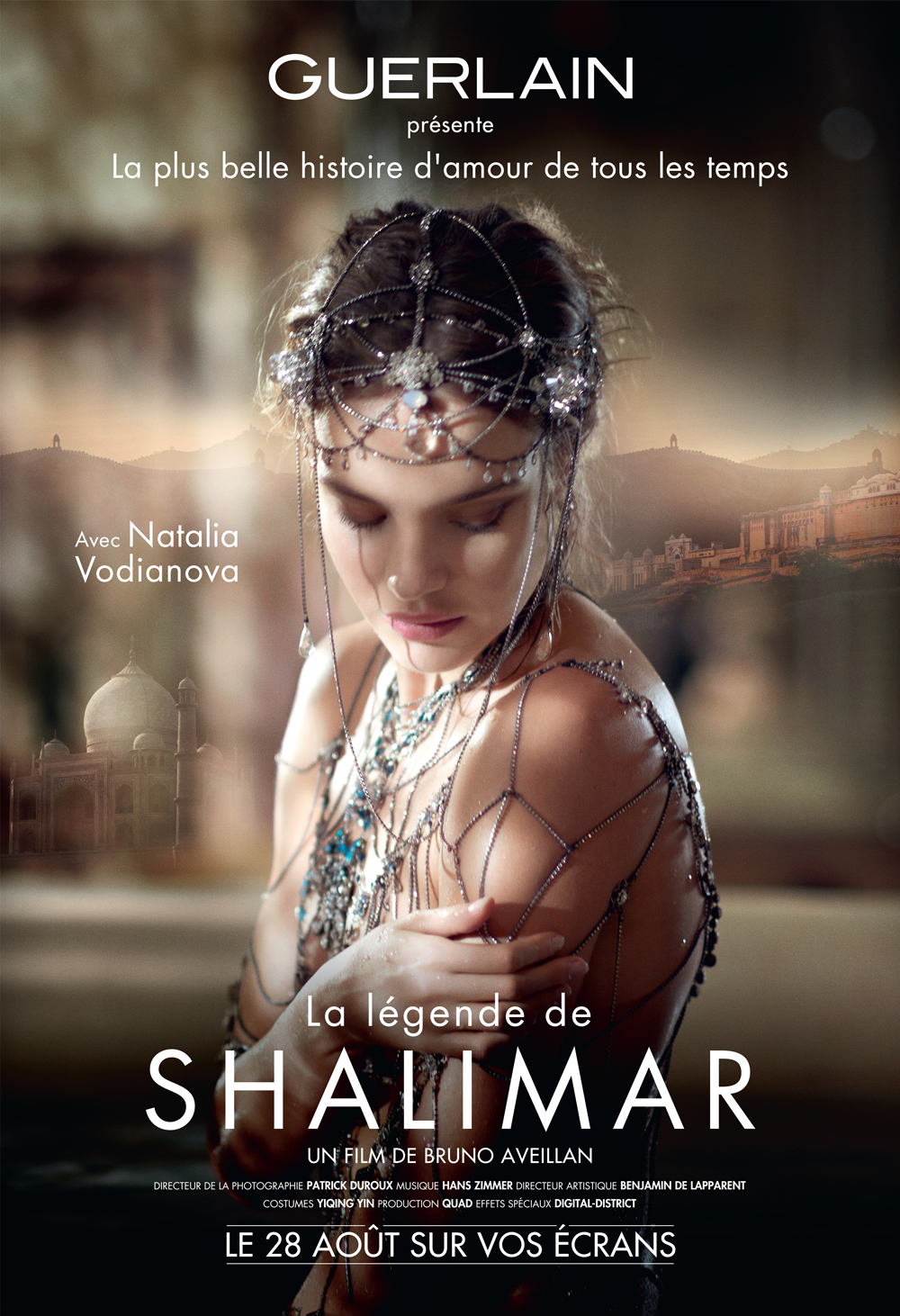
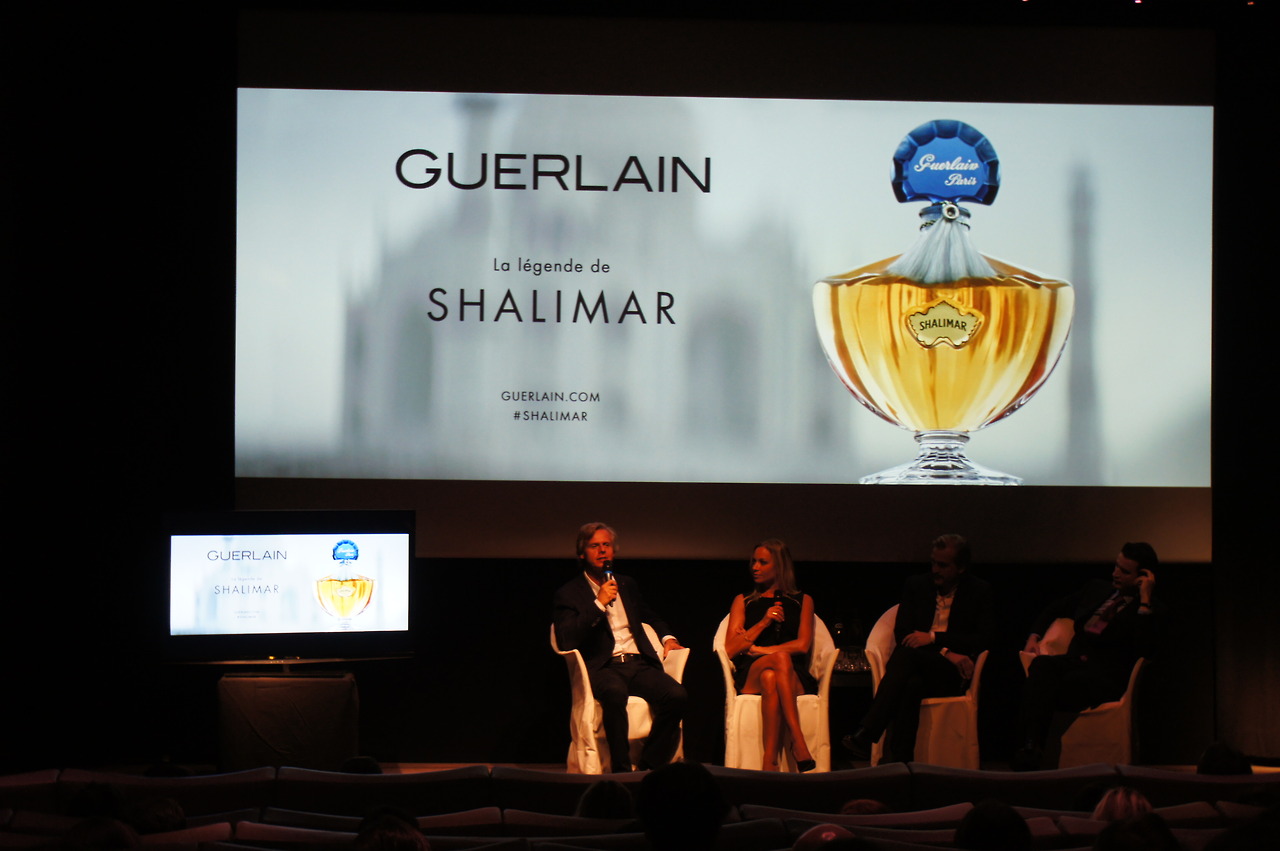
 Last Monday, we discovered for you the new Shalimar advertising campaign created by the talented Bruno Aveillan. The evening proved to be a magical one.
The story :
Having myself visited the Taj Mahal, one of the wonders of the world, I couldn’t help but be moved by the beautiful story that Guerlain tells us with Shalimar: the revisited story of the infinite love between Shah Jahan and Mumtaz Mahal.
Once upon a time, in India, there was a love story between a Mughal emperor and his beloved wife. In the 17th century, troubadours immortalized the love story of Shah Jahan and Mumtaz Mahal on their sitars. A true story that became legend, exalted and magnified.
This all-powerful emperor cultivated in the secret of his heart an unspeakable passion for his divine wife. To protect their love, Mumtaz lived in a palace, far from the tumult and chaos of the world, surrounded by magnificent gardens called Shalimar.
To reach her, Shah Jahan had to cross arid steppes surrounded by blue mountains. When he closed his eyes, he imagined her getting ready like an odalisque. He could see the precious silk carpets, the brocade cushions, her maids throwing armfuls of flowers into her bath. He could see her golden hair, delicately caress the grain of her skin and smell her perfume. Images of her emerged. A breast. An ankle. The nape of her neck. Nothing left but the earlobe, the shoulder, her mouth always. Faster, faster, find her again.
Suddenly, conch shells roared through the vibrating air, silencing the high-pitched cry of the peacocks, he had reached the goal of his journey… the Gardens of Shalimar.
It was then that he caught sight of her, goddess among goddesses amid the flamboyant trees.
He could hear the clinking of her bracelets. Her gold-embroidered sari rustled on her slender, supple figure. Finally, he saw her face and, as if overcome by such beauty and emotion, lowered his eyelids. She stood before him, speechless. He took all the time he needed to detail, to savor the long pearl necklace, and, deep in the hollow of her breasts, to guess the secret of her voluptuous trail. This love, which they experienced as a perpetual feast, plunged them into a world where only the moment mattered. This moment of love that Shah Jahan wanted to immortalize…
He led her towards the shores of the lake.
Not an egret in flight, not a movement in the water as she climbed aboard a light, flat-bottomed boat. The whole universe seemed to be holding its breath, when, before their very eyes, the water parted and four spikes pierced the surface. They slowly rose towards the sky, revealing four white marble domes perched on minarets dripping with crystal-clear water, framing a gigantic dome of immaculate marble. Openwork facades as if embroidered in stone, galleries with elegant arcades, doors and balustrades inlaid with semi-precious stones… An entire palace springs from the waters. An extraordinary present. The Taj Mahal will mock Time and become a “wonder” admired by the whole world.
A magnificent story told by this film combining legend and advertising culture.






























SHALIMAR, THE WORLD’S FIRST ORIENTAL PERFUM
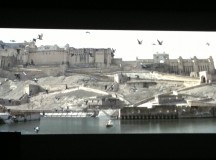
Paris, 1925. The Exposition Internationale des Arts Décoratifs celebrates the advent of the modernist aesthetic to which it would give its name: Art Deco. It was there that Shalimar was presented, the quintessence of this desire for the Orient that took the art of perfume back to its distant origins.
The perfume was conceived as early as 1921 by Jacques Guerlain. The idea came to him when chemist Justin Du Pont suggested a new vanilla. To test it, Jacques Guerlain poured it into a bottle of Jicky… These were the beginnings of the first great perfume in the Oriental family. Shalimar is Oriental in its suave, gourmand notes, reminiscent of the balms of the Arabian Nights. A smiling flight of citrus, with bergamot in overdose, shimmers through the base notes, leaving a sensual, unforgettable trace. An exquisite, paradoxical balance between freshness and sensuality, garden and alcove, signed by the mythical Guerlinade, an accord of bergamot, iris, rose, jasmine, tonka bean, resins and, above all, the vanilla note that forms the pulpy heart of Shalimar… Oriental, but also inspired. It was a maharajah visiting Paris who told Jacques and Raymond Guerlain the story of the gardens of Shalimar, which in the 17th century were the site of the love affair between Shah Jahan, the fifth Mughal emperor, and his beloved wife, the Persian Mumtaz Mahal. Their love was so absolute that, when his companion died, the emperor erected a white marble mausoleum for her in Agra, which was to become one of the wonders of the world: the Taj Mahal, “a solitary tear suspended from the cheek of time”, according to the poet Rabindranath Tagore…
To embellish this story that has become a legend, Raymond Guerlain designed an elegant bottle whose curves evoke those of the basins that adorn the gardens, crowned by a fan-shaped stopper made by Baccarat in blue crystal – a technical feat and a first in perfumery, as is the base of the bottle. The creation won first prize at the 1925 exhibition.
A pioneering fragrance, Shalimar is now part of our olfactory heritage – of our culture – yet it remains as relevant as ever, as one of the world’s best-selling perfumes. It owes its longevity both to its beauty and to the remarkable coherence between its fragrance, its bottle and its legend. That of a passion that stands the test of time, immortalized by a fragrance that spans the ages…
THE DIRECTOR
Bruno Aveillan, born in Toulouse, is considered one of France’s leading advertising film directors. His training as a painter and his high aesthetic standards are expressed in spots of extreme visual sophistication. In 1998, “La Foule pour Perrier” was voted “Favorite Film of the French” by an IPSOS poll. In 2001, he joined Martin Scorcese, Wong Kar-Wai and Oliver Stone in directing the “Orange” spots. In 2008, Louis Vuitton called on him for the first advertising film in its history, “Where will life take you”, which won numerous international awards. Also a photographer, Bruno
Aveillan presented his fourth exhibition in Milan and Paris in 2012, and has just published his third photo book. His famously exacting standards magnify this splendid film.

THE SHOOTING
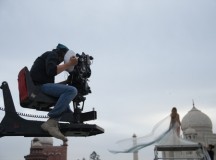
Shooting the tale of Shalimar took a team of over a hundred people all over India: Jaipur for its Jaigarth fort and Mawta Lake; Udaïpur for Badi Lake, its mountains and a reserve of white marble dust giving the illusion of snow; the Himalayas for its pure springs from which 6,000 liters of water were taken and carried by elephant… And of course, the Taj Mahal in Agra.
The Phantom camera used by Bruno Aveillan captures shots of spectacular precision and beauty, such as that of the galloping horse. What’s more, the director shoots exclusively in 35 mm, a technique now abandoned by feature films for its image beauty, transparency and distinctive grain. This type of shooting enhances the sensitivity of Bruno Aveillan’s work in creating the image.
AMBASSADOR
Natalia Vodianova, who has played the role of Shalimar since 2008, naturally lends her radiant beauty to Mumtaz Mahal in this new film. It may seem a surprising choice, but it’s one that’s paid off, given the expressive nature of the model-turned-actress. We spoke to her at the screening.




THE COSTUME CREATOR
Regular readers of our site will know of our affection for the Chinese designer Yiqing Yin, responsible for the film’s sumptuous costumes.
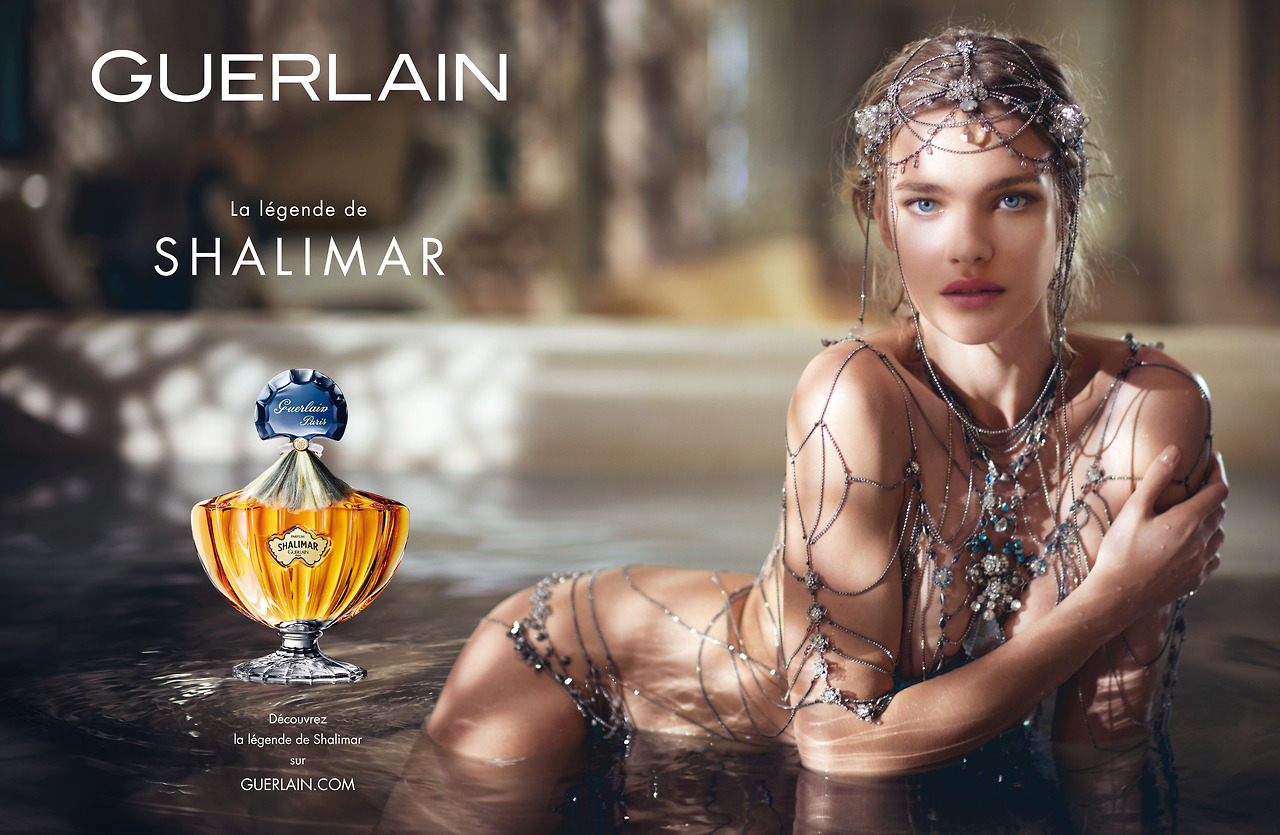
The dress worn by Natalia is adorned with lace embroidery by Sophie Hallette and pearls. The dress is constructed to give the impression
that the embroidery has crystallized on the body. The body and head adornment, “Taj”, is a precious second skin delicately covering the body with
crystal jewels.





THE COMPOSER
Hans Zimmer, born in Frankfurt, Germany, on September 12, 1957, is considered one of the greatest contemporary composers of film music.
His greatest successes include the soundtrack to Ridley Scott’s “Gladiator”, and his composition for the animated film “The Lion King” by
Roger Allers and Rob Minkoff, for which he won his first Oscar, as well as a Golden Globe and a Grammy Award. He also wrote the music for the
film “Shalimar”, released in 2013.
Cette publication est également disponible en :

