

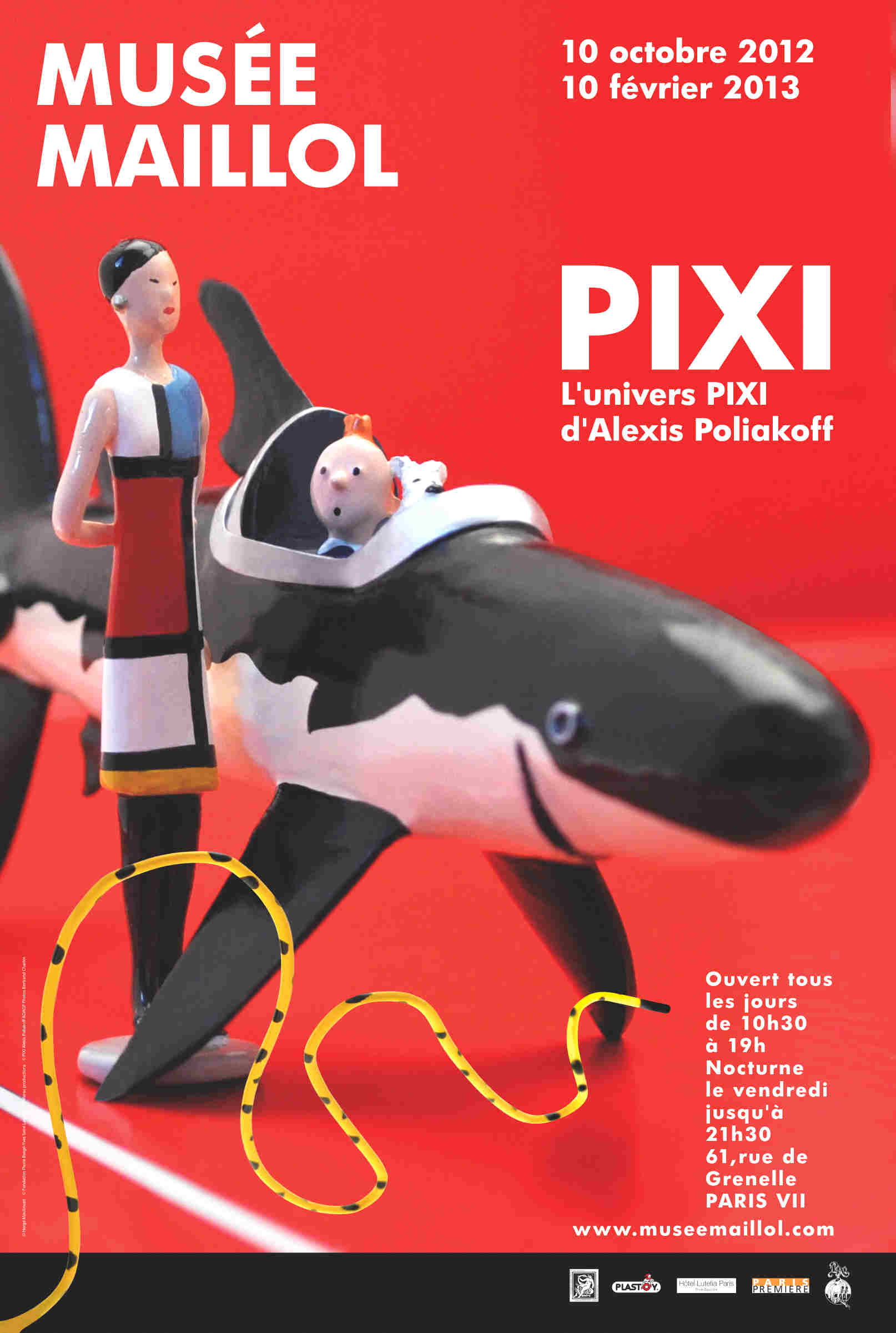
 30 years ago, Alexis Poliakoff invented PIXI, bringing along his father-in-law Pierre Guénard, an industrialist, and young Philippe-Antoine Guénard, just starting out in the world of work, followed by the whole family.
Alexis Poliakoff’s PIXI world can be traced back to the little childhood suitcase he kept by his bed. This suitcase contained the imaginary treasures he created in figurines, from this microcosm: the buccaneers of Treasure Island, Buffalo Bill and the Sitting-Bull camp, Francis Garnier reconquering Hanoi occupied by the dreaded black flags, Bonaparte’s soldiers at the Pont d’Arcole. No industrial toys, Alexis Poliakoff made them with his own hands, from loaves of modeling clay that his father gave him to keep quiet in his workshop. With his father’s sculptor friends, he soon discovered the power of earth and clay, which harden as they
dry, and don’t deteriorate like modelling clay.
His skill was soon recognized, and at the age of nine he won first prize in the Figaro modeling competition on the theme of the city of Paris, with a reconstruction of the Place de la Concorde. It was with the sponsorship of Alain Saint-Ogan (creator of Zig et Puce) that he entered the theater of his imagination.
Later, discovering the magic of animated film thanks to an 8mm camera, he went on to make experimental films by animating his own figurines, and learned the trade of film technician from the masters of the Nouvelle Vague: Godard, Chabrol, Rivette, Berri, Tavernier, whose assistant he became for 4 years before embarking on the production and direction of animated films.
The death of his father left him with a body of work to take care of, and forced him to make a certain professional choice by making himself available for the defense 3and illustration of Poliakoff’s painting. It was also an opportunity for him to embark on the PIXI adventure in the early 80s, imagining, reduced to the contents of this little childhood suitcase, his entire memory of the world. He chose the format of the toy soldier, an old-fashioned world with which he was very familiar, and to which he gave a new lease of life, creating an everyday world of contemporary life based on the traditional
technique of representing the military world.
He began by giving the PIXI company a very artisanal historical legitimacy by creating everyday life at the beginning of the 20th century. Very soon, the subjects of contemporary life began to appear. Gone were the military parades, long live today’s fashion shows, treated like toy soldiers to excite designers and couturiers.
Alexis Poliakoff wanted to invite his childhood friends from the
comic strip into his world.
It was his correspondence with Hergé that enabled him to approach his heirs, and this was to be the start of a long collaboration that would give Tintinophiles a new vision. Subsequently, PIXI would interpret all the characters from the world of comics, and this would become PIXI’s hobbyhorse.
Vitalized by the dynamism of his son-in-law Philippe-Antoine Guénard, who took over the management of the business and created the “PLASTOY” company, obtaining licenses for all kinds of materials, interpreting the whole world of comic strips in three dimensions and making it an essential name in the toy industry too.
This exhibition is an illustration of our world in miniature, as well as a revisitation of comic-book heroes in an extra dimension.
From October 10 to February 10, 2013 at Musée Maillol
Cette publication est également disponible en :

