

Sunday, January 29, 2012
McDonald’s Ornano
Paris
Café de Flore
Canadian film by Jean-Marc Vallée
With Vanessa Paradis, Kevin Parent, Hélène Florent
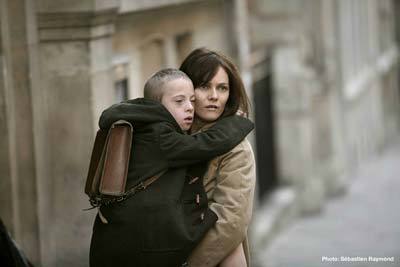
It’s a difficult gamble. How can you say good things about a film when almost everything points to it being a failure? A first story, in every way incestuous, between a mother Jacqueline and her Down’s syndrome son Laurent in 60’s Paris. We explore the feelings of “Mère Courage” (Mother Courage), who fights against all odds to save her son, against a society that grants him a life span of less than 25 years. In view of this accelerated life expectancy, little Laurent has also decided to rush everything and, at the age of 7 (look at that), falls madly in love with a little Down’s syndrome girl like himself. But not too badly.
A second story as warm and vulgar as this compilation of tattoos of dubious taste on these unparalleled smooth bodies. He, Antoine by name, is in his forties, an adored DJ in his spare time, but dressed in an – almost – three-piece suit when he mixes… Look for the mistake! In short, a sort of modern-day pop/romantic hero, who insists on true love at first sight, whatever the cost, but who doesn’t hesitate for long to leave his youthful love, as gothic as it is mystical, for a Cinderella whose regular AA meetings are the only thing that brings them together. The bottle or pill addiction as a hyphen, phew.
If the director of C.R.A.Z.Y. nailed it in 2005 with a young gay David Bowie fan who dares a difficult coming-out, in this Café de Flore he pushes the envelope of mediocrity. The story within the story of the story, that’s the concept. The brunette, a goth-mystic who sleepwalks every other night, sees in her dreams a little boy with Down’s syndrome, who is none other than Laurent, but who is also the image of her ex-partner. The secondary characters follow the same pattern. Too painful to conjugate here…
All of this culminates in a kind of quasi-liberating/mystical experience in which the brunette comes to apologize – on a very dark night – to her ex. This forgiveness, which gives rise to a three-body semi-restraint, should give rise to the idea that she finally agrees to free the loved one so that he can sail serenely towards his loving double. The other one. We (almost) wish we’d had a threesome instead, such is the doughiness of it all. But the director – daring as he is – has really decided to make us nauseous right to the end of his 2:09 running time.
That’s all there is to it for some people, but there’s no denying that Café de Flore stops here.
And for others, like me, but others too… We took bridges, footbridges and viaducts. We slid over silliness with a scarf over our eyes. We distilled down to the good stuff. Above all, we saw better than the film let on. We took The Cure, Sigur Ros, Sophie Hunger and Pink Floyd too loudly in our ears. We overlooked the awkwardness, the clichés, the India Ink bullshit on those bodies, the yoga bit, the sensually bland episodes… We decided that our DJ might as well do a bit more coke, just to see. We made an explosive comeback to the story of our youth. We told her dad to fuck off (a little, just to see, again) with his moralism and shitty principles. We told the gothic brunette to stop acting like a character, and that she had every right to be in pain and not accept the impossible.
In this, the director has got it all wrong. The story is not in the story of the story. The film here is only outside the film.
Elisa Palmer
Cette publication est également disponible en :

