
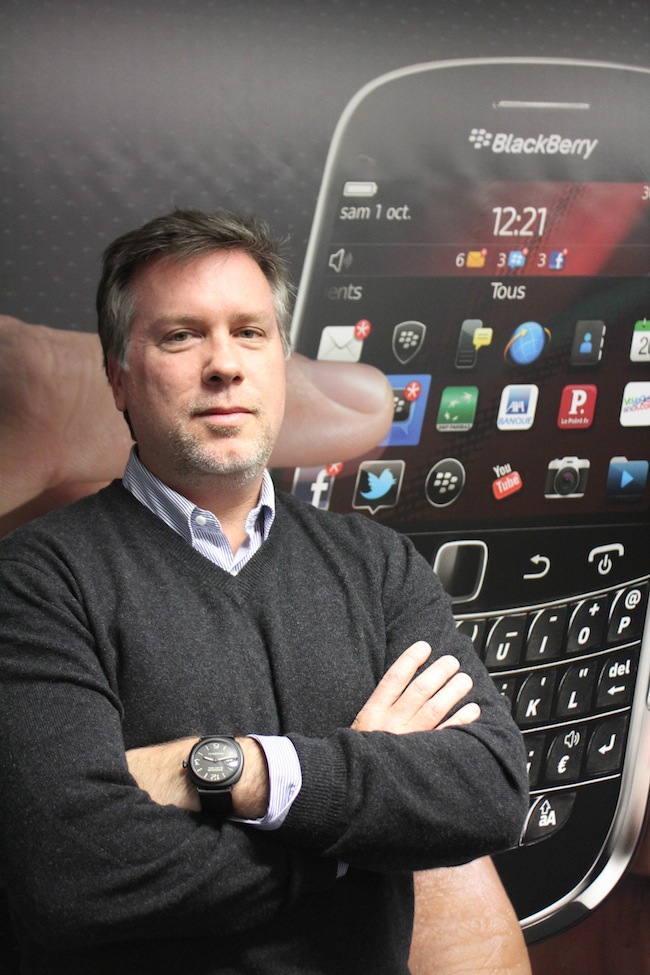
Interview with Todd Wood, senior vice president of design at RIM
On a rainy afternoon in November, we had the privilege of meeting Todd Wood, Mr. Design at Blackberry RIM. A no-holds-barred chat about the future of telephony and the history of one of the world’s greatest success stories.
Luxsure: What are the origins of Blackberry?
Todd Wood: Blackberry is 12 years old, and RIM is a Canadian company.
The founding idea was to create a tool for writing and receiving e-mail on the move. It all started with interactive pagers and ended with today’s smartphones, which are communicative, multimedia tools.

L: Blackberry’s main target is businessmen, but today a large number of young people use Blackberrys. How do you explain this?
TW: We’ve been delighted by the success of BBM, it’s very exciting.
There’s been an evolution in communication with Blackberry. What used to be formal communication is becoming more casual and mass-market.
We make it a point of honor to stay close to our consumers, listening to their needs without favoring one target over another. When designing terminals, we don’t force ourselves to design products for young people in particular, because that’s the best way to lose this target.
We prefer to focus on our know-how, creating tools that facilitate communication. Our consumers like our products just the way they are.
Of course we add color and offer a variety of designs, but it’s not aimed at any particular target. We don’t want to be a fashion brand.

L: 2011 is a landmark year for RIM, with the launch of a wider range of products.
TW: This is our most ambitious terminal launch to date, and we’ve tried to meet as many of our customers’ needs as possible. We also wanted to clarify our range. We have 5 flagship product ranges: the Bold range, the iconic, top-of-the-range BlackBerry format; the Torch range, which includes an all-touch and hybrid proposition; and the Curve range, again a classic, compact and affordable format. It’s all a question of choice.
Personally, I no longer need a computer; I use the BlackBerry Torch 9810, which I combine with the BlackBerry Playbook tablet.
The mobile market is mature, allowing consumers to make a choice according to their use and affinity. All these mobiles use the new Blackberry 7 operating system, which is very fluid and powerful.
We also have to constantly adapt to technological developments, 3g and soon 4g. We try to offer the market a good compromise between technology and user experience.
We also keep a close eye on competitive developments, which is healthy.
We respect the competition, but we’re focused on our future and our customers.
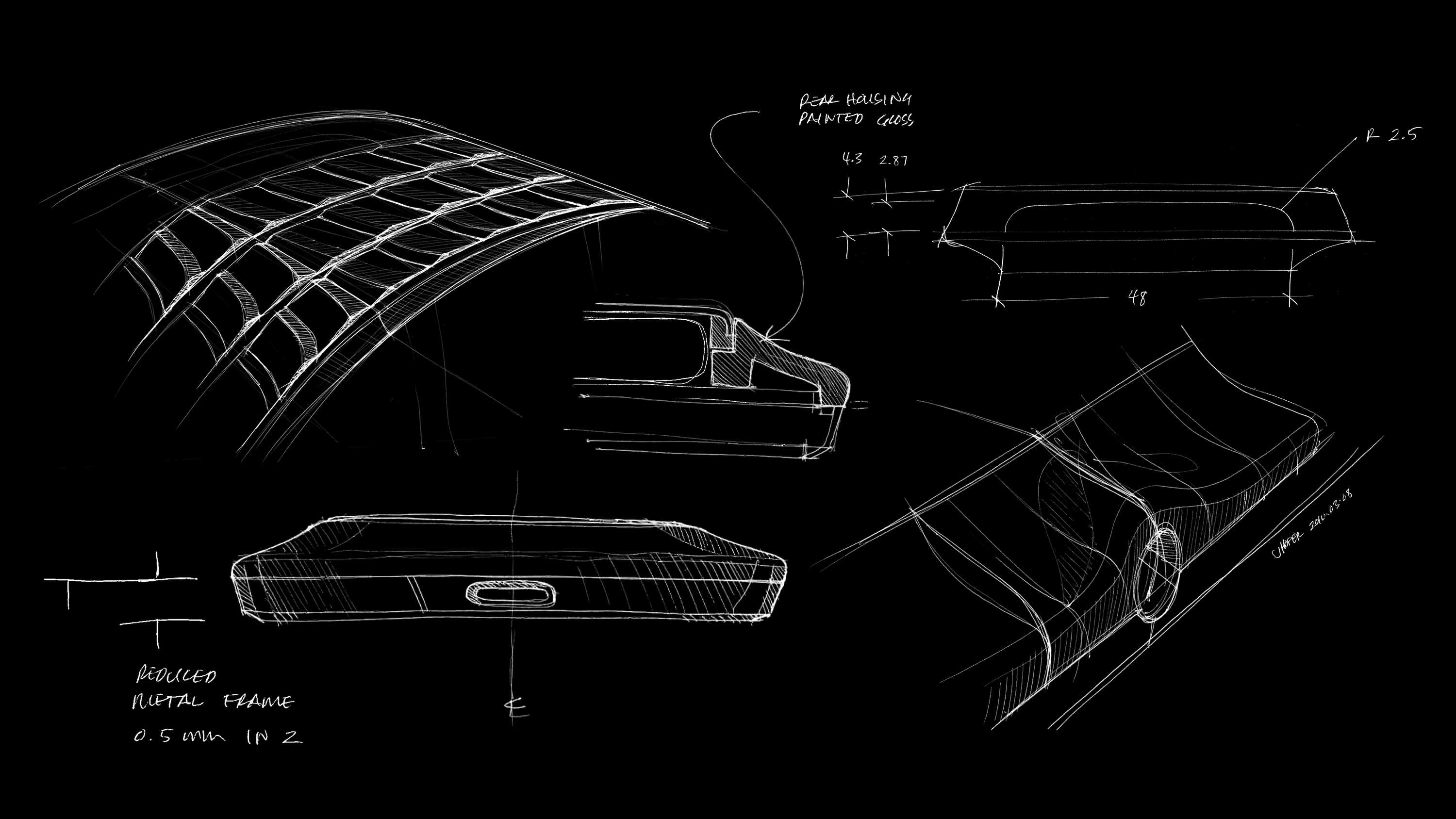
Bold_9900 Dessins faits mains
L: What are the main differences between laptop and tablet design?
TW: The biggest difference between a tablet and a cell phone has to do with usage. The keyboard, screen and navigation are the central elements of a BlackBerry smartphone. A tablet, on the other hand, is more all about touch. In designing the BlackBerry PlayBook, we’ve put more emphasis on the screen and the purity of the design.
We use gestures and multitouch to bring the Playbook to life.
We wanted to create a tool that would enable mobility, and choosing the 7-inch size is a good compromise, as it’s the size of a DVD case. The tablet is thin, light and very pleasant to use.
We worked on the contrast between the coldness of the screen on one side and the softness of the back of the tablet on the other.
All BlackBerry products have a similarity in terms of design: they are built on a central axis, a symmetry. It’s our design DNA.
L: How is design organized at Blackberry?
TW: We take care of the whole user experience (hardware, software, apps), everything is centralized in our design studio.
Application design is done by former designers or graphic artists. There are no boundaries between software and hardware, we connect the two.
We use a lot of simulations and prototypes.
We put a lot of work into design, and every touch on a Blackberry is different and has its own design.
Lots of little details that you can’t see at first glance, but which make all the difference to the final product.
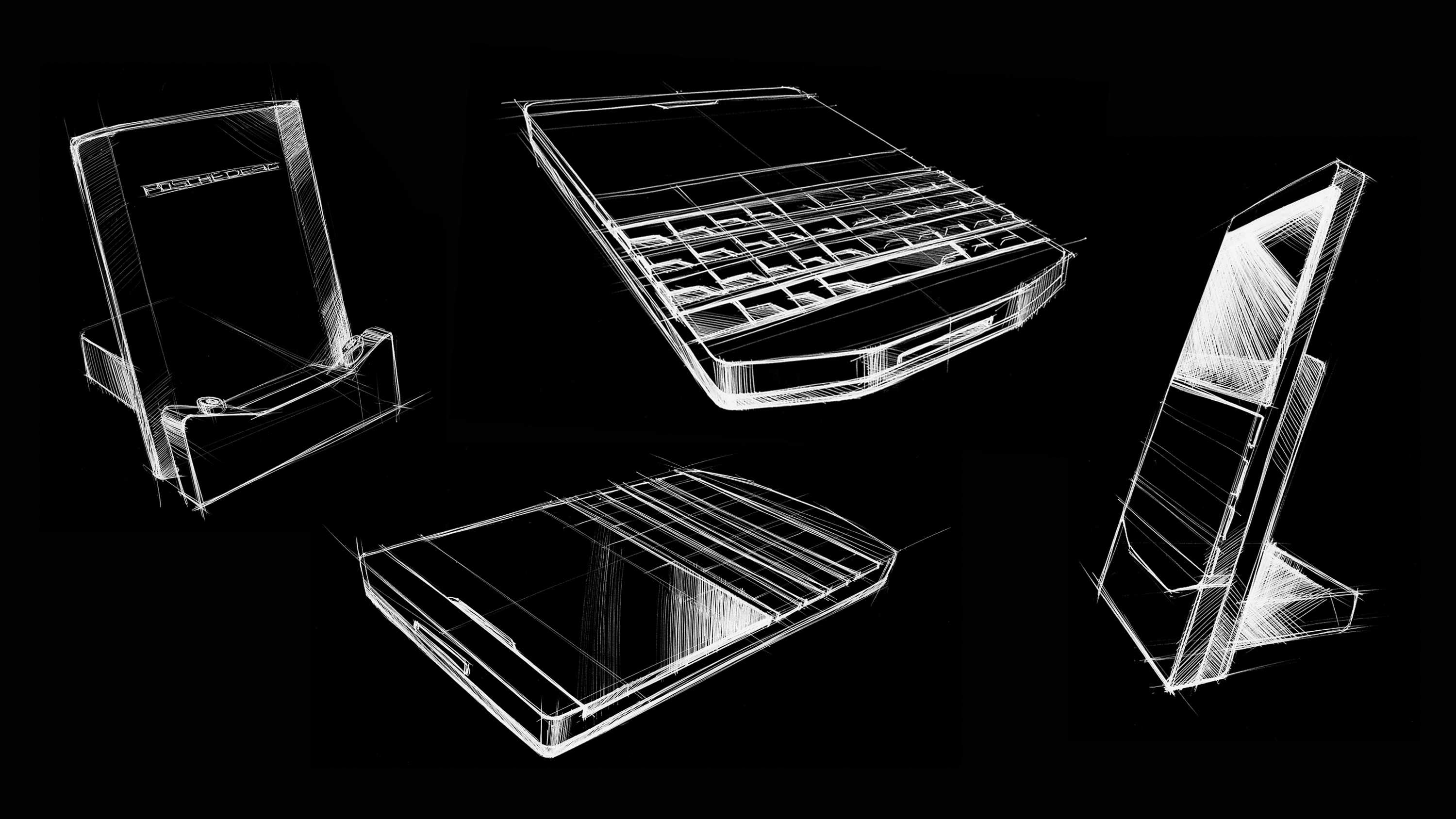
Blackberry Porsche Design
L: Tell us about the partnership between Blackberry and Porsche Design?
TW: We were approached by Porsche Design. Porsche Design is an interesting and influential brand in design. I was a fan of the brand myself when I was a student.
F. A Porsche, who now heads the Porsche design studio, is the man who designed the Porsche 911. The Porsche family left the group in 1972 and launched this design studio. They wanted to add a smartphone to their design collection, and wanted to team up with Blackberry because they were using Blackberry phones themselves.
Roland Heiler and I met to see how good an idea this could be.
The most exciting thing about this project was that we were designing a luxury product, so we could do things that we wouldn’t be allowed to do with mass-market products. We were free.
We also share many common values, such as originality, creativity and a focus on ease of use. We wanted the product to be true to both brands, and to be totally functional. Despite its extravagant appearance, the BlackBerry Porsche Design fits in perfectly with the Blackberry range.
L: After touch and the classic keyboard, what does the future hold for cell phones?
TW: We’re always looking for new ways to work, to see if we can use/integrate new features. Some people have turned to the stylus, or to using the voice. In all this, the most important thing is social norms, because cultural habits have a strong impact on technology.
Multitouch and tactile technology are still in their infancy, and we haven’t yet seen the full extent of their capabilities. We’ve become accustomed to new gestures thanks to telephones and tablets: the gesture of zooming in using our thumb and forefinger seems natural to us, whereas it didn’t exist just a short while ago.
L: How do social networks impact your design?
TW: BlackBerry is, I think, the perfect tool for all this because these applications are all about text. Twitter needs speed, so Blackberry is a great ally. More and more users are constantly connected to their social networks and BBM than to their e-mail. That’s why we designed the Social Feeds Aggregator, to give you an overview of all your social feeds at once. This has less impact on the hardware and more on the software. Having said that, we’ve seen users programming certain keys on their phones for faster access to their social applications, which is quite amusing.
L: The only thing that isn’t moving faster in the world of mobility is the battery… How much attention are you paying to the battery?
TW: We’re very sensitive to this problem. We’re constantly connected these days, and today’s networks consume a lot of battery power.
Consumers are hoping for at least a day’s autonomy.
Sometimes we don’t compromise on the battery. We could have even slimmer products, but we don’t want that to spoil the user experience.
We’ve also opted for a detachable, replaceable battery, so that users can have a spare without too much hassle.
We prefer to use our design skills to improve the fluidity and look of the smartphone.
Pascal Iakovou
Cette publication est également disponible en :

