

Jean-Claude Wolff has been a free and authentic composer for some thirty years. Last May, one of his works was performed by the New York Chamber Brass ensemble at the prestigious Purchase College University in New York. In March, at the Printemps musical d’Annecy festival, we were able to discover Fragment of exile, a work for cello and piano. From solo instrument to large orchestra, from solo voice with piano to opera, Jean-Claude Wolff has written for all types of ensemble. Shis works testify to the richness and originality of his musical universe. An encounter with a composer who occupies a special place in the very private cenacle of contemporary music. 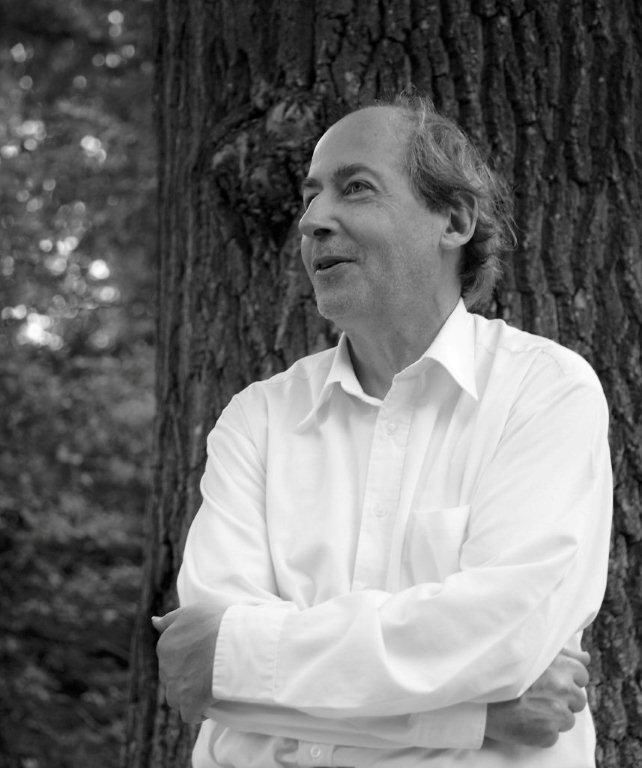
How does a chamber ensemble like the New York Chamber Brass come into contact with a composer like yourself?
There are many possible encounters between a composer and an ensemble. In this case, the meeting came about through an agent – Hélène Villette – who sensed that there might be artistic connivances between my music and the New York Chamber Brass. I sent Hélène Villette scores and recordings of my music, and for her part, she introduced me to the ensemble’s repertoire, consisting mainly of original compositions written for this group – namely two trumpets, a horn, a trombone and a tuba.
Is it an aesthetic choice for the New York Chamber Brass to call on designers?
The repertoire for brass quintet is not very extensive, consisting mainly of works by composers of the 20th and 21st centuries. The ensemble, led by Graham Ashton, is always on the lookout for new works. It turned out that our aesthetic universes could find correspondences. So I composed a work for him, specifying that I wanted to retain complete stylistic freedom.
The work in question is entitled Pratea, résonances liturgiques. Why this title?
Pratea in Latin means La Prée and refers to the Abbaye de la Prée, an ancient Cistercian abbey in the Berry region, near Issoudun. The abbey is a place of residence for artists, including visual artists, filmmakers, writers and composers. It was here that I was able to compose this work. It’s a place where something spiritual blows through, something difficult to define…
Hence the liturgical resonances?
It was necessary to include them in the title… At La Prée, there’s an atmosphere that has to do with the spirit of nature, with a certain mystical connotation. I don’t know if I managed to convey this emotion in Pratea, but it was one of my starting points.
How and why do you decide to write for a specific course?
There are several possible scenarios. It may be an order for a specific course, as with Pratea. You have to accept or refuse. It’s a question of knowing whether this imposed formation meets your inner requirements. Most of the time, you compose without a commission, hoping that you’ll find opportunities to produce the work. The most extreme case is that of my opera Le Quatuor , for which I’m currently unable to find a production.
What are your sources of inspiration?
I don’t think composers are always aware of their inspirations. As Debussy said, it could be the wind in the leaves… Anything can become music. What often inspires me is an expressive need. For me, the origin of a work is often emotional. With musical composition, we’re lucky – for me at least – not to need words to evoke deep, intimate emotions…
And how do you translate this “feeling” into musical language?
When it’s an instrumental work, I start with a sensation that turns into a chord, a melody, a timbre or a combination of timbres… The succession or juxtaposition of small different elements can give the work its atmosphere, its framework, as can be found in certain passages of the symphonies of Gustav Mahler or American composers like George Crumb. Sometimes, it’s just a mosaic that’s being built up, and you have to give it an intimate coherence that doesn’t depend on pre-established forms. Even the most connoted forms, such as the fugue, can be used, but they have to be in tune with the thought and gesture of the work, otherwise we quickly fall into academicism. This can also happen with the absence of forms…
How do you reconcile this emotional intimacy with the specifications of a commission?
You need foresight, humility… If you’re told you need a brass quintet or a reed trio, it triggers ideas for sounds and combinations. It’s always a challenge to meet a set of specifications that includes: the formation, the duration of the work and the deadline, the “time left” to compose it. With a bit of practice, you become more lucid than at the beginning of a composer’s life when faced with this problem. On the other hand, I categorically refuse the slightest stylistic constraint, such as making a work melodic, making a work that’s not too sad or adding “contemporary” instrumental effects… or doing without them!
In your opinion, is there an ideal shape that we’re trying to get closer to?
I don’t know what you call the ideal form… I prefer to refer to this phrase from the Gospel: “There are many dwelling places in the Father’s house”. But I’ve always adhered to the idea of an absolute beauty. I’ve always believed in this idea, currently considered utopian, enunciated by Jean-Jacques Rousseau – among others – and found in the writings of Robert Schumann… A certain spiritual demand, a “true” music, as Celibidache said, yes, that’s part of my research. But these demands, misinterpreted, can lead to dogmatism and intolerance, to a lack of open-mindedness, if I may put it that way, which is very dangerous…
There’s something of a musical calling in you. Have you always wanted to become a composer?
I’ve always wanted to write little melodies in the style of the music I learned as a child on the piano. Unlike young people who improvise, I wanted to fix them on paper, to give them a lasting existence. This trend continued throughout my adolescence. Around the age of fifteen, I started putting more important things down on paper. At the time, I adored two composers who are beacons for me: Beethoven and Bartok.
And then, what happened?
When I graduated from high school, it was obvious to me that I wanted to live my life in music. I hesitated between composing and conducting. I soon realized that conducting wasn’t for me: I was – and still am – too shy, too introverted, you have to have a certain “comediante” side. But I always had this desire, and sometimes this joy, to create, even if my so-called theoretical studies didn’t always encourage this impulse. I entered the Conservatoire National Supérieur de Musique de Paris and took composition classes with Henri Dutilleux and Ivo Malec, as well as Claude Ballif’s analysis course.
Are you nostalgic for your early days?
In itself, nostalgia – the “Sehnsucht” of the Germanic world – is part of my temperament, part of my expression, so I may miss the old days… But I suppose your question is more about the time of my higher musical studies, so I can answer that I have no nostalgia for them, that I lived that period in great isolation, a great musical solitude, and that, despite the human and musical quality of several of my interlocutors, I didn’t make the encounter that would have enabled me to clarify my language, to discover, beyond fashions and catchwords, my real personality. No, I don’t have many good memories, apart from the occasional heated discussion with a few colleagues, but rather with those who were somewhat marginalized in their relationship with institutions.
Are there any doubts along the way?
Doubt has never left me, I’d say it’s consubstantial with my nature, but that’s not very original, many creators live with this feeling. What can be dangerous is when self-doubt gnaws at you to the point of never being able to finish a piece. The desire for self-improvement is wonderful, but it shouldn’t get in the way of pleasure and joy.
So it’s a lifetime commitment. What were the works you wrote that confirmed your choice?
The first work I think of is my symphony number 2 for violin and orchestra, a relatively old score I composed when I was resident at the Villa Medici in Rome. For the first time, I felt I was letting go of a melodic expansiveness I’d been holding back until then. It’s a score that lasts twenty minutes, in a somewhat “Mittel Europa” spirit. The work is reminiscent of Arnold Schönberg, Alban Berg, Gyorgy Ligeti and writers like Arthur Schnitzler and Joseph Roth… Of course, this kind of correspondence remains highly personal. This work has had important social repercussions for me. It was created and recorded. That’s far from always being the case.
Are there any other pieces that are particularly close to your heart?
Yes, many years later, my recently-composed opera Le Quatuor. This composition was supported by the Fondation Beaumarchais (2005-2009), but for the moment has no prospect of being performed. Its production requires considerable resources in terms of singers, instrumentalists and staging. What’s more, it lasts 3hrs 15mins, whereas the fashion is for short operas, often on political or social subjects, which is not the case here.
Then why did you write it?
Because I really wanted to. I wanted to write a dramatic work with a situation, an action, an affect linked to characters, a real psychology translated by purely musical means. And then there was a real encounter with Rory Nelson, who is a writer as well as a musician, and who is the author of a long short story, The Quartet. When I read it, I had the feeling that it was the right subject for me, both dreamlike and realistic. The characters are sensitive, lively and mysterious all at once. The plot is clear-cut, but it also allows for a wide range of interpretations and flights of imagination… It reminded me of Bergman’s films, where the fantastic element blends with realistic, framed elements. I’m thinking of Wild Strawberries, Silence and, among his more recent films, Fanny and Alexander. Composing this opera kept me busy for ten years, although I also wrote a number of commissioned instrumental and vocal works over the same period.
Given all the work you’ve produced, do you feel you belong to a particular movement?
It’s hard to define yourself… If we’re talking about schools and trends, I’d like to stress that I’m independent. It’s true that many composers claim not to belong to any particular movement, but in fact they do belong to a school: whether it’s post-serial, spectral, “neo-tonal”, minimalist, repetitive or electroacoustic. Personally, I’d like to reject nothing. It all depends on the work and the thought.
So how would you define your music?
I would say that my music is expressive, even affective, but within the framework of an elaborate architecture. And in my works, I sometimes seek a synthesis or an encounter between several musical currents, when at least I think that musical thought demands it. I refuse all censorship and self-censorship in a score. I’m learning to listen to my inner voice, as Andrée Chedid used to say, with whom I had the joy of working. Above all, I feel attached to the tradition of European music, in this great history that goes from Gregorian chant to the present day. I have to say that I’m very European, in the sense that Stefan Zweig set out in the title of his diary, which of course takes nothing away from the homage I can pay to the expressions of other civilizations. I live with what Gyorgy Kurtag calls the filter of memory… something in music, in art, but also in sensitive nature, which inhabits me and which from time to time reveals itself more clearly on the occasion of the composition of a musical page.
What about today?
I’m currently working on two commissions. A composition for three women’s voices, to be called Exils élégiaques, inspired by little-known 17th-century poets such as Nervèze. It was commissioned by the “Résonance Contemporaine” ensemble, directed by Alain Goudard, with whom I’ve been working regularly for some fifteen years. The second commission is a piece for guitar and string orchestra by guitarist André Simony, who has just recorded an album of South American music and is preparing a second album of contemporary music, which will include one of my scores, Morale II. The guitar is a very difficult instrument to write for, if you don’t want to fall into arpeggio clichés. I’ve composed for it several times, either as a soloist or as part of a chamber ensemble, but I’ve never been completely satisfied with the guitar writing itself.
Can you be one hundred percent satisfied with your work?
Of course, I can only answer in a personal capacity. There’s often a gulf between the ideal dreamed of at the very beginning of the idea for the work and the final realization… At the same time, you have to have the humility – or the wisdom – if you’re convinced that you’ve worked (because it’s work, and sometimes very hard work) conscientiously (and if not, what’s the point!?) to say to yourself: I did, at that moment, what I could. Be personal, without ever trying to be… express the sensitive, the interior, the affect, while remaining within a musical expression… never despise the listener or the spectator, but never compose according to his or her supposed desires… If you can say that after having finished a work, it’s already not so bad!
Interview by Odile Woesland
photo credit: Guy Bompais
For more information, visit
www.jeanclaudewolff.com
Cette publication est également disponible en :

