

Tinged with an “almost” tender cynicism, an “almost” desperate sense of humor, the two songs just published by Michel Houellebecq – world-famous novelist and 2010 Goncourt Prize winner – and Jean-Claude Vannier – creator, with Gainsbourg, of the legendary album L’Histoire de Melody Nelson – take their disillusioned melancholy from the marital bed to the suburban supermarket. And – above all – they resemble their authors. Terribly so. Interview with Jean-Claude Vannier. 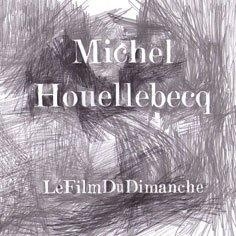
When did you first meet?
Jean-Claude Vannier: I met Michel Houellebecq in 1999, at a cocktail party at Le Procope (a famous Parisian café on the Left Bank), where I was receiving the Prix de l’humour noir. He came up to me – he wasn’t that well known at the time – and said, “Every time I listen to a song or a piece of music I like, you’re always in it, in one way or another.”
And then what happened?
J-C Vannier: He said he’d like to get to know me, and sent me his poetry collections, which I really liked. We agreed to meet at the end of July. On the 31st exactly, while I was spending some time in the Cévennes, the phone rang: he was waiting for me at the village café. We met there, and I gave him two tunes. He wrote the songs Le film du dimanche and Novembre.
Why didn’t you compose from his poems?
J-C Vannier: Because a song isn’t just poetry set to music, it’s a whole, with lyrics and music designed for each other, to be sung by someone we’ve chosen.
So why did you choose precisely these two pieces of music for Michel Houellebecq?
J-C Vannier: In fact, one piece of music I already had seemed miraculously appropriate, and I wrote the other especially for this occasion, with Michel in mind.
How did you feel when you read the lyrics to Le film du dimanche and Novembre?
J-C Vannier: That what I sensed was coming true: there’s something in common between this music and these lyrics. I found them full of a sorry humor, like what I try to convey in my music in general, a regret, an amused nostalgia for something that doesn’t exist. I was extremely impressed and pleased when Michel read me his lyrics.
You get the same disillusioned look, full of cold humor…
J-C Vannier: It’s true. When I read his books of poetry, I found we had the same way of looking at life, the same way of looking at the city… I felt I was on familiar ground. It was as if I’d found a fellow traveler.
Was it difficult to convince Michel Houellebecq to sing?
J-C Vannier: In 2000, he had already made a record, Présence Humaine, produced by Bertrand Burgalat, in which he spoke over rock music. But I preferred him to really sing. He bravely took singing lessons, and we recorded the songs. I really like the way he sings. He sings like an author. He has the charm of certain American artists…
For example?
J-C Vannier: I’m thinking of Cole Porter… In one of his albums, Let’s Misbehave, he accompanies himself on the piano. When you listen to him, you hear his own truth. It’s the same for Michel Houellebecq. It’s not a singer’s voice… You hear an author with his words, his soul. It’s really very touching.
What would you say about your music?
J-C Vannier: I can’t talk about it. In fact, it’s impossible to talk about music. It’s such a deep feeling, it goes straight to the heart, it pierces you in spite of yourself. I can’t explain it.
Why release these songs more than ten years after their creation?
J-C Vannier: When Michel and I wrote them, it was for our own pleasure… not for success, nor to become billionaires (laughs). A month after he won the Prix Goncourt, I sent him a congratulatory e-mail. He asked me what had become of our songs. So I sent him the recordings and said, “If you don’t get a horror attack when you listen to them, we can put them on the net.”
They haven’t aged a day!
J-C Vannier: You can hate what I write, you can dislike Michel’s words. But in the end, each of us has our own way, our own style. The problem isn’t being good or bad; the only difficulty is being yourself. In fact, to my mind, that’s the only question that matters: does it resemble him, does it resemble us?
You can listen to Jean-Claude Vannier live on France Inter on February 19 at 3:45pm, in a program presented by Valli. In the meantime, you can download November and the Sunday Film by clicking here :
http://world.idolweb.fr/alceste-musique/michel-houellebecq/le-film-du-dimanche—single/3700551712717.html
Interview by Odile Woesland.
Single visual by : Camille Vannier.
Cette publication est également disponible en :

