

The exhibition“Rose, c’est Paris” at the BnF Richelieu in Paris until July 11, 2010 is an intense experience, a plunge into the world of dreaming, eroticism and the unspoken but above all an exploration of duality.
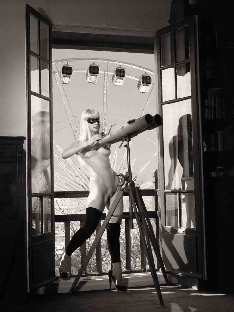
Magic City III
Duality of supports first.
The exhibition relates B.’s initiatory quest for her twin sister Rose, whom she claims has disappeared, in an intimate Paris described through the lens of Bettina Rheims, in the course of a fictional work conceived with the complicity of Serge Bramly. A film and 120 photographs help us follow the heroine’s journey in a surreal Paris that seems to have no desire to take root in today’s Paris. But it is a journey in Black and White where famous and anonymous models are staged in mythical places in the form of paintings. Two complementary supports but which knew how to preserve their independence: they can survive one without the other even if they speak only of one voice so that one explains the non-details of the other in a brilliant step of two.
However, the film is shown every day at the entrance of the exhibition. There are also a few screens in the exhibition room itself to follow Rose’s progress. But the small corner at the entrance is not very convenient to watch the movie which lasts more than one hour. It is better to plan to see it on a screening day in the BnF auditorium in more comfortable conditions to fully appreciate it. However, these broadcasts are too few and are exclusively on Saturdays.
Duality of views where the photographer Bettina Rheims’ view merges with the words of the writer Serge Bramly.
The two authors imagined together scenes, like a series of living paintings, that Serge Bramly filmed with an HD camera at the same time that Bettina Rheims photographed them. They have imagined hypotheses about Rose’s disappearance in which her twin sister acts like Fantomas in a legendary Paris. She becomes in turn a stripper, a Japanese opium smoker, a real chameleon of modern times. The initials of the two sisters are B and R. Is it just Bettina talking about herself in a coded language that only insiders can understand? Or is it rather to remind us that one could be Bettina Rheimsand the other Serge Bramly?
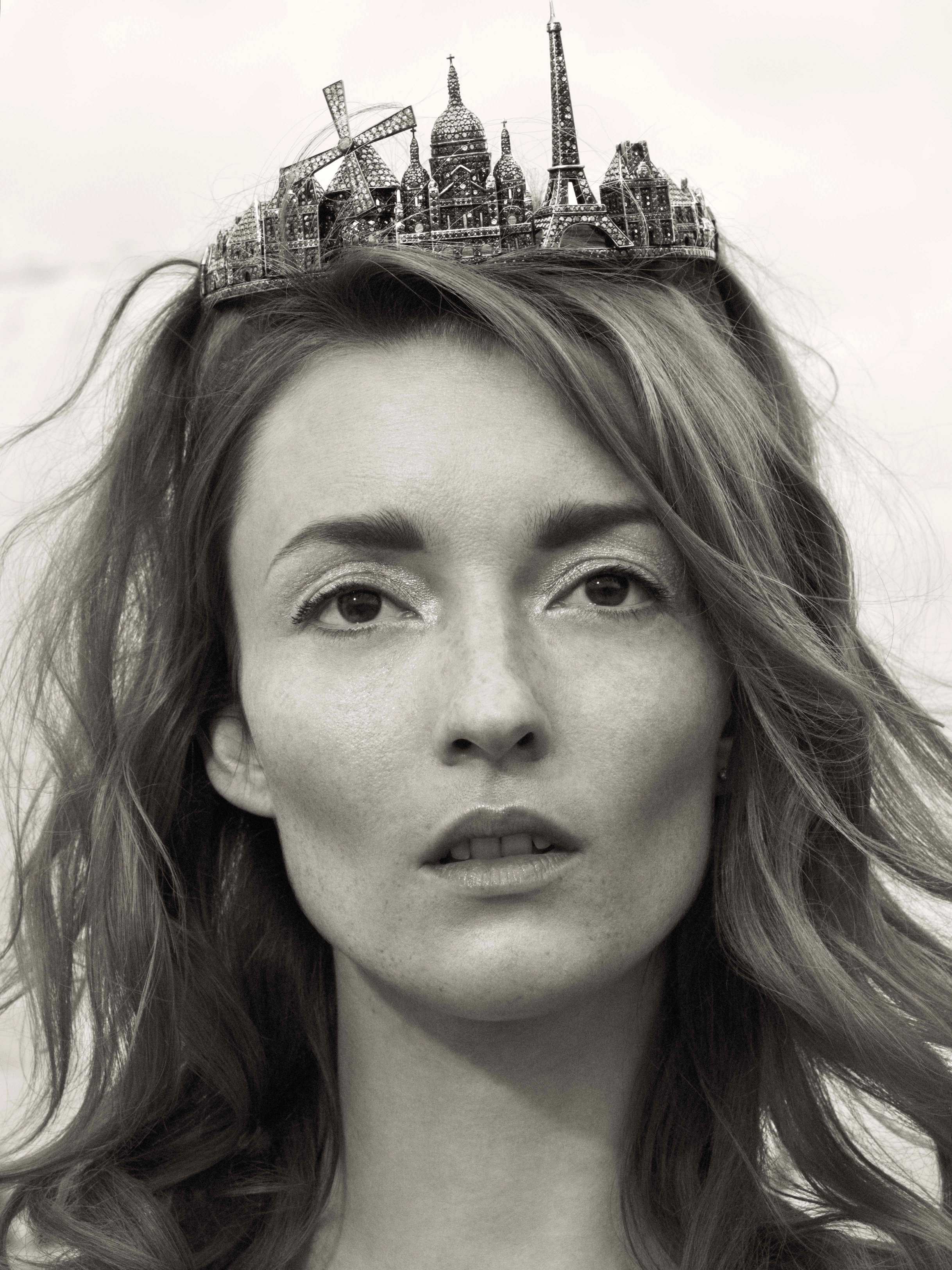
Paris Diadème
Duality of heroines where B. searches for her twin sister even if we know in advance that her quest will take her nowhere but to herself.
Because there again, duality is very present, Rose and her sister in mirror effect, like a duplicate who sometimes watches herself suffer. And throughout her quest, she meets women who look like Rose but are not Rose, such different facets of the same woman. Doesn’t Rose wear a mask on half her face? B. does not hesitate to replace her sister to live her life, her sufferings, her pleasures, one and the other are going to end up merging then to dissolve surely. Through the different scenes we will meet Naomi Campbell – one of the only characters whose voice we will hear -, Michelle Yeoh, Monica Bellucci, Charlotte Rampling, Valérie Lemercier as a gastronome, Anna Mouglalis as an oracle, Audrey Marnay, Louise Bourgoin as a modern Marianne or Hélèna Noguerra as the fabulous Sainte-Rita. Famous or anonymous, women are everywhere because Rose can borrow all the faces to be the absolute woman, assuming her dark side and playing it to perfection. The rose is very present in the story (and in the photographer’s work) until it is poisoned.
Duality of Paris.
Of course, the emblematic monuments of Paris (Eiffel Tower, Sainte-Chapelle) are present but Bettina Rheims prefers to take us to an underground Paris, mysterious, full of secrets: the dome of the Observatory, the basements of the Palais de Tokyo, the underground canals… But these places are more than just scenery, they are an integral part of the story, they inspire the quest itself and set the action in a Paris between two wars, far from a modern and flamboyant Paris.
This fantastic story is strewn with tributes and references (Salvador Dalí, Man Ray). The film begins with a tribute to Serge Gainsbourg, the man who loved women, and turns into a real cry of love for Helmut Newton, through paintings of porno-chic aesthetics, sadomasochistic scenes in disembodied dolls with an icy aesthetic.
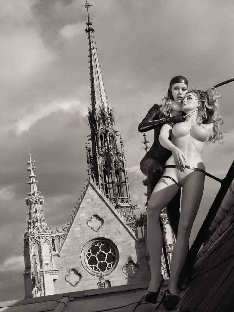
Joyau de l'art gothique
But very quickly, the shadow of Marcel Duchamp hovers over Rose, he who loved secrecy, signs and games so much. He did not hesitate to divert the elements and to play with words. Bettina uses her lens in turn to play with the elements and perhaps with us. Like not seeing Rrose Sélavy, Duchamp’s fictional double, in “Rose, c’est Paris”! The artist immortalizes here a Mona Lisa in the subway which is not without reminding L.H.O.O.Q. or reinterprets there the Bride put to nude by her bachelors, even.
The cinema of old is not forgotten between Belle de jour and Casque D’or, the references abound for our greatest pleasure with Death put to death, which is not without reminding a certain film of Quentin Tarantino. And the Vanity Chair is one of the most brilliant vanities photographed in years.
A magnificent work TASCHEN Rose, c’est Paris is available in a limited edition at a price of 750 euros with a signed and numbered Collector’s Edition (1500 copies) which includes 200 photographs, a DVD and various objects (rose, wolf, miniature Eiffel Tower…) presented in a suitcase. The exhibition catalog is nevertheless available for 25 euros and offers a selection of photographs as well as an interview with the two artists.
Bettina Rheims shows us a bit of herself through this exhibition but she doesn’t give us all the keys. It’s up to us to find them, only his relatives know, we must guess. But one cannot help but contemplate his work bordering on perfection, his mastery of shadows and his share of darkness, his highlights and his obsessions. The photographer proves to us that she is indeed“a photographer of the skin” as she says herself. A former model turned photographer, she exposes other women through her lens, revealing them in their most intimate form. His alter ego Serge Bramly is a writer, scriptwriter, food critic and art critic, especially of photography, for many magazines. He has collaborated many times with Bettina on her previous projects.
We can only bow down to their work and go in search of Rose…..
Photo credits: © Bettina Rheims, Courtesy Jérôme de Noirmont Gallery, Paris
BnF – Richelieu site,
Gallery of Photography, 3-5, rue Vivienne. 75002 Paris.
Tuesday to Saturday 10am to 7pm, Sunday 12pm to 7pm
Closed Mondays and public holidays.
Admission: 7 € , Reduced rate: 5 €.
Marie-Odile Radom
Cette publication est également disponible en :

