

Charles Baudelaire : There is in the act of love a great resemblance with torture or with a surgical operation. (The Flowers of Evil)
Love Can Damage Your Health – Telepopmusik
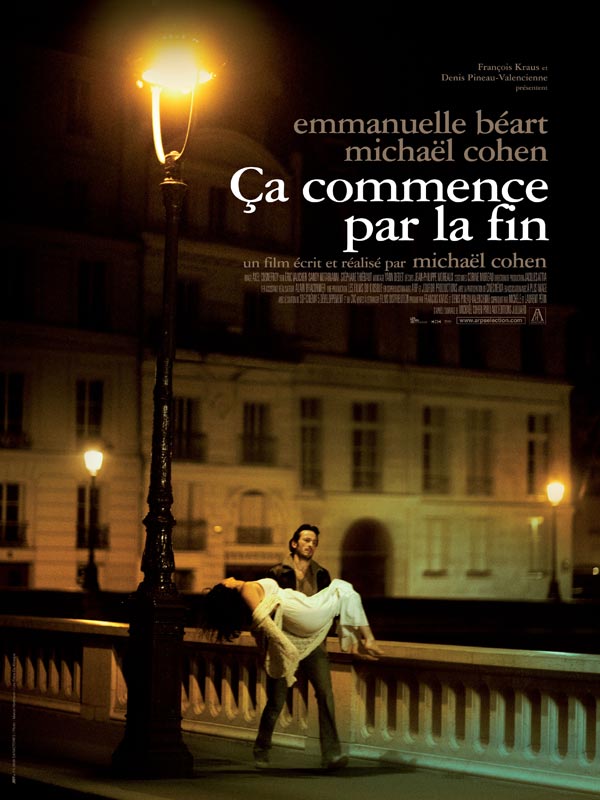
-
Interpreters : Emmanuelle Béart (Gabrielle), Michaël Cohen (Jean), Léopold Kraus (the child), Jean-Paul Dubois (the café waiter)
-
Distribution : Arp Sélection
-
Duration: 1h28
-
Release date: May 26, 2010
It starts with the end – The trailer
The critics have – almost unanimously – shot down this first film by Michaël Cohen.
Some examples, gleaned here and there:
Le Figaroscope: It’s a well-known refrain that love stories usually end badly. Entrust one to a couple of actors, united in real life, Michaël Cohen and Emmanuelle Béart, and they come up with a kind of disaster movie (…) where passion in love turns into a war of the sexes full of clichés.
Les Inrockuptibles : Michaël Cohen (…) stages this impossible love with a little too much heaviness. (…) The scenario, more than going in circles, is often quite clumsy. (…) Emmanuelle Béart, fragile, raw, has to give everything, it is difficult for her to save the first film of the one she shares her life with.
Ouest France : Despite the real passion that the couple can put into it (…) one is more annoyed than moved and disturbed by this melodrama imprisoned in an extreme formalism.
Télérama: We are not happy to demolish this “love story in the disorder”, where (they) seem to play their life… But his sincerity is matched only by his clumsiness.
Le Monde : Lack of invention in the script and the direction.
TéléCinéObs : A man and a woman tear each other apart before our eyes. Either. But when the screen turns into a keyhole and stages an illustration of the Kama-sutra for star peep-shows and a vociferous hysterical passion, the feeling of attending a show exclusively intended for those who orchestrated it leads to a nameless embarrassment.
1.2.3 Criticism.
Disaster film, heap of clichés, heaviness and clumsiness, excessive formalism, lack of inventiveness in terms of history and staging, feeling of uneasiness in front of this film where we would become almost voyeurs…
And Etc Etc Etc.
I told you so…
And, one would almost wonder how the couple Béart/Cohen is doing today (after the release of the film), in real life?
So yes or no?
Does “Ça commence par la fin” really impose on us, for almost an hour and a half, something excessively embarrassing, namely a love story that “goes to shit (too often)” (in every sense of the word)?
To be honest, I doubt it, I don’t know, and I don’t really care (either).
On the other hand, I am willing to tell you my story about the film. With, it goes without saying, all the criticisms in less, because I have the impression that, from this point of view, I am already a little late…
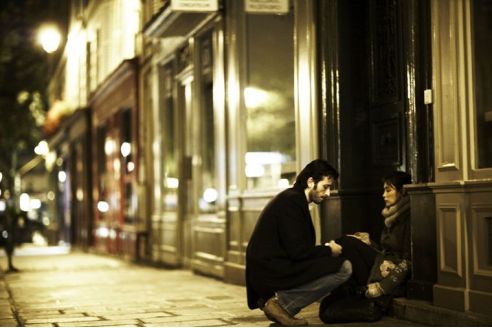

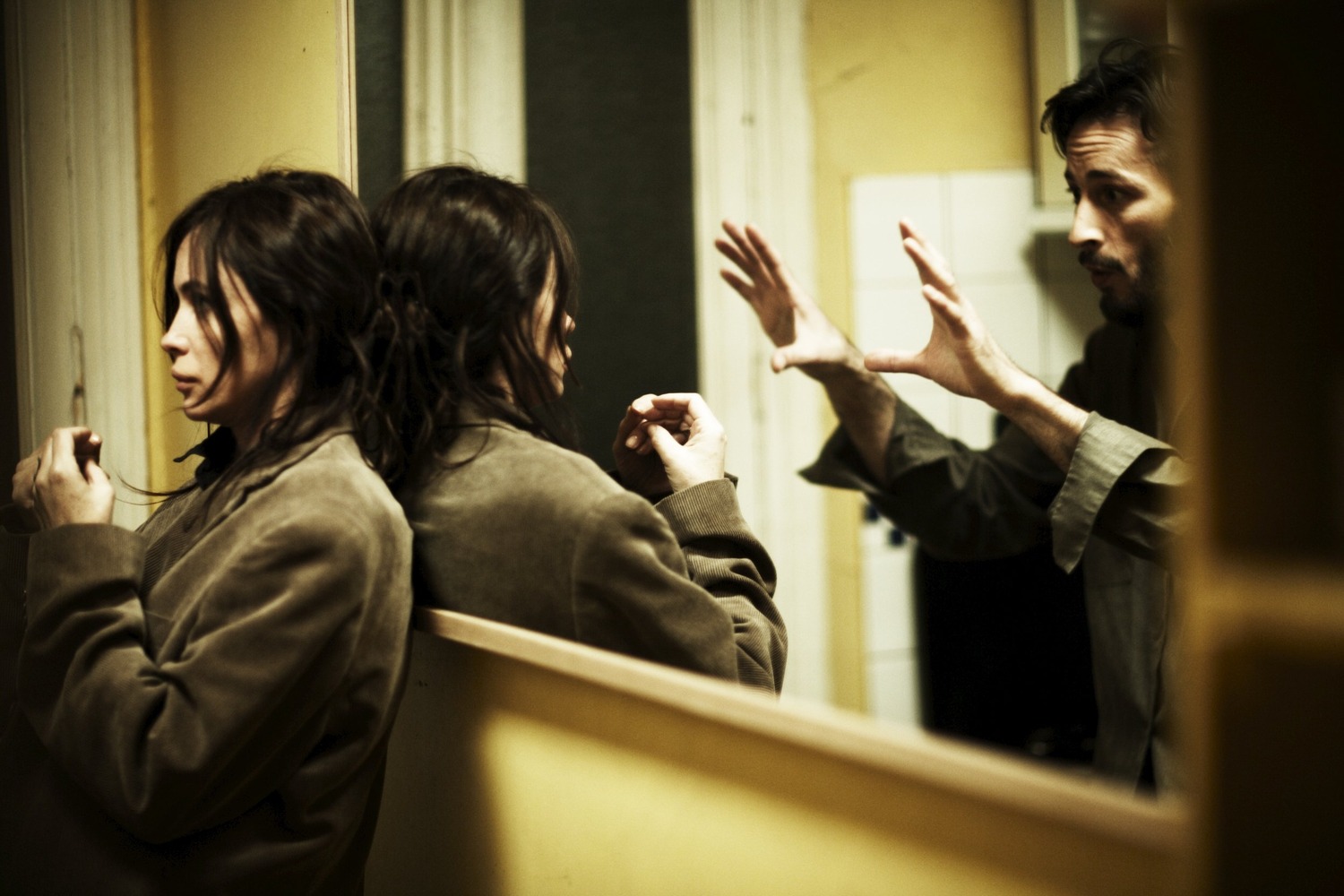
This is Paris. A sunny Paris. Its café terraces. The Turgot in the 9th (I think). She drinks coffee. She eats lemons, with the skin. She also drinks beer. And, she smokes, a lot. He spends his time looking at her. To really look at it.
She works in a company that “helps companies set up”. By the way, in this regard, he’s kind of taking the piss. He is writing a book about the sunny moments of the café terraces in Paris. By the way, on this subject, she also makes fun of him a little.
She is never alone. Finally, she still has lovers. Lots of lovers “who reassure her”. The two of them “fuck” most of the time in a bar bathroom. She speaks simply. A “raw speech”. And, she often leaves him. Like closing a little – like – a western door.
Gabrielle: I’m leaving you.
Jean: Not me.
There are no rules. Everything creates disorder. We don’t know “what moment in history”. We cling to his beard, which gives us some clues of time. He says that his beard protects him from being naked. They are still naked, often.
It’s (always) the same story. They meet each other. They love each other. They tear each other apart. They separate. And they cry. All the same, with lyrics, sometimes naive, sometimes disgusting, but in a mess without name, and several times, history of…
Gabrielle: I’m a jerk, I love you.
John: The next time you leave me, I’ll kill you.
She screams of having no limits. No limits. (Except that we realize how much worse he is). For lack of a train, he even throws himself out of his window. Luckily, nothing was broken on the outside.
The whole film, she is afraid, and that’s it. Panic attacks and multiple fears around him and the pathological love she has for him. As for him, he is simply afraid that one day, she will stop – just – loving him.
Gabrielle: I didn’t want to let go of your hand, but I thought we had made a decision and we were going to live with it.
Jean: Did you come back for me?
Gabrielle: Yes, I did what you never stopped doing.
So, if the film is badly made, and if there are cinematographic, technical, dialogue clumsinesses…, which don’t necessarily give the right combinations, maybe in the end, it makes sense.
PS: It’s still a love story.
Elisa Palmer / LUXSURE
Cette publication est également disponible en :

