

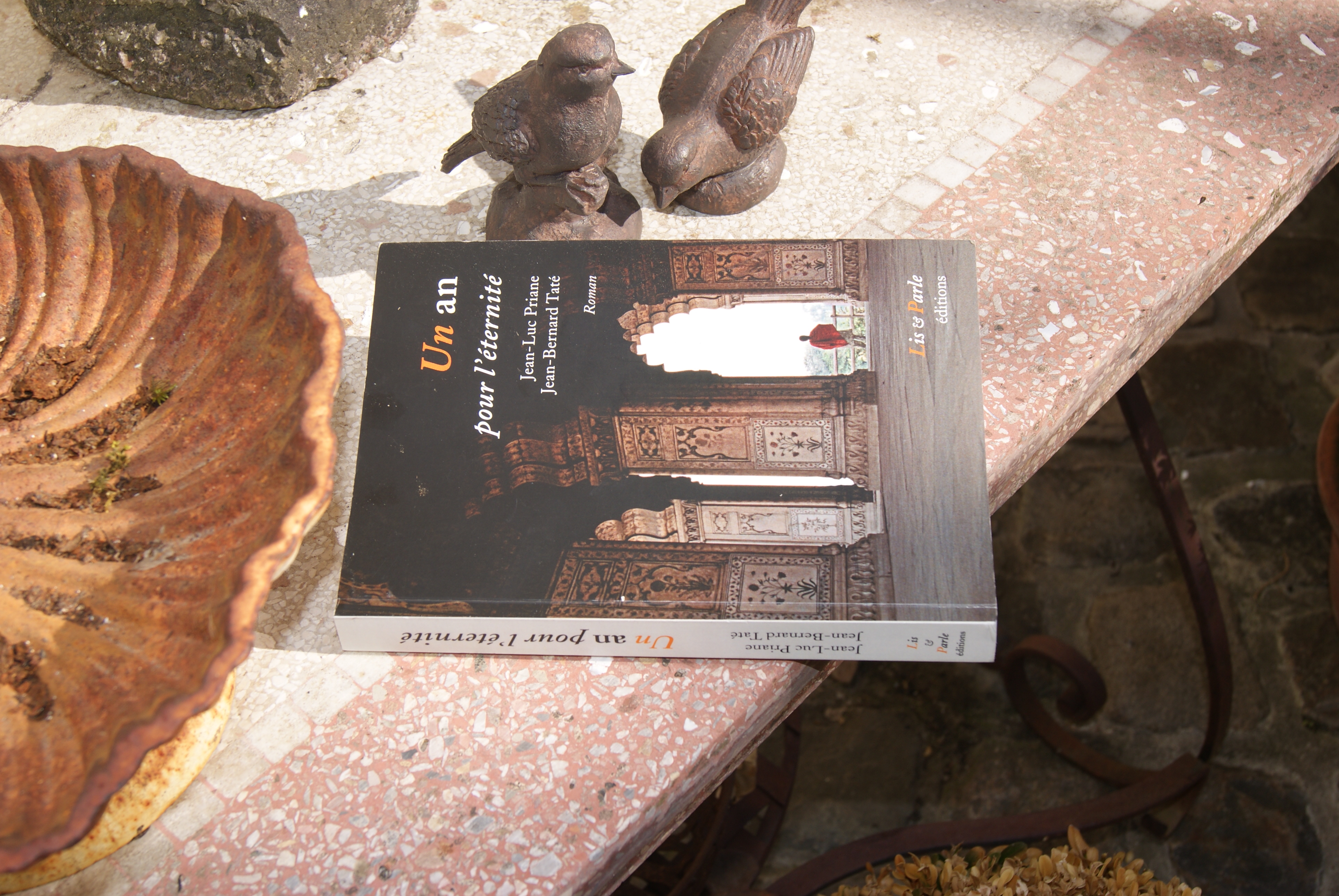
One year for eternity
Jean-Luc Priane and Jean-Bernard Taté
Editions Lis & Parle
April 2010
Price: €19
Tuesday, May 18, 2010 – Le Tréport (Haute-Normandie)
I took the book on vacation.
(I should add, however, for the sake of accuracy, that this is not a summer novel).
The “Lis & Parle” editions did not exist, in my mind, before I received the book in my “BAL”. From now on, after reading (3 or 4 hours in one go), I take on my second mission: speaking.
Cover photo: the Mongolian fortress in New Delhi, India. In the title: a rather stereotyped formula, a little naive. Finally, on the back cover: a version of the story from which one retains diagonally these few elements: “Three young friends united as the fingers of a hand”, “an excessively constraining promise”, “an act taken at an age where the consequences are difficult to foresee”, “the torments inherent in the human condition”, “in India and Nepal”, “candid friendship of a tender age”, “feeling of betrayal”, “destructive anger”…
To think the story, it is above all to put three bodies in play around a triangle: Maxime, Samuel, and Meera. And if, by chance, you have chosen Spanish as your first or second language of study, the few linguistic references that have been passed down through time will allow you to establish the link between the name “Meera” and the place of choice that the story has devoted to it…
Our three “young friends” are different.
- When Maxime, French, the only son of the family, has as a father, a former laureate of HEC, at the head of a multinational import-export company,
- Samuel, whose parents were massacred in 1994 during the clashes that took place after Gandhi’s assassination, now lives more or less “free” with his grandmother,
- and Meera remains “a Brahmin’s daughter”, held back and consumed by the idea that she will later become the wife of the man chosen by her parents.
At an age when their beliefs, their origins, their family and social environments, and above all the destinies towards which they are inexorably tending, have not – yet – completely trapped them and diverted them from a part of innocence and naivety inherent to their young years, they spend most of their time together, in India, enjoying this obvious friendship.
Until the day when …
To spend – simply – good time, and to enjoy without restraint of these unlimited minutes which they waste together, are not enough any more, and send back the young boys towards a latent obstacle.
So, one deep night, they decide to make a pact:
“Maxime, aren’t you afraid that, later on, we’ll fall in love with Meera and that it will destroy everything in our friendship?
Maxime did not know what to answer and remained mute.
It would be too bad if that happened. You mustn’t, so I propose that you and I make a promise to each other, a promise that will save all three of us. You can’t refuse, Maxime! “.
Those who have tried (and failed) to make a good whipped cream already know the rest of the story: “Leave the fresh cream in the refrigerator for a few hours. When it’s nice and cold, whip it until it has a meringue-like consistency, and has about doubled in volume (you don’t want to go any further, or you’d be making butter).”
It is certain that the effect of this novel has more to do with the desires of the characters to go further, and thus to make butter… And, Maxime and Samuel will grow up. And, Meera, who was almost – innocently – having fun with each other, is going to turn her childhood heroes into prisoners alienated by a common passion, namely her. So, what will become of this promise of children, and how, once adults, will they know how to face it? This is the question – faithfully – that the book pins down over almost 250 pages.
If we were to quote :
page 201-202:
“From a very young age, we are taught to be the best, to be a winner. We are taught very early on that the success of our lives is based solely on our social success. So we are ready to crush our neighbor, our friend, to take his place, while we glorify the respect of others. We start to lie, to betray; and covetousness is our daily bread. Fear is everywhere. Fear of losing our habits, our little comfort, fear of displeasing, fear of growing old, of dying. Fear of our own loneliness, so we create superficial relationships and talk about our stored-up wealth and our pounds to lose. We sully the image of our absent friends to make ourselves look good, it’s so easy. We cheat on our wives with other women. We spend our time running. Running not to be late for work, running to go shopping in the stores, running to go on vacation. Our life has become a constant race. But, really, what are we running after? Nobody knows anymore, and nobody cares. We miss the essential. Our life is a pack of lies, and we don’t know why we live anymore! We have lost our roots, our conscience, our faith and our trust in life. This is my world, Goré.
page 231:
“Meera then remembered her childhood, all those moments spent with the two boys, those furtive smiles that she threw to one, then to the other, those whispers exchanged in the hollow of one ear, only one ear. Suddenly, the horrible realization spread before her eyes. She had been much more than a master piece in this destructive game, she had designed it. An executioner with an angelic appearance. Yes, an unbearable yes resonated within her. Yes, she had played this game. Pleasing one and the other, at the same time, in a reckless thirst for recognition.”
If we were to criticize :
Unfortunately, the story is too often caricatured, and everyone’s universe becomes a little too polished. Perhaps we would have preferred that Maxime “sniffed the rail”, without the mention of the quotation marks… Perhaps, also, one would have taken pleasure in delving further into the constraints and limits that trap them in their simple condition of man. And yet – in spite of the criticisms – we feel that a message, admittedly at a low rate, not corrosive enough, has been passed on. In short, a work that questions itself a little…
Elisa Palmer / LUXSURE
Cette publication est également disponible en :

