

At one o’clock in the morning, reading this book (Editor’s note: Théorie du chiffon by Marc Lambron) is a bit like taking a slap, turning the other cheek, and pushing the vice to the point of wanting to kiss the bad guy…
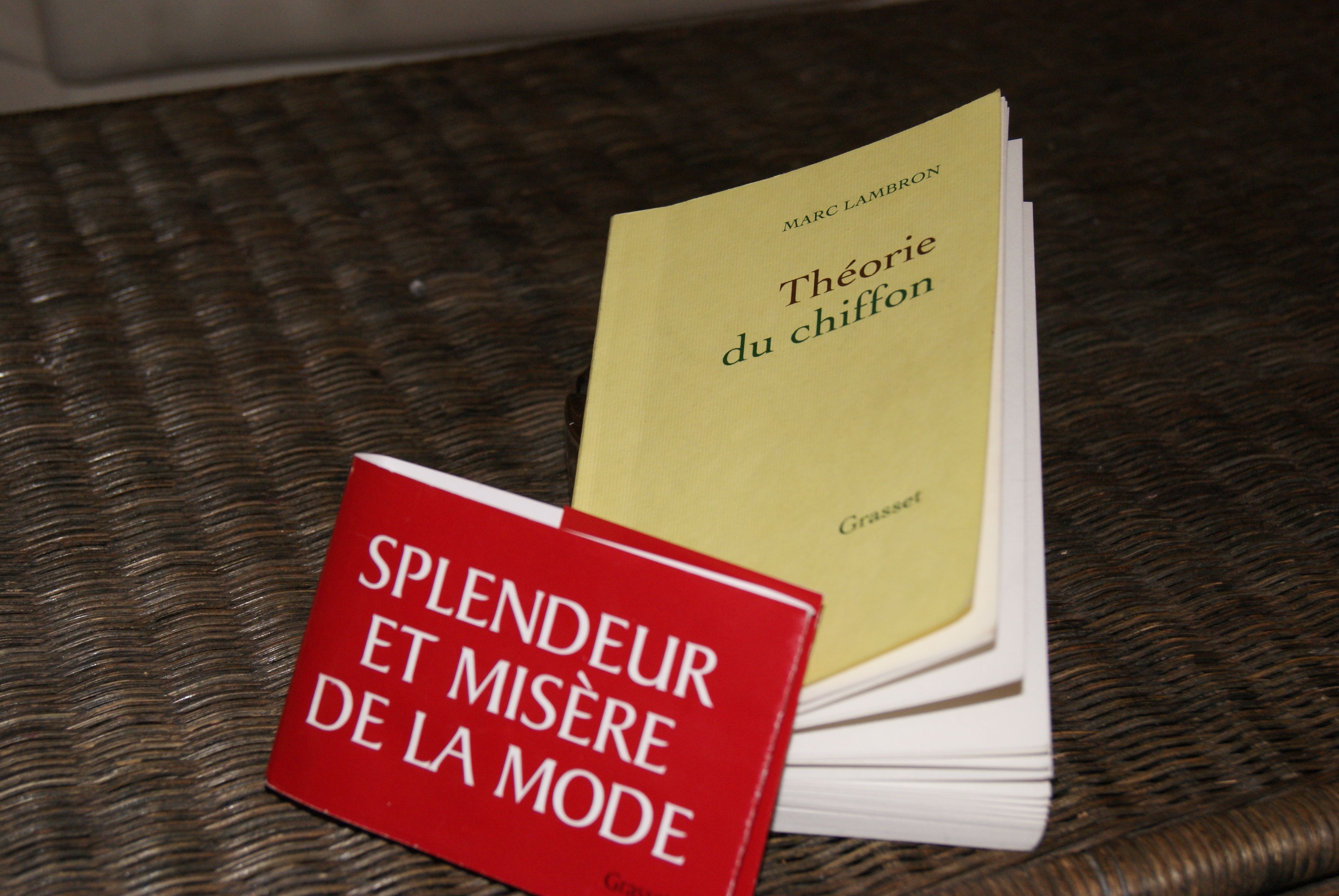
Jean-Louis Beaujour, a great French fashion designer, gives himself up (almost as his last time) to the French novelist, and presumably friend, or at least confidant of choice, Hélène Delmas.
Don’t get me wrong, the man in question is not talking about sewing, “In reality, he is speaking out on the zeitgeist” (yes, I know, it can be scary).
162 pages where the internationally renowned fashion designer goes through with a scalpel everything that makes him earn a lot of money and thus live: other designers, his clients, the muses, the models, the fashion editors, the television…
No one is harmed. It’s “Super Street Fighter” in the fashion world.
My top 5 in terms of quotes:
-
“Jean-Louis Beaujour: As if the victims of fashion did not know that they are going to die, and that before this deadline it is possible to tear off from life something else than three pia-pia in front of chamarré fabrics. All these ilots are nobodies. We enucleated their cortex. ” (p. 27)
-
“Jean-Louis Beaujour: I have my professional muses, it’s true. Priced. And not in a small way.
Hélène Delmas: They are worth the price?
Jean-Louis Beaujour : As human beings, sometimes. As a trompe-l’oeil, always. ” (p.30)
-
“Jean-Louis Beaujour: My hysterics are excellent social barometers, governed by sunflower-like temperaments. They always point their heads towards the unattainable king, the impossible fiancé, the husband of others. Since they end up being very knowledgeable without understanding much of what they know, I sort it out. It’s my gossip brigade, my private detective agency.” (p.38)
-
“Jean-Louis Beaujour: The official Cannes screenings have become washing machines for remorse, the moral elixir that exempts from their sins all these beautiful souls intoxicated with diamond dust…” (p.52)
-
“Jean-Louis Beaujour (about fashion editors): “Not only do I think that a wrapped woman is an insult to my art, but I make it known in the newspapers. The editors love it! Then they leave buried in gifts, multiplied by the number of firms that shower them with goodies to get three lines in the gazettes. Samples, shoes, perfumes, clothes, their apartments are Ali-Baba caves. Believe me, it is rare to see women dedicated to the destiny of warehouse, but, struck by grace, the fashion editors succeed.” (p. 79)
The Sacred Guru never stops spitting his venom.
And during this time, while reading the pages, and facing the massive arrival of sharp criticisms, that we take well in the face, and this in a frontal way (because this world, my time, it is also – a little – ours to all), we oscillate between a desire to say to him “shit” and as a sign of acquiescence of the head, because – all in all – he does not say only stupid things, Jean-Louis.
Among the designer’s insights:
-
“Jean-Louis Beaujour: The garment is only a piece of fabric, it is the women who give it a spirit.” (p. 15)
-
“Jean-Louis Beaujour: Let us forget time, Hélène, and it will forget us. No, I still wonder, if you will, what mental operations one must go through to come to consider, deeply, passionately, viscerally, that my creations are essential, to the point of occupying a predominant place in the obsessions of fashion victims. It’s the only sect that is voted for, since it elects its gurus. I am more their creature than they are mine. (p. 26)
-
“Jean-Louis Beaujour: There are families who hold the upper hand in regional metropolises. Some of these local kingpins, who arrived in Paris in a huff, full of provincial arrogance, see themselves supplanted by natives of the same city, more modest by their roots but superior by their gifts. Paris reshuffles the deck based on talent, not origin. As long as this continues, this city will survive.” (p. 44)
-
“Jean-Louis Beaujour (about the Cannes Festival): As it is a good place to stamp a silhouette, I will not deprive myself of printing my profile, the best, the right one. But you will never hear me give lessons on the misery of the world. There are some ridiculous things that one prefers to spare oneself. (p. 52)
-
“Hélène Delmas: Nello once said that a heterosexual designer is like a field hockey player without a stick.
Jean-Louis Beaujour: He would have been better off sipping his Campari. Sexual preference nationalism is always out of place, believe me. There is no reason to turn a private taste into a badge of excellence, otherwise all fags would be talented. ” (p.57-58)
-
“Jean-Louis Beaujour: You have to take a broader view of things, Hélène. A women’s magazine, wherever it is made, is a modern place. That is, God does not exist there.
Hélène Delmas: God? My God!
Jean-Louis Beaujour: Don’t play dumb. I mean the idea of an infinite, invisible life, a beyond the world. Never. Consequently, everything is controlled to the point of anguish by physical finitude. ” (p. 74)
-
“Jean-Louis Beaujour: If I first wanted to appear in public in order to make my dresses known, I sometimes wonder if I didn’t end up designing dresses to continue appearing in public. In any case, I’d rather go to the TV than watch it.
Hélène Delmas: Why?
Jean-Louis Beaujour : Because it took me a long time to understand that what makes people unhappy is not life, but its commentary. When I return to my books, to the delicate conversation with some friends, I bathe in the color of a happy civilization. While the TV throws itself on you like a net on an animal. Clowning around is one thing. Being a slave to it is another. ” (p. 82-83)
Now, it’s three o’clock in the morning, and we realize that regardless of all the hullabaloo about the world of fashion and the people who make it up, our great couturier suffers only from having a heart, and that it is precisely this overflow of love and empathy, anaesthetized by the violence of a malfunctioning world, advocating the culture of appearances and suspending itself in a physical finitude, that invites him to get closer to no one and to corrupt everyone.
The most beautiful passage in the book:
“Hélène Delmas: What do you call “knowing how to love”?
Jean-Louis Beaujour: If you force me to specify, I will be serious for three minutes to tell you that it is ethical integrity combined with sexual freedom. The idea of a woman who would never do any concrete dirty things, would behave well in everything and in substance, but would have no limits in her pleasure. The few of this kind that I know, I cherish them like inner statues, I look at them with tenderness like the fragile engravings of my old books.
Hélène Delmas: The profile you describe looks like a very promiscuous Catholic, doesn’t it?
Jean-Louis Beaujour : If you like, but knowing how to dissociate the order of moral attitudes from one’s own freedom to love. Because sex is still the suspension of judgment, the freedom to do everything as long as there is no harm to others. That’s what I’m excited about, not the way a woman walks into a room, but the idea that she’s doing it without judgment.
Hélène Delmas: A kind of childhood?
Jean-Louis Beaujour: That’s right. I am erotically happy when the idea of condemnation is absent. I’ve been burdened with too much of this – with my morals, if you will – for me not to be sensitive to this grace.
Hélène Delmas: But you need, in your idea, that the woman is moral?
Jean-Louis Beaujour: That’s better. Because esteem is also erotic. To put it another way, I think the extension of moral characters should be the ability to suspend sexual judgments. Because the corner stone is not there. That a woman does very sexual things has nothing to do with deep morals. This is not the place. In However, if she shoots a girlfriend in the back to take her place, for example, then she behaves like a slut. ” (p. 140-141)
A book that can be read in one go in less than two hours.
That makes you want to share (no matter what time it is).
And that takes the reader far beyond the “Rag Theory”.
Elisa Palmer
Cette publication est également disponible en :

